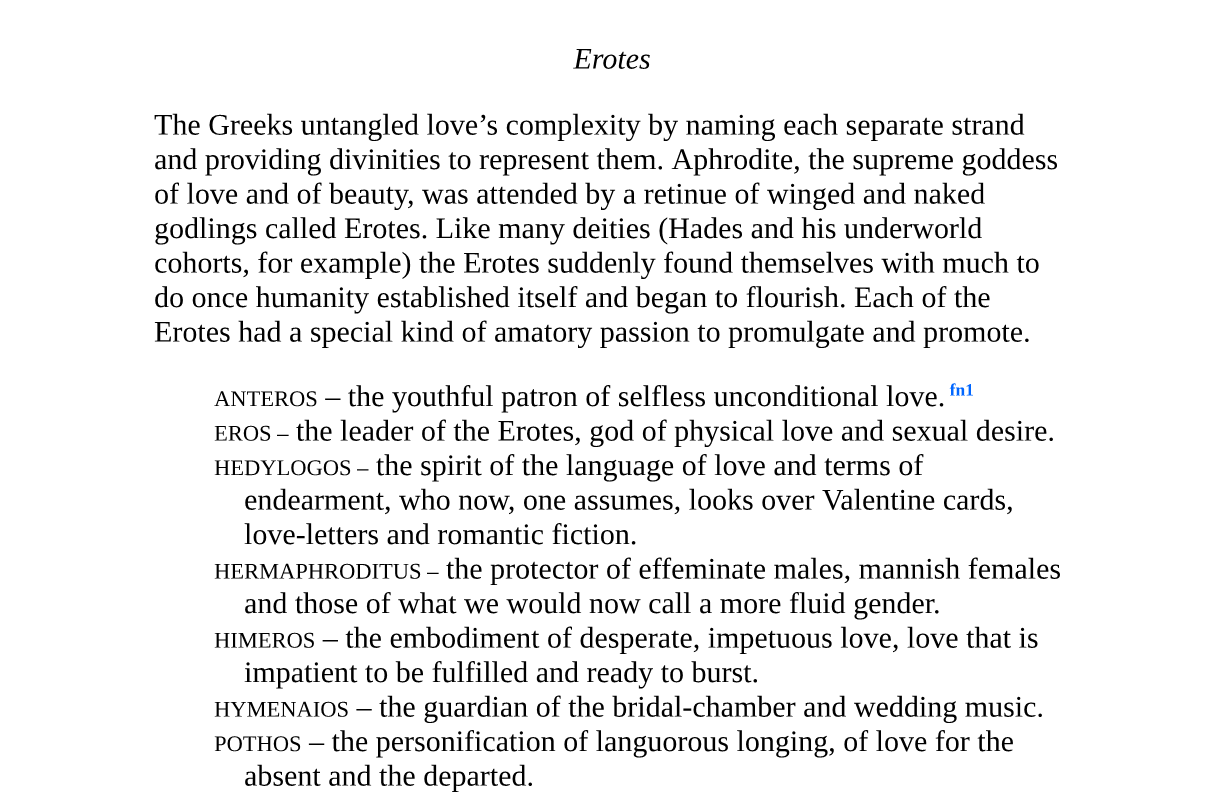
| Draggable item | arrow_right_alt | Corresponding Item |
|---|---|---|
HIMEROS | arrow_right_alt | the youthful patron of selfless unconditional love |
HYMENAIOS | arrow_right_alt | the leader of the Erotes, god of physical love and sexual desire |
ANTEROS | arrow_right_alt | the spirit of the language of love and terms of endearment |
POTHOS | arrow_right_alt | the protector of effeminate males, mannish females and those of what we would now call a more fluid gender |
HERMAPHRODITUS | arrow_right_alt | the embodiment of desperate, impetuous love, love that is impatient to be fulfilled and ready to burst |
HEDYLOGOS | arrow_right_alt | the guardian of the bridal-chamber and wedding music |
EROS | arrow_right_alt | the personification of languorous longing, of love for the absent and the departed |
Cupid makes people fall in love with each other:
Cupid and Psyche name their daughter:
Venus is jealous of Psyche because:
The voice Psyche hears:
Psyche sorts through a giant pile of seeds:
What motivates the main characters in this myth? Love? Jealousy? Shame? Is there a single emotion driving the story?
Is there a simple “moral” to the myth of Psyche? If so, what do you think it is?
What does this myth seem to be saying about the relationship between humans and the gods?