EXPLORE: ~ 35-40 min
RELATIONSHIPS BETWEEN VARIABLES RELATED TO SEA LEVEL RISE
1
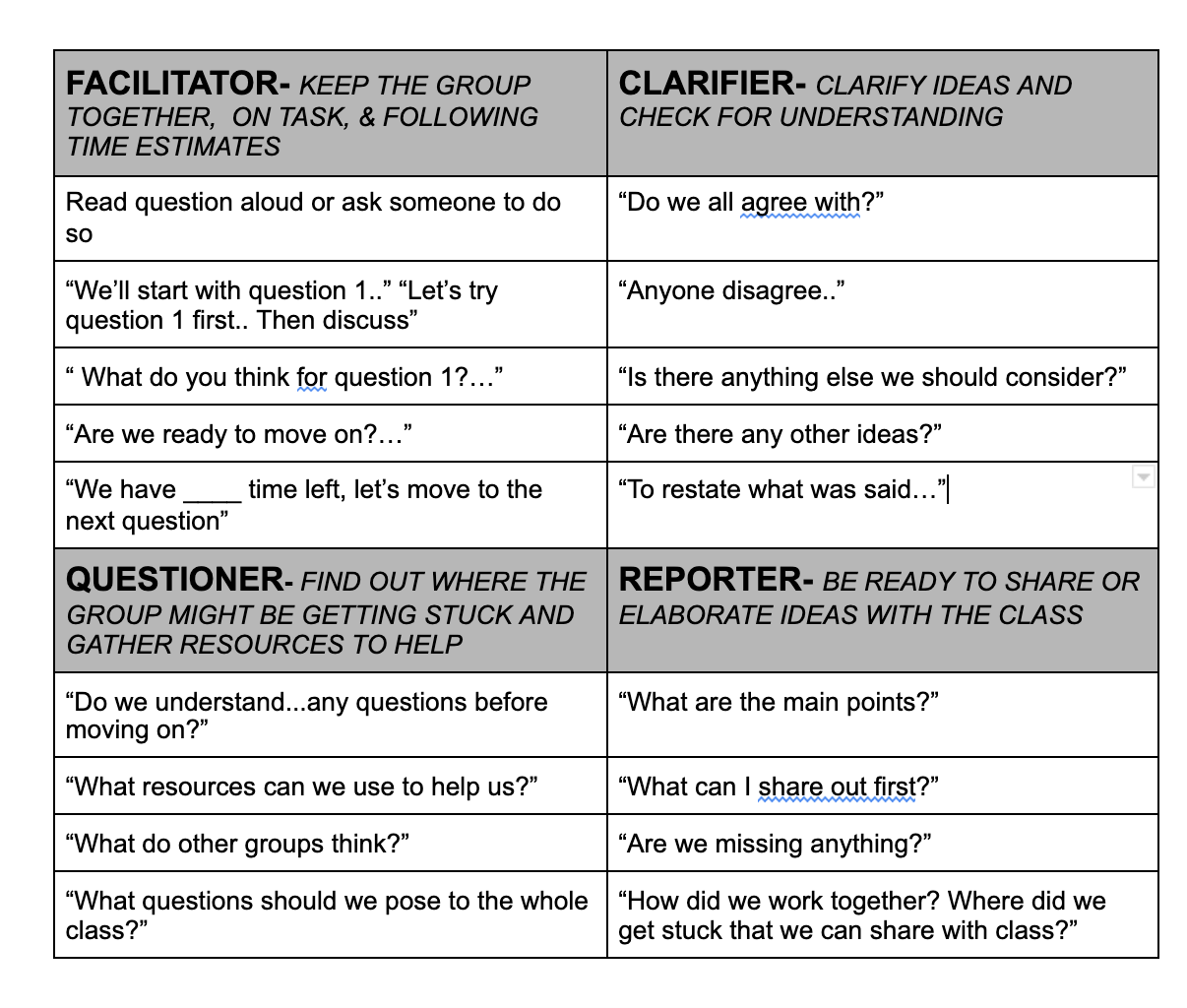
What is your group role
What is your group role
1
1
What is your group role
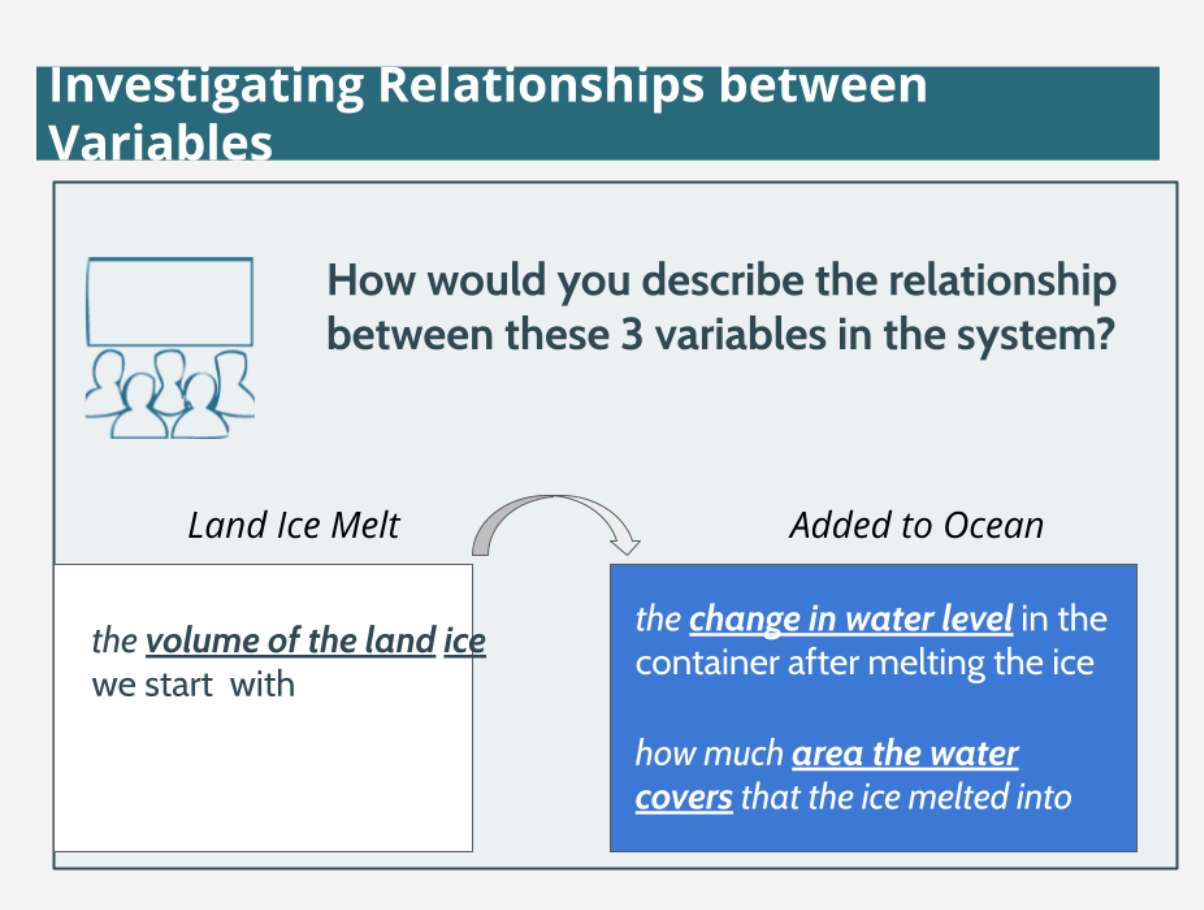
Predict: If the volume of land ice that melts increases, which variable will that most affect?
Explain your reasoning for questioning 5.
What is one thing you are going to do to help your table group by using your role?
How did your group decided to work?
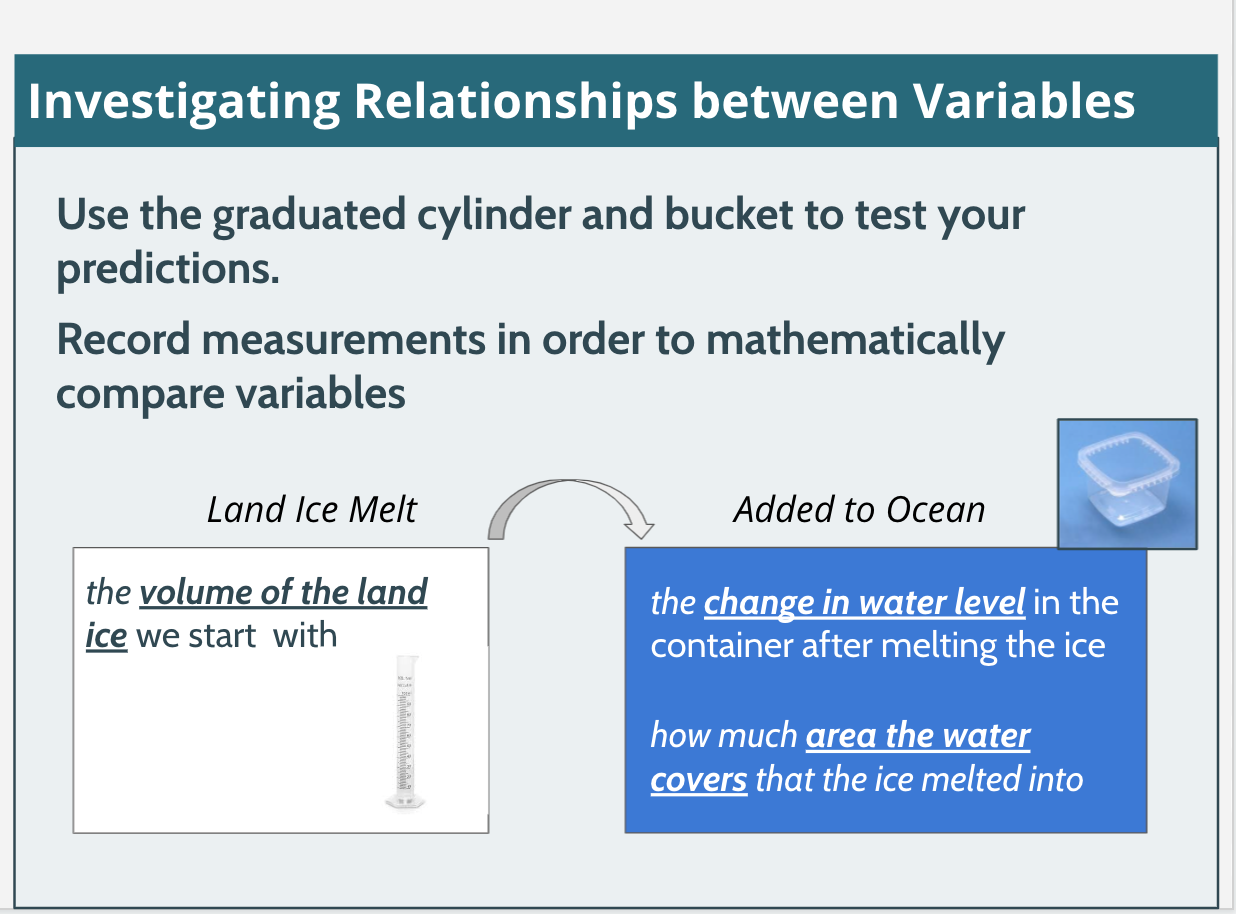
What are the three variables being described in the land ice melt and added to the ocean shown to the left. Choose all that are true
Independent Variable- The variable that the experimenter sets up, tests or changes
Dependent Variable- The variable that the experimenter measures based on changing the independent variable
Control Variable(s)- All other variables that could influence the results that need to remain constant
If we wanted to see how changes in the volume of melted ice that we start with affects sea level rise, which would be our independent variable?
If we wanted to see how changes in the volume of melted ice that we start with affects sea level rise, which would be our dependent variable?
If we wanted to see how changes in the volume of melted ice that we start with affects sea level rise, which would be our control variable?
Mini-Experiment: Test your predictions. Use the graduated cylinder to measure different volumes of water (the starting ice on land that melts). Transfer this water (melted ice) into the ocean container. Measure the rise in water level.
Click on Show your Work
Record your starting volume of water and how much the water level rose in the data table given.
Use these values for your mini-lab experiment if you weren't able to complete this during class
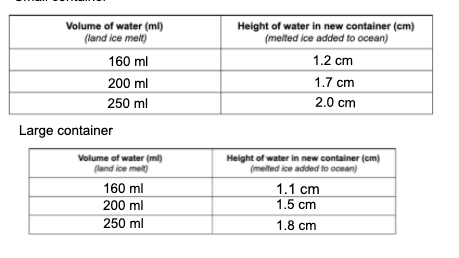
As you increased the volume of water in the graduated cylinder, the height of the water level in the ocean container_______________.
How does the size of the ocean container (area the water covers) affect how much sea level rises?
If you _______________ the size of the container (area), the sea level rise ________.
Think about it: How could you figure out the height that water will rise in the ocean container if you know your starting volume of ice and the area of your container?
Volume= length x width x height
Area= length x width
We can calculate height by...
(If you're not sure, take an educated guess and move to the next questions which will help walk you through this)
Which of the following mathematical formulas will allow us to solve for height. Choose all that are true
Volume= length x width x height
v= l x w x h
Area= length x width
A= l x w
Explain your reasoning for question 14.
I chose _______ choices because...
Checking our Answers:
For question 14 you find the height by using the formula from choice B or D. They are showing the same thing.
h= l x w x h (volume)
l x w (area for square)
l and w cancel so that what you're left with is h OR if you divide the volume by the area, what remains is your height.
Calculate the area of the ocean container. Use the formula below and include units in your final answer.
Choose one container - large or small
A= l x w
Measure in cm for your unit so that would be cm x cm or cm2
Use one of your volumes of water from your experiment to now calculate the height the water level should rise in the container you chose (large or small) Use the formula below and include your final answer with units.
Volume of water in cylinder
Area of ocean container
ml= cm3 use cm3 for your volume unit and cm2 for your area unit
Compare your calculated answer to the change in height you measured in your mini experiment.
Evaluate your answer to question 18. Is this what you would expect to get? Why or Why not.
My answer is what I expected because...
My answer is not what I expected because...
Based on your experiment, choose all that are true about how the variables relate to each other. Choose all that are true
Name one Got and one Need from the Explore that you have so far.
Got- Something you understand about how the three variables in the picture relate to each other (volume, area, height)
Need- A question, concept or idea you're not sure about
Got- One thing I got...
Need- One thing I need...
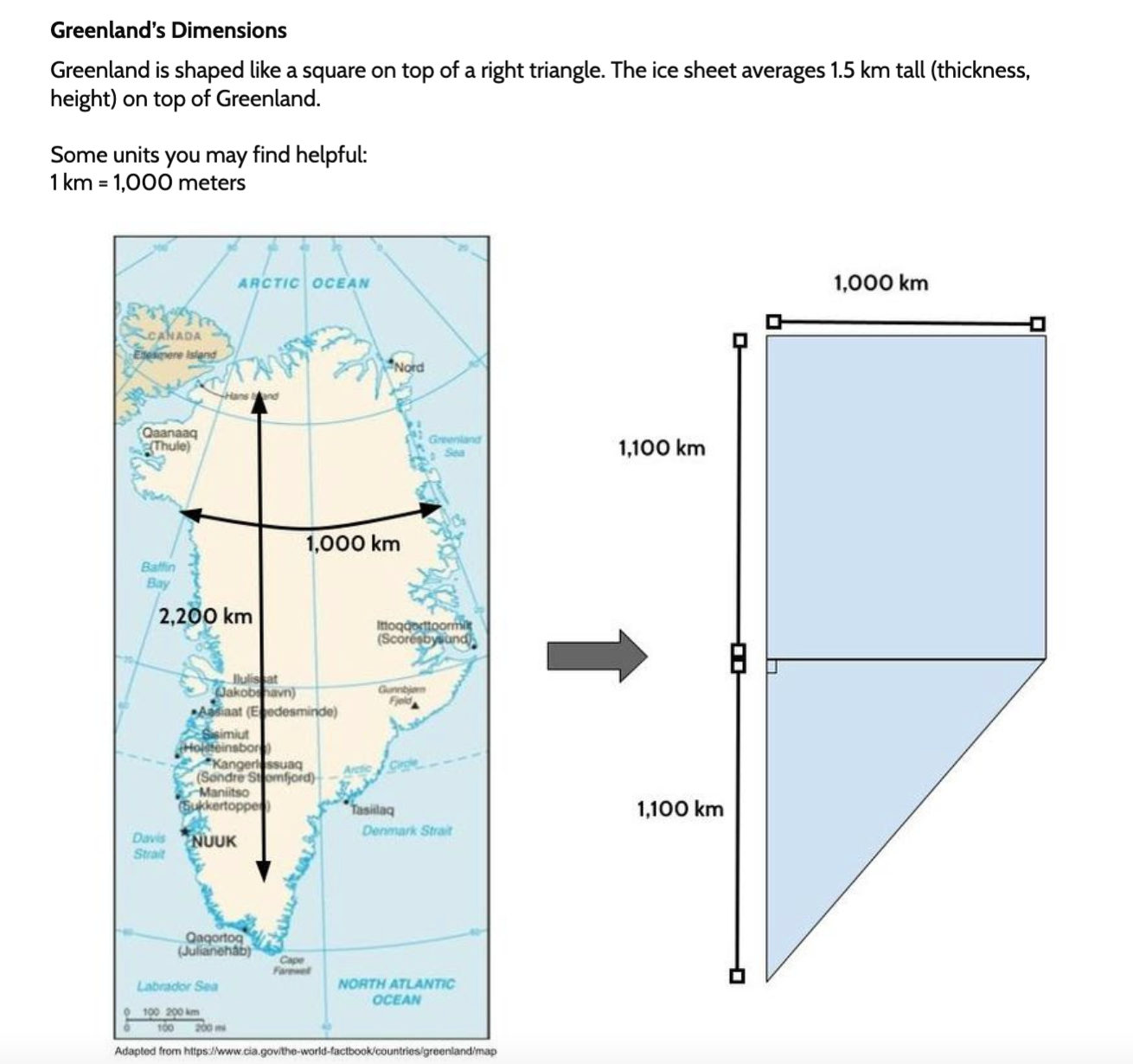
The shape of Greenland is shown to the left along with length and width dimensions.
The thickness or height of the ice sheets on Greenland is 1.5km tall.
Here is a help video for questions 22-30 if you need it. I suggest that you watch, pause the video and record for each question.
How can your group figure out the volume (in km3) of land ice in Greenland?
Hint: Look at the measurements given. How could you find the volume of the entire space?
Describe some steps you could take to figure this out. Don't solve yet!
Take 1-2 min. to discuss with your group. Record any ideas and then move to the next question
Calculate the area of Greenland using the measurements given.
Think about what you need to do to calculate the total area
Helpful tools:
Area of square= length x width
Area of triangle = 1/2 height (length) x width
Use your answer to question 23 to now calculate the volume of ice on Greenland.
The thickness or height of ice on Greenland = 1.5km
Helpful tools:
Area of square= length x width
Area of triangle = 1/2 height (length) x width
Volume= length x width x height
Area of Earth’s oceans = 3.619 x 10⁸ km2
This is written in scientific notation. It can be easier to read and use for very large or very small numbers.
A positive exponent after the 10 indicates that the decimal must be moved that many places to the right to get the standard number.
The “standard” way of writing the area of Earth’s oceans is 361,900,000 km2.
How can you calculate the height of sea level rise? (Hint: check question 17 to help you with this!)
Discuss with your group for 1-2 min. Record your ideas and then move to the next question.
Calculate the height of sea level rise if all the ice on Greenland melted.
Hint: Use response from question 24 and the info. text about area of Earth's oceans to help you solve.
Climate scientists are estimating that as much as 25% of the ice on Greenland could melt within this century.
Use your response from question 26 to estimate how much the sea level would rise if 25% of the ice on Greenland melted?
What does your estimated value really mean?
Check out this Nasa climate simulation- Click on the sea level tab
Is your prediction for question 28 close to what the simulation shows?
What effects on coasts do you see in the simulation with that level of sea level rise (or a bit greater)?
My prediction is...
One effect I notice from the simulation is...
As we've seen, rising sea levels can cause flooding.
Scientists and engineers are trying to design solutions to stop the ice from melting off of Greenland and entering into the ocean. Think about what you do to prevent ice from melting in your life. Could we use some of these ideas to design a solution?
Brainstorm 1-2 ideas for designing something that could slow or prevent ice melt at Greenland.
Record:
3 new things that you learned by working on this 1.5 activity
2 things that you still want to learn or you're wondering about now
1 question that you now have
3- I learned...
2- I want to learn...
1- I wonder...
You can check your calculation answers here once the answers are turned on after you press submit!