Jump Start
Anza
Buen inicio
Simbuka Tangira
0
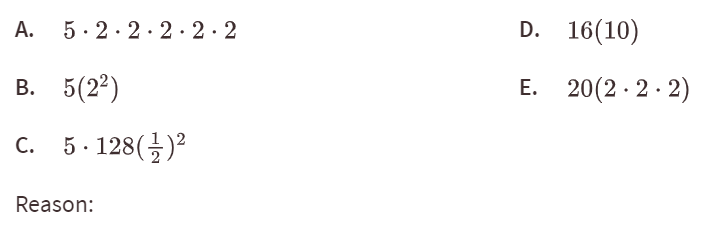
Which one doesn't belong?
¿Cuál no pertenece?
Ninde utarimo?
Keebaa iska leh?
Keebaa iska leh?
Which one doesn't belong?
¿Cuál no pertenece?
Ninde utarimo?
Keebaa iska leh?
Keebaa iska leh?
Which one doesn't belong?
¿Cuál no pertenece?
Ninde utarimo?
Keebaa iska leh?
Keebaa iska leh?
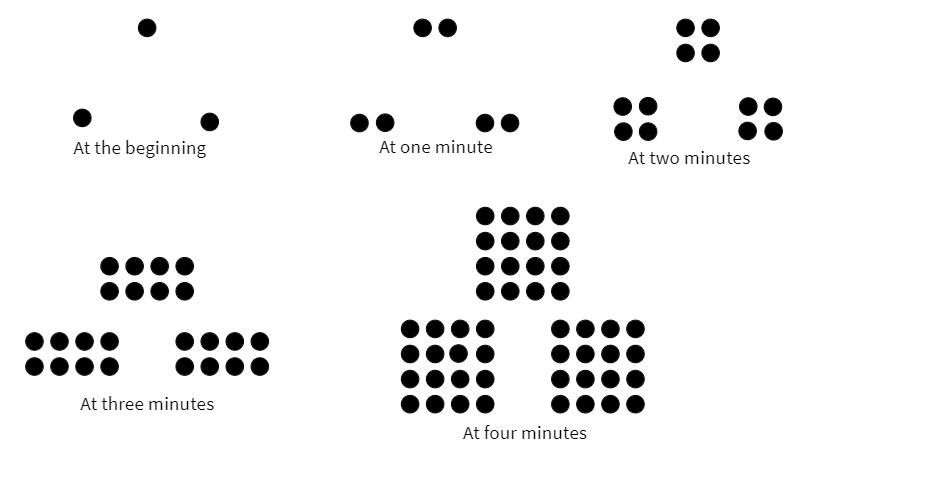
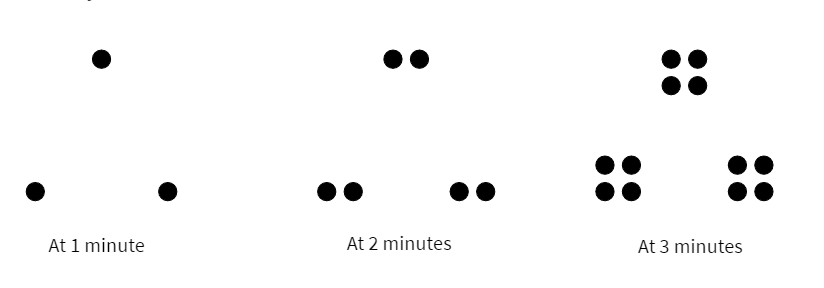
Describe and label the pattern of change you see in the given sequence of figures.
Sobanura kandi ushireho akamenyetso k'impinduka ubona muburyo bwatanzwe bwimibare.
Eleza na uweke alama muundo wa mabadiliko unayoona katika mlolongo wa takwimu.
Describe y rotula el patrón de cambio que ves en la secuencia de figuras dada.
Write the recursive equation to model the pattern if the diagram were relabeled.
Escribe la ecuación recursiva para modelar el patrón si el diagrama fuera reetiquetado.
Andika ikigereranyo gisubiramo kugirango ugereranye icyitegererezo niba igishushanyo cyarahinduwe.
Andika hesabu inayorudiwa ili kuiga mfano ikiwa mchoro ulibadilishwa jina.
Write the explicit equation to model the pattern if the diagram were relabeled.
Andika usawa sawa ili kuiga muundo ikiwa mchoro ulibadilishwa jina.
Escribe la ecuación explícita para modelar el patrón si el diagrama fuera reetiquetado.
Andika ikigereranyo gisobanutse kugirango ugereranye icyitegererezo niba igishushanyo cyarahinduwe.
Geometric sequence:
Secuencia geométrica:
Urutonde rwa geometrike:
Mlolongo wa jiometri:
Table of Values:
Jedwali la Maadili:
Tabla de valores:
Imbonerahamwe yagaciro:
Explicit equation:
Ikigereranyo cyumvikana:
Mlingano dhahiri:
Ecuación explícita:
Recursive equation:
Ecuación recursiva:
Ikigereranyo gisubiramo:
Mlinganyo wa kurudia:
Change factor (pattern of growth)
Factor de cambio (patrón de crecimiento)
Hindura ibintu (uburyo bwo gukura)
Sababu ya mabadiliko (muundo wa ukuaji)
Common ratio ( r ), (constant ratio)
Uwiano wa kawaida (r), (uwiano wa kila wakati)
Razón común (r), (razón constante)
Ikigereranyo rusange (r), (igipimo gihoraho)
Assuming the sequence continues in the same way, how many dots are there at 5 minutes?
Kwa kudhani mlolongo unaendelea kwa njia ile ile, kuna dots ngapi kwa dakika 5?
Haddii aan u malaynayno in isku xigxigu u sii socdo si la mid ah, imisa dhibco ayaa jira 5 daqiiqo?
Dufate ko urukurikirane rukomeza muburyo bumwe, utudomo angahe muminota 5?
Suponiendo que la secuencia continúa de la misma manera, ¿cuántos puntos hay a los 5 minutos?
Model the sequence of figures using a table, graph, and recursive and explicit equations to show how many dots are in the pattern at t minutes.
Modele la secuencia de figuras usando una tabla, gráfico y ecuaciones recursivas y explícitas para mostrar cuántos puntos hay en el patrón en minutos.
Tanga urutonde rwimibare ukoresheje imbonerahamwe, igishushanyo, hamwe nibisubirwamo kandi byeruye kugirango werekane umubare utudomo turi mumashusho att iminota.
Mfano wa mlolongo wa takwimu ukitumia jedwali, grafu, na hesabu zinazojirudia na wazi kuonyesha jinsi dots nyingi ziko kwenye muundo wa dakika.
Table of Values:
Jedwali la Maadili:
Tabla de valores:
Imbonerahamwe yagaciro:
Recursive equation:
Ikigereranyo gisubiramo:
Mlinganyo wa kurudia:
Ecuación recursiva:
Explicit equation:
Ecuación explícita:
Ikigereranyo cyumvikana:
Mlingano dhahiri:
Use your explicit equation to create your graph.
Tumia equation yako wazi kuunda grafu yako.
Usa tu ecuación explícita para crear tu gráfica.
Koresha ikigereranyo cyawe gisobanutse kugirango ukore igishushanyo cyawe.
Graph:
Grafu:
Grafico:
Igishushanyo:
Exponent
Ikigaragaza
Mpatanishi
Exponente
Exponential form and expanded form
Forma exponencial y forma expandida
Ifishi yerekana kandi yagutse
Fomu ya ufafanuzi na fomu iliyopanuliwa
Expression
Maelezo ya Aljebra
Expresión algebraica
Imvugo ya Algebraic
Geometric sequence
Urutonde rwa geometrike
Mlolongo wa kijiometri
Secuencia geométrica
Prime number
número primo
Umubare wambere
Nambari kuu
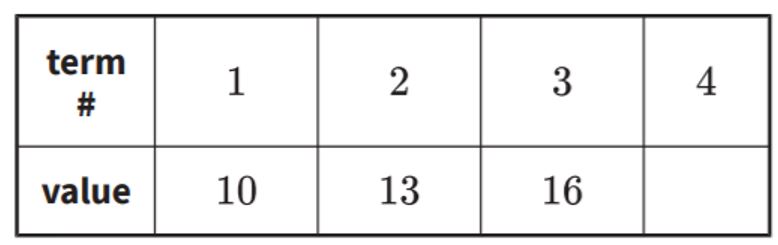
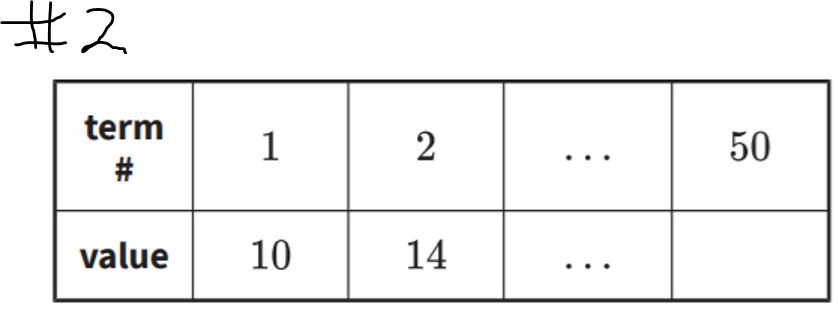
For problems 1-4, create the missing equation for the sequence based on the table, the description, or the given equation. Then decide which equation will help to find the missing term of the sequence most efficiently. Find the term and explain your choice.
Kwa shida 1-4, tengeneza equation iliyokosekana kwa mlolongo kulingana na meza, maelezo, au equation iliyopewa. Kisha amua ni mlingano gani utasaidia kupata muda uliopotea wa mlolongo kwa ufanisi zaidi. Pata neno na ueleze chaguo lako.
Para los problemas 1-4, cree la ecuación que falta para la secuencia según la tabla, la descripción o la ecuación dada. Luego, decida qué ecuación ayudará a encontrar el término faltante de la secuencia de manera más eficiente. Encuentra el término y explica tu elección.
Kubibazo 1-4, kora ikigereranyo cyabuze kugirango ukurikirane ukurikije imbonerahamwe, ibisobanuro, cyangwa ikigereranyo cyatanzwe. Noneho hitamo ikigereranyo kizafasha kubona igihe cyabuze cyurukurikirane neza. Shakisha ijambo hanyuma usobanure ibyo wahisemo.
Recursive: now = previous term + 3
Isubiramo: ubu = ijambo ryabanje + 3
Inarudia: sasa = muda uliopita + 3
Recursivo: ahora = término anterior + 3
Write the explicit equation.
Escribe la ecuación explícita.
Andika ikigereranyo gisobanutse.
Andika usawa wazi.
Find the value of the 4th term:
Pata thamani ya muda wa 4:
Encuentra el valor del cuarto término:
Shakisha agaciro ka manda ya 4:
Explanation:
Ibisobanuro:
Ufafanuzi:
Explicación:
Recursive equation:
Mlinganyo wa kurudia:
Ecuación recursiva:
Ikigereranyo gisubiramo:
Find the value of the 50th term:
Shakisha agaciro ka manda ya 50:
Pata thamani ya kipindi cha 50:
Encuentra el valor del término 50:
Explanation:
Explicación:
Ibisobanuro:
Ufafanuzi:
#3. The value of the 2nd term is 24.
The sequence is being doubled at each step.
# 3. Thamani ya kipindi cha 2 ni 24.
Mlolongo unakuwa mara mbili kwa kila hatua.
# 3. El valor del segundo término es 24.
La secuencia se duplica en cada paso.
# 3. Agaciro ka manda ya 2 ni 24.
Urukurikirane rurimo gukuba kabiri kuri buri ntambwe.
Explicit equation: f(n) = 6(2^n)
Ikigereranyo cyumvikana: f (n) = 6 (2^n)
Mlingano wazi: f (n) = 6 (2^n)
Ecuación explícita: f (n) = 6 (2^n)
Recursive equation:
Ecuación recursiva:
Ikigereranyo gisubiramo:
Mlinganyo wa kurudia:
Find the value of the 3rd
term:
Pata thamani ya muda wa 3:
Encuentra el valor del tercer término:
Shakisha agaciro ka manda ya 3:
Explanation:
Ibisobanuro:
Ufafanuzi:
Explicación:
#4. The value of the 3rd term is 12.
The sequence is being doubled at each step.
# 4. El valor del tercer término es 12.
La secuencia se duplica en cada paso.
# 4. Agaciro ka manda ya 3 ni 12.
Urukurikirane rurimo gukuba kabiri kuri buri ntambwe.
# 4. Thamani ya kipindi cha 3 ni 12.
Mlolongo unakuwa mara mbili kwa kila hatua.
Recursive: now = previous term x 2
Inajirudia: sasa = muda uliopita x 2
Recursivo: ahora = término anterior x 2
Isubiramo: ubu = ijambo ryabanje x 2
Explicit equation:
Ikigereranyo cyumvikana:
Mlingano dhahiri:
Ecuación explícita:
Find the value of the 10th term:
Encuentra el valor del décimo término:
Shakisha agaciro ka manda ya 10:
Pata thamani ya muda wa 10:
Explanation:
Ufafanuzi:
Explicación:
Ibisobanuro:
Evaluate the function to determine the output.
Suzuma imikorere kugirango umenye ibisohoka.
Tathmini kazi ili kubaini pato.
Evalúe la función para determinar la salida.
Example:
Recall that f(2) means to replace the value of n with 2 and work the problem to find f(n). The point (f, f(n) ) would be the location on a coordinate graph where n describes the location along the x-axis and f(n) is the height of the graph. So that if f(n) = 2n + 2, then f(5) = 2(5) + 2 = 10 + 2 = 12
Ejemplo:
Recuerde que f (2) significa reemplazar el valor de n con 2 y resolver el problema para encontrar f (n). El punto (f, f (n)) sería la ubicación en un gráfico de coordenadas donde n describe la ubicación a lo largo del eje xy f (n) es la altura del gráfico. De modo que si f (n) = 2n + 2, entonces f (5) = 2 (5) + 2 = 10 + 2 = 12
Urugero:
Ibuka ko f (2) bisobanura gusimbuza agaciro n n 2 hanyuma ugakora ikibazo kugirango ubone f (n). Ingingo (f, f (n)) yaba ikibanza kiri ku gishushanyo mbonera aho n isobanura ahantu hafi ya x-axis na f (n) ni uburebure bwishusho. Kugira ngo niba f (n) = 2n + 2, noneho f (5) = 2 (5) + 2 = 10 + 2 = 12
Mfano:
Kumbuka kwamba f (2) inamaanisha kuchukua nafasi ya thamani ya n na 2 na utumie shida kupata f (n). Hoja (f, f (n)) itakuwa mahali kwenye grafu ya kuratibu ambapo n inaelezea eneo kando ya mhimili wa x na f (n) ni urefu wa grafu. Ili kwamba ikiwa f (n) = 2n + 2, basi f (5) = 2 (5) + 2 = 10 + 2 = 12
Given that f(n) = 2(2)^n and g(n) = 8(5)^n, evaluate the following functions with the indicated values.
Kwa kuwa f (n) = 2 (2) ^ n na g (n) = 8 (5) ^ n, tathmini kazi zifuatazo na maadili yaliyoonyeshwa.
Dado que f (n) = 2 (2) ^ n y g (n) = 8 (5) ^ n, evalúe las siguientes funciones con los valores indicados.
Urebye ko f (n) = 2 (2) ^ n na g (n) = 8 (5) ^ n, suzuma imirimo ikurikira hamwe nagaciro kerekanwe.
f(5) =
g(0) =
f(2) =
g(3) =