Chapter 1 Application Test B

Last updated over 3 years ago
33 questions
D, E, and F are collinear, with E between D and F. Use the given information to write an equation for x, then find DE and EF:

DE = 2x + 3
EF = x - 1
DF = 35
1

What is the value of x?

1

What is the length of DE?

1

What is the length of EF?

L, M, and N are collinear, with M as the midpoint of \overline{LN}. Use the given information to write an equation for x, then find LM and MN:

LM = 5x - 7
MN = 2x + 8
1

What is the value of x?

1

What is the length of LM?

1

What is the length of MN?

2

Point T is between S and R. P is the midpoint of \overline{ST}. SR = 22, PT = 7. Using the workspace provided, draw a sketch and find RT.

2

Find the distance between the points (-2, 8) and (-4, 4). Round your answer to the nearest hundredth.

2

Find the midpoint between the points (-3, -2) and (-1, 2).

1

Use the given endpoint E(-5, 7) and midpoint M(-8, 2) to find the coordinates of the other endpoint S.

Use the following diagram for the next 2 questions. The locations of Tom's house and Jenny's house are located on the map below.
2

Find the midpoint between Tom and Jenny.

2

Find the distance between Tom and Jenny. Round your answer to the nearest hundredth.

Use the number line below for the next 4 questions. Find the lengths of each indicated segment.
1

RU

1

SU

1

TR

1

TU

1

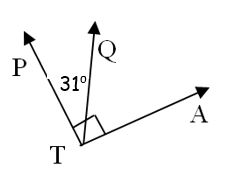
Using the diagram below, what is m\angle{QTA}?

Use the diagram below for the next 2 questions.

\overrightarrow{PT} bisects \angle{RPS}.
1

What is the value of x?

1

What is m\angle{RPT}?

Use the diagram below for the next 3 questions. Use the given information to write an equation for x, then find the measures of \angle{WYC} and \angle{ZYC}.

m\angle{WYC} = (5x - 6)o
m\angle{ZYC} = (2x - 2)o
m\angle{WYZ} = 48o
1

What is the value of x?

1

What is m\angle{ZYC}?

1

What is m\angle{WYC}?

Use the diagram below for the next 2 questions.
1

If m\angle{3} = 40o, then m\angle{1} = ___________

1

If m\angle{2} = 140o, then m\angle{4} = ___________

2

In the diagram below, m\angle{LRM} = (11x - 6)o and m\angle{PRQ} = (9x + 12)o. Solve for x.

2

In the diagram below, m\angle{ABD} = (2x + 25)o and m\angle{DBC} = (3x + 10)o. Solve for x.

2

In the diagram below, m\angle{GHK} = (3x + 7)o and m\angle{KHJ} = (8x - 3)o. Solve for x.

2

\angle{1} is supplementary to \angle{2}. m\angle{1} = (3x - 4)o and m\angle{2} = (5x + 16)o. Solve for x.

2

\angle{3} is complementary to \angle{4}. m\angle{3} = (4x - 8)o and m\angle{4} = (x - 2)o. Solve for x.

2

Using the Pythagorean Theorem to solve for b.

2

Using the Pythagorean Theorem to solve for c.

2

You are leaning a ladder against a wall. The height of the wall is 15 ft., and the distance from the wall to the foot of the ladder is 8 ft. How long is the ladder? Draw a picture if necessary and use the Pythagorean Theorem.

0

BONUS: Solve for x and y. Write your answers as x, y.