
1
1
1
1
1
1
1
1
1
1
1
1
Select all quadrilaterals that have 180 degree rotational symmetry.

Select the statement that must be true.
EFGH is a parallelogram and angle HEF is a right angle.
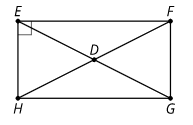
Select all statements that must be true.
Figure ABCD is a parallelogram. Is triangle ADB congruent to triangle CBD?
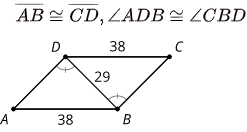
Show or explain your reasoning.
Figure KLMN is a parallelogram. Prove that triangle KNL is congruent to triangle MLN.
This lesson is from Illustrative Mathematics. Geometry, Unit 2, Lesson 15. Internet. Available from https://curriculum.illustrativemathematics.org/HS/teachers/2/2/15/index.html ; accessed 29/July/2021.
IM Algebra 1, Geometry, Algebra 2 is © 2019 Illustrative Mathematics. Licensed under the Creative Commons Attribution 4.0 International License (CC BY 4.0).
The Illustrative Mathematics name and logo are not subject to the Creative Commons license and may not be used without the prior and express written consent of Illustrative Mathematics.
These materials include public domain images or openly licensed images that are copyrighted by their respective owners. Openly licensed images remain under the terms of their respective licenses. See the image attribution section for more information.