Log in
Sign up for FREE
arrow_back
Library

Illustrative Mathematics - Geometry - Unit 7 - Lesson 12

star
star
star
star
star
Last updated about 3 years ago
7 questions
1
G.C.5
1
G.C.5
1
G.C.5
1
G.C.5
1
G.C.5
1
G.C.5
1
G.C.5
Question 1
1.

Match each diagram showing a sector with the measure of its central angle in radians.

Draggable itemarrow_right_altCorresponding Item
arrow_right_alt
arrow_right_alt
arrow_right_alt
arrow_right_alt
arrow_right_alt
arrow_right_alt
Question 2
2.

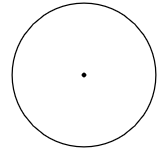
In the circle, sketch a central angle that measures \frac{2\pi}{3} radians.

Question 3
3.

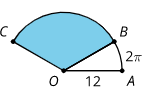
Angle AOC has a measure of \frac{5\pi}{6} radians. The length of arc AB is 2\pi units and the radius is 12 units.
What is the area of sector BOC?

Question 4
4.

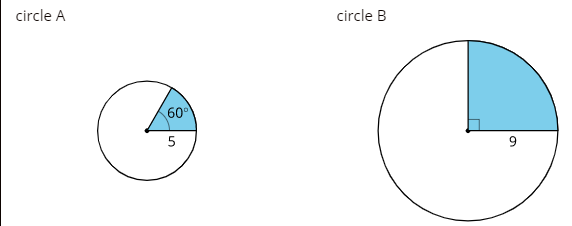
Lin thinks that the central angle in circle A is congruent to the central angle in circle B.
Do you agree with Lin? Show or explain your reasoning.

Question 5
5.

Question 6
6.

Match each arc length and radius with the measure of the central angle that defines the arc.

Draggable itemarrow_right_altCorresponding Item
arc length 9\pi cm, radius 12 cm
arrow_right_alt
angle: 30 degrees
arc length 4\pi cm, radius 10 cm
arrow_right_alt
angle: 72 degrees
arc length 3\pi cm, radius 18 cm
arrow_right_alt
arrow_right_alt
Question 7
7.

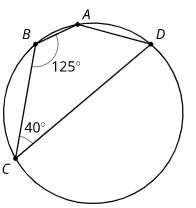
Quadrilateral ABCD is shown with the given angle measures.
Select all true statements.

This lesson is from Illustrative Mathematics. Geometry, Unit 7, Lesson 12. Internet. Available from https://curriculum.illustrativemathematics.org/HS/teachers/2/7/12/preparation.html ; accessed 29/July/2021.

IM Algebra 1, Geometry, Algebra 2 is © 2019 Illustrative Mathematics. Licensed under the Creative Commons Attribution 4.0 International License (CC BY 4.0).

The Illustrative Mathematics name and logo are not subject to the Creative Commons license and may not be used without the prior and express written consent of Illustrative Mathematics.

These materials include public domain images or openly licensed images that are copyrighted by their respective owners. Openly licensed images remain under the terms of their respective licenses. See the image attribution section for more information.
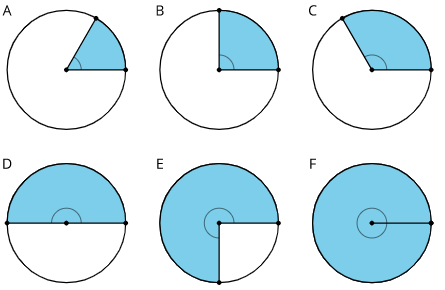
diagram C
\frac{3\pi}{2}
diagram B
\pi
diagram E
\frac{\pi}{3}
diagram A
\frac{\pi}{2}
diagram F
2\pi
diagram D
\frac{2\pi}{3}
The fraction of the circumference taken up by the arc outlining circle A’s sector is smaller than the fraction of the circumference taken up by the arc in circle B.
The ratio of the area of circle A’s sector to its total area is \frac{1}{6}.
Not taking into account the sectors, circle A and circle B are similar.
The ratio of circle A’s area to circle B’s area is \frac{5}{9}.
angle: 135 degrees
arc length 5\pi cm, radius 5 cm
angle: 180 degrees
Angle A measures 55 degrees.
The measures of angle A and angle D must add to 180 degrees.
Angle D measures 40 degrees.
Angle A measures 140 degrees.
Angle D measures 55 degrees.