1
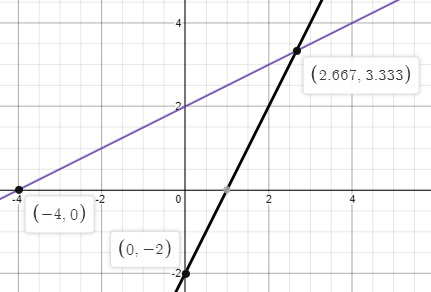
Are the functions shown inverses of each other?
Why or why not?
Are the functions shown inverses of each other?
Why or why not?
Directions:
0) Make sure you've turned in your study guide.
On your desk - paper, pencil, calculator
On your browser - this test, Desmos links below.
In your backpack - phones, electronics, notes.
1) Take the test. If you're struggling, come back to the directions and formulae. Give it your best shot, but keep moving through the questions.
2) Some questions allow you to show your work. For these, just type what steps you took to get your answer. I may be able to give you partial credit if some of your steps are correct. You don't have to show your work.
3) Check your answers. Pay careful attention that you gave what the question was asking for. Check formatting especially.
4) Submit the test.
5) Close your Chromebook. Read, draw, or work on paper schoolwork quietly.
Formulae:
Vertex form of a parabola:
Directions:
0) Make sure you've turned in your study guide.
On your desk - paper, pencil, calculator
On your browser - this test, Desmos links below.
In your backpack - phones, electronics, notes.
1) Take the test. If you're struggling, come back to the directions and formulae. Give it your best shot, but keep moving through the questions.
2) Some questions allow you to show your work. For these, just type what steps you took to get your answer. I may be able to give you partial credit if some of your steps are correct. You don't have to show your work.
3) Check your answers. Pay careful attention that you gave what the question was asking for. Check formatting especially.
4) Submit the test.
5) Close your Chromebook. Read, draw, or work on paper schoolwork quietly.
Formulae:
Vertex form of a parabola:
For the following function, identify the function features, transformations, and inverse.
Domain?
Use interval notation, one space after the comma.
Range?
Use interval notation, one space after the comma.
What is the inverse of the function?
Use vertex form, no spaces.
(y=...)
For the following function, identify the function features, transformations, and inverse.
Domain?
Use interval notation, one space after the comma.
Range?
Use interval notation, one space after the comma.
For the following function, identify the function features, transformations, and inverse.
Domain?
Use interval notation, one space after the comma.
Range?
Use interval notation, one space after the comma.
What is the inverse of the function?
Use vertex form.
For the following function, identify the function features, transformations, and inverse.
What is the vertex of the function?
Use (x, y) format, one space after the comma.
What is the increasing interval?
Use interval notation, one space after the comma.
For the following function, identify the function features, transformations, and inverse.
What is the vertex of the function?
Use (x, y) format, one space after the comma.
What is the increasing interval?
Use interval notation, one space after the comma.
For the following function, identify the function features, transformations, and inverse.
What is the vertex of the function?
Use (x, y) format, one space after the comma.
What is the increasing interval?
Use interval notation, one space after the comma.
What is the vertex form of the function?
Use y=... format.
For the following function, identify the function features, transformations, and inverse.
What is the vertex of the function?
Use (x, y) format, one space after the comma.
What is the increasing interval?
Use interval notation.
What is the vertex form of the function?
Use y=... format.
Are the functions shown inverses of each other?
Why or why not?
What transformations are there?
What transformations are there?
What is the inverse of the function?
What transformations are there?
What are the function transformations?
What is the inverse for the function?
Select the end behaviors for the function.
What are the function transformations?
Select the end behaviors.
Select the end behaviors.
Select the end behaviors.