1
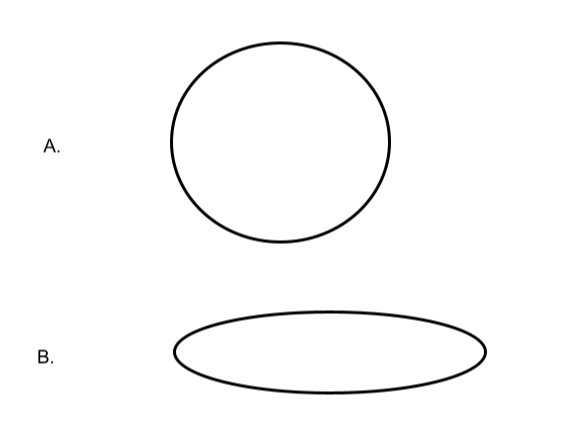
Which orbit represents an object with a high eccenricity?
Which orbit represents an object with a high eccenricity?
1
1
1
1
Match the term with its definition
| Draggable item | arrow_right_alt | Corresponding Item |
|---|---|---|
The horizontal radius of an elliptical orbit | arrow_right_alt | Eccentricity |
The point in an orbit farthest from the Sun | arrow_right_alt | Major Axis |
The calculated measure of how circular or oval shaped an orbit is | arrow_right_alt | Minor Axis |
One of the center points of an ellipse (in our solar system, one is the Sun) | arrow_right_alt | Perihelion |
The vertical diameter of an elliptical orbit | arrow_right_alt | Aphelion |
The amount of time it takes for an object to make a complete orbit | arrow_right_alt | Focal Point |
The attractive force determined by the mass of 2 objects and the distance between them | arrow_right_alt | Orbital period |
The horizontal diameter of an elliptical orbit | arrow_right_alt | Gravity |
The point in an orbit closest to Sun | arrow_right_alt | Semi Major Axis |
Match the Laws of Motion
| Draggable item | arrow_right_alt | Corresponding Item |
|---|---|---|
Kepler's First Law | arrow_right_alt | An object at rest will stay at rest, an object in motion will stay in motion unless acted upon by an outside force |
Kepler's Third Law | arrow_right_alt | When two bodies interact, they apply forces to one another that are equal in magnitude and opposite in direction |
Kepler's Second Law | arrow_right_alt | Objects in our solar system orbit in elliptical orbits with one focal point being the Sun |
Newton's Third Law | arrow_right_alt | The closer an object is the the object it's orbiting, the higher it's velocity |
Newton's First Law | arrow_right_alt | The larger the semimajor axis of an orbit, the longer the orbital period. |
Which 2 factors determine the force of gravity between 2 objects?
Which orbit represents an object with a high eccenricity?
Which 2 numbers would you need to calculate the eccentricity of an object's orbit?
Which orbit represents an object with a low eccentricity?
Which orbit will have an object with a high variation in its orbit? (Sometimes its very close to the Sun, sometimes its very far away?
Which orbit would represent an object with the most consistent velocity?
Which orbit would represent an object with the most consistent gravitational pull on the star?