Part 1: What have we figured out so far?
Objective: Students can apply scientific reasoning and evidence from Earth materials, meteorites, and other planetary surfaces to construct an account of Earth’s formation and early history.
Use your notes, the last formative we did, the reading, "Formation of Planets" and the video to develop a timeline of Earth's formation and early history.
A note on the video: You'll only need the first 3(ish) minutes of this video but the rest is interesting if you want to continue watching it and we will talk about it in the future in this class!
Our Solar System, including Earth, is estimated to be about
It is estimated that Earth's crust and oceans were formed around
Which of the following theories do scientists have to explain how Earth and other planets in our solar system formed?
Which of the following is scientific evidence to support accretion theory?
Which of the following theories do scientists have to explain how Earth's moon formed?
Which of the following is scientific evidence to support giant impact theory?
Which of the following is scientific evidence to support when Earth's crust and oceans began forming?
Put these events in chronological order (in the order they happened).
Earth's crust continues to cool and solidify, oceans form
Our solar system is a nebula
Earth's materials start to separate into layers based on their densities
debris from the collision accretes (clumps) to form Earth's moon
The protostar and protoplanetary disk form
Accretion of space minerals, dust and rocks clump together to form the planets
A planet called Theia collides with Earth, breaking off parts of the crust and mantle and sending debris into orbit around the Earth
Earth is a hot gooey ball of lava
Earth's crust begins to form
Put these layers of Earth in order from most dense to lease dense
outer core
mantle
crust
inner core
atmosphere
Why do these layers exist?
I know we've already talked about this but what features do you observe when you look at terrestrial planets (like the ones above?)
What ideas do you have for why terrestrial planets looks the way they do?
What features do you observe when you look at jovian planets (like the ones above?)
What ideas do you have for why jovian planets looks the way they do?
As we will learn in future units, the Earth has many processes that change its surface. The processes are not present in the same ways on other planets and the processes on Earth effectively “erase” many of the pieces of evidence for what early Earth looked like so we have to look at other planets and things in space like asteroids, meteorites and the moon to understand what the early Solar System was like. We can do this because everything in the solar system formed at the same time, from mostly the same stuff.
What are some of the processes you know of that could "erase" impact craters on Earth that don't exist on other planets? List as many as you can think of.
Is Earth terrestrial or jovian?
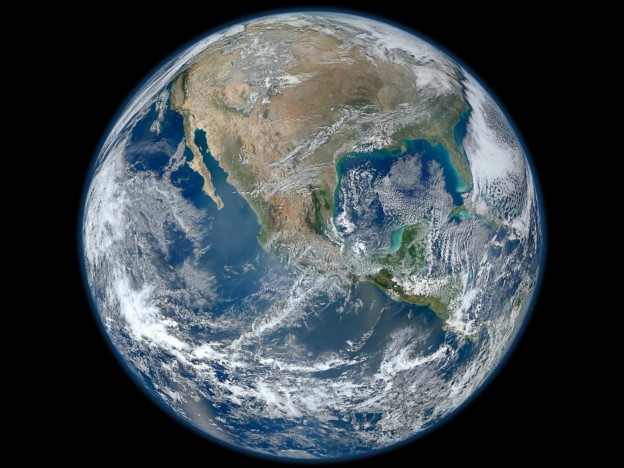
Does Earth have surface features like other terrestrial planets? Other jovian planets? What ideas do you have for why Earth looks the way that it does?
Atmospheres
What is the Earth’s atmosphere?
The Earth’s atmosphere is a thin layer of gases that surrounds the Earth. It seals the planet and protects us from the vacuum of space. It protects us from electromagnetic radiation given off by the Sun and small objects flying through space such as meteoroids.
Atmospheres in the solar system
Here on Earth, we tend to take our atmosphere for granted, and not without reason. Our atmosphere has a lovely mix of 78% nitrogen and 21% oxygen with trace amounts of water vapor, carbon dioxide and other gaseous molecules. In short, our atmosphere is plentiful and life-sustaining. But what about the other planets of the Solar System? How do they stack up in terms of atmospheric composition? We know for a fact that they are not breathable by humans and cannot support life. But just what is the difference between these balls of rock and gas and our own?
Our next-door neighbor, Venus, has a thick carbon-dioxide atmosphere with no oxygen, but with sulfuric acid clouds. Mars also has an atmosphere that is primarily carbon-dioxide, but on Mars, the atmosphere is extremely thin, and prone to high winds. The giant jovian planets- Jupiter, Saturn, Uranus, and Neptune have extremely thick atmospheres of hydrogen, helium, methane, and ammonia. In fact, the jovian planets are often called gaseous planets because they are largely composed of their very thick gaseous atmospheres.
Why all this diversity?
The presence of hydrogen and hydrogen-rich molecules in the atmospheres of the outer planets is easy to rationalize. Most of the universe is hydrogen. The only reason hydrogen and helium are rare in the inner solar system is that these light gases were blown away in the early stages of the solar system via radiation pressure and the solar wind. Planets like Jupiter kept their hydrogen, and, since the hydrogen atom likes to combine with other atoms, you get things like methane, and ammonia.
Escape of an Atmosphere
The thickness of a planet's atmosphere depends on the planet's gravity and the temperature of the atmosphere. A planet with weaker gravity (because it is smaller) does not have as strong a hold on the molecules that make up its atmosphere as a planet with stronger gravity, so the gas molecules will be more likely to escape the planet's gravity.
If the atmosphere is cool enough, then the gas molecules will not be moving fast enough to escape the planet's gravity. But how strong is ``strong enough'' and how cool is ``cool enough'' to hold onto an atmosphere? To answer that you need to consider the following about a planet:
its mass and how its gravitational pull on gas molecules
its temperature and the energy of gas molecules which may allow them to escape gravity
Based on the reading, summarize the differences between the atmospheres of terrestrial and jovian planets.
Which types of planets (terrestrial or jovian) can support life? Why? In your answer use evidence from both the “How Planets Form” reading and the “Atmospheres” reading.
What was early Earth like? Could living things survive early Earth? Why or why not?
What has happened to Earth to make it habitable for life? Hints: consider its surface and atsmophere in your answer.