7th Math 1.9 Classwork A
star
star
star
star
star
Last updated about 3 years ago
11 Nsɛmmisa

1
1
1
1
1
0
1
1
1

4
4
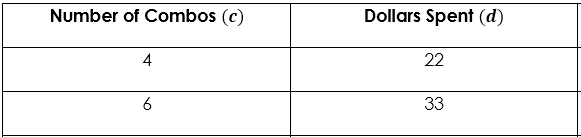
Combos--The next week, all the 7th grade teachers go back to In-N-Out, but this time they are ordering combo meals (a cheeseburger with soda and fries). The amount they paid is shown in the table:
CFS:
#1: Accurately computes unit rate or constant of proportionality
#2: Uses accurate unit rate and variables to represent proportional relationship with equation
#3: Solves by substituting values into the equation
a) Write an equation of the form
b) If Ms. Zangrilli wants to buy delicious combo meals for the entire Prize staff (35 people), how much money would they have to spend? Explain using your equation.
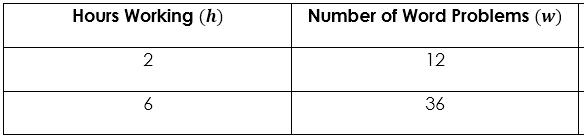
HW—One of Mr. Hwung’s jobs is to sit at his computer and create math assignments with silly stories and questions. For every 2 hours he spends working, he can write 12 word problems.
CFS:
#1: Accurately computes unit rate or constant of proportionality
#2: Uses accurate unit rate and variables to represent proportional relationship with equation
#3: Solves by substituting values into the equation
a) Write an equation to represent the relationship between hours working (h) and the number of word problems created (w)
b) How many word problems would Mr. Hwung be able to write if he spends 4.5 hours working on Saturday? Use your equation to answer.
Draw your subsitution in the Formative SYW
Bike Rides—At Mancini’s Bike World, the cost of renting a mountain bike is very cheap. Kevin sees that renting the very popular Mancini Mach 10™ is $37.50 for 5 hours.
CFS:
#1: Accurately computes unit rate or constant of proportionality
#2: Uses accurate unit rate and variables to represent proportional relationship with equation
#3: Solves by substituting values into the equation
a) Write an equation to represent the relationship between hours renting and the total cost. Let hours be h and total cost be c.
b) Kevin wants to rent the Mancini Mach 10™ for an entire day (24 hours). How much would he have to pay? Use your equation to prove your answer.
Draw your subsitution in the Formative SYW
Road Trip Again—Mr. Hwung and Mr. Kovalik are driving to and from Sunnyvale over the weekend. They drive 28 miles and use up half a gallon of gas. They know that the relationship between gallons of gas and miles driven is proportional.
CFS:
#1: Accurately computes unit rate or constant of proportionality
#2: Uses accurate unit rate and variables to represent proportional relationship with equation
#3: Solves by substituting values into the equation
a) What is the constant of proportionality? What does it mean in the context of the problem?
b) Write an equation in the form of
c) If the two teachers fill up their gas tank with 11 gallons of gas, what is the farthest distance they can drive? Use your equation.
Talking about Takis!--Some 7th graders went to Mancini Mart to buy Takis. The large bag of Takis sells for $4 and contains 65 chips. Let c be the number of chips received and let d be the dollars spent.
a) Which of the students wrote the correct equation? Explain why.
CFS:
#1: Accurately computes unit rate or constant of proportionality
#2: Uses accurate unit rate and variables to represent proportional relationship with equation
b) Later in the day, a student spent $16 just on Takis. How many chips should they receive? Explain using the correct equation.
"When they spend $16 on Takis, they should receive... because..."
CFS:
#2: Uses accurate unit rate and variables to represent proportional relationship with equation
#3: Explains using relevant vocabulary and evidence