Guided Notes: Fossils
star
star
star
star
star
Last updated almost 4 years ago
64 questions
Link to video directions.
All answers to this section are found in the link below
https://ucmp.berkeley.edu/education/explorations/tours/fossil/5to8/Intro.html
Directions
https://ucmp.berkeley.edu/education/explorations/tours/fossil/5to8/Intro.html
3
The fossil record holds important _______ about life in the past.
But not everything that once lived gets _______ as a fossil, nor do all fossils survive Earth’s _______.
https://ucmp.berkeley.edu/education/explorations/tours/fossil/5to8/Page1.html
1
All of the fossils that exist, whether dug up or still in the earth, provide what?
1
Definition of a Fossil Record
1
What is a Paleontologist?
https://ucmp.berkeley.edu/education/explorations/tours/fossil/5to8/Page2.html
2
Fossils can be _______ _______ of ancient organisms.
4
What are some examples of those parts that can be left behind as fossils? (List 4)
1) _______
2) _______
3) _______
4) _______
https://ucmp.berkeley.edu/education/explorations/tours/fossil/5to8/Page2b.html
1
Fossils can also be _______ left by organisms.
4
What are some examples of those traces that can be left behind as fossils? (List 4)
1) _______
2) _______
3) _______
4) _______
https://ucmp.berkeley.edu/education/explorations/tours/fossil/5to8/Page2c.html
1
It __________ possible for a fossil to be both a trace fossil and body fossil.
1
What is a body fossil?
1
What is a trace fossil?
https://ucmp.berkeley.edu/education/explorations/tours/fossil/5to8/Page3.html
4
Most fossils are formed when _______ and their _______ are _______ by _______.
4
Layers of sediment, such as _______ and _______, cover the remains of the _______ or its _______.
3
Eventually, the layers may _______ into _______ rock, _______ the remains inside.
1
Why is burial important speed important with fossils?
1
What is a scavenger?
1
What is a decomposer?
1
What are physical factors?
https://ucmp.berkeley.edu/education/explorations/tours/fossil/5to8/Page4.html
1
Which organism do you think is most likely to be preserved.
1
If an organism or its trace gets buried _______, it is less likely to be _______.
https://ucmp.berkeley.edu/education/explorations/tours/fossil/5to8/Page5.html
1
If a trace or body part/organism gets buried is it 100% guaranteed that it will fossilize? _______
Why or why not? _______
https://ucmp.berkeley.edu/education/explorations/tours/fossil/5to8/Page6.html
1
What are molds?
What are molds?
1
What are mineralizations?
1
What are impressions?
1
What are microfossils?
1
In each of these examples, the organism was buried in sediment. But does an organism have to be buried in sediment to become a fossil? _______
Why or why not. _______
https://ucmp.berkeley.edu/education/explorations/tours/fossil/5to8/Page6b.html
1
Explain how an organism can be preserved in ice.
1
Explain how an organism can be preserved in amber.
1
What is amber?
What is amber?
1
Explain how an organism can be preserved in tar.
https://ucmp.berkeley.edu/education/explorations/tours/fossil/5to8/Page7.html
1
Which do you think is more likely to fossilize?
1
Explain your reasoning for the above answer.
1
What substance best helps soft structures remain preserved?
https://ucmp.berkeley.edu/education/explorations/tours/fossil/5to8/Page8.html
1
How does the Benthic Ocean environment affect fossilization?
1
How does the Lake environment affect fossilization?
1
How does the Rocky Intertidal environment affect fossilization?
1
How does the Rainforest environment affect fossilization?
https://ucmp.berkeley.edu/education/explorations/tours/fossil/5to8/Page9.html
1
You just learned that not all organisms have an equal chance of fossilizing. What are the important factors to consider?
1
Why is the above answer the correct answer?
3
Why is the fossil record not complete?
1) All _______
2) Only some _______
3) Of those that remain. _______
1
Of all the organisms alive today, what percent do you think will eventually become fossils?
https://ucmp.berkeley.edu/education/explorations/tours/fossil/5to8/Page9a.html
3
Remember _______
Insects _______
On the other hand, _______
https://ucmp.berkeley.edu/education/explorations/tours/fossil/5to8/Page10.html
1
How can fossils get crushed?
1
How can fossils get melted?
1
How can fossils get moved?
1
How can fossils get eroded?
https://ucmp.berkeley.edu/education/explorations/tours/fossil/5to8/Page11.html
1
Igneous rocks are...
1
Sedimentary rocks are...
1
Metamorphic rocks are...
1
Which type of rock is most likely to contain fossils?
https://ucmp.berkeley.edu/education/explorations/tours/fossil/5to8/Page12.html
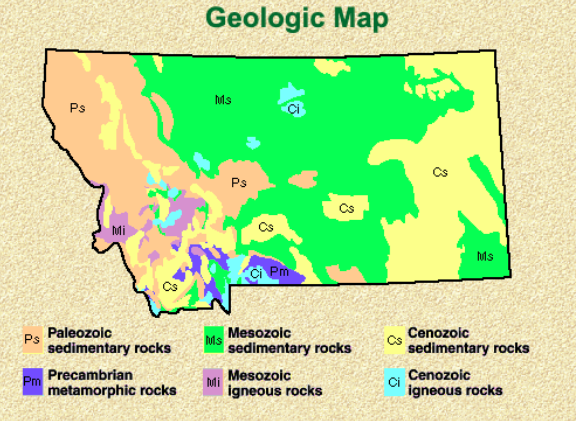
Take a look at this geologic map of Montana. The different colors represent the rocks we can see at the surface, both by age and by type.
1
Imagine that you are a paleontologist in search of Tyrannosaurus rex.Where would you start looking
Imagine that you are a paleontologist in search of Tyrannosaurus rex.
Where would you start looking
1
Why was the above the correct answer?
https://ucmp.berkeley.edu/education/explorations/tours/fossil/5to8/Page12b.html
1
What is the uplift process?
1
What is the erosion process?
1
Where do paleontologists look for fossils because the location has, like similar areas, are places where uplift and erosion occur.
https://ucmp.berkeley.edu/education/explorations/tours/fossil/5to8/Page13.html
1
Why don’t paleontologists always find fossils in the areas likely to contain fossils?
5
How do fossils represent only a partial picture of life in the past?
1) Organisms _______
2) Only _______
3) Of those that remain, _______
4) Some fossils _______
5) Of those fossils that do exist, _______
https://ucmp.berkeley.edu/education/explorations/tours/fossil/5to8/Page14.html
1
Fossils are:
Fossils are:
1
Which would most likley to fossilize
1
Why is a mammoth more likely to fossilize than a caterpillar?
1
Rapid burial is important in the fossilization process because:
1
Fossils are more likely to be found in...
1
Few organisms ever become fossils because:
1
BONUS: (and be careful; this one is a bit tricky!) Of the tiny percentage of organisms that ever become fossils, most are never found because: