Quiz 5.1 - Ops, Features, and Roots

Last updated almost 4 years ago
16 questions
Note from the author:
For the ones that don't give you a specific polynomial, it may be helpful to make up your own that fits the description.
1

Simplify the expression.

(-6a^{4}b^{3})^{2} \,\cdot\, -2ab^{5}

Write your answer in standard form with only positive exponents. No spaces.

1

Simplify the expression.

\frac{8x^{-3}y \,\cdot\, 5x^{5}y}{10x^{3}y^{2}}

Write your answer in standard form with only positive exponents. No spaces.

1

Simplify the expression.

(6x2 + 7x) + (5 - 2x2 + 9x)

Write your answer in standard form with only positive exponents. No spaces.

1

Simplify the expression.

(4h3 + 6h2 + 1) - (5h2 - 8h4 + 6)

Write your answer in standard form with only positive exponents. No spaces.

1

Simplify the expression.

(x + 2)(2x2 - x - 9)

Write your answer in standard form with only positive exponents. No spaces.

1

Simplify the expression.

3x(x - 7)(x - 1)2

Write your answer in standard form with only positive exponents. No spaces.

1

Simplify the expression.

\frac{21c^{10}d^{3}+56c^{6}d^{2}-7c^{2}d}{7c^{2}d}

Write your answer in standard form with only positive exponents. No spaces.

1

f(x) is a polynomial. The ends of f(x) both point down. Which describes the degree of f(x)?

1

f(x) is a polynomial. The ends of f(x) both point down. Which describes the leading coefficient of f(x)?

1

g(x) is a polynomial. As x approaches negative infinity, g(x) approaches negative infinity; As x approaches positive infinity, g(x) approaches positive infinity. Which describes the degree of g(x)?

1

g(x) is a polynomial. As x approaches negative infinity, g(x) approaches negative infinity; As x approaches positive infinity, g(x) approaches positive infinity. Which describes the leading coefficient of g(x)?

1

Identify the zeroes of the function.

f(x) = -x(3x - 2)2(x+9)

Use x={#, #, #} format, with exactly one space after each comma, no others. Use increasing order.

1

At which zero does the graph of f(x) from #15 "bounce", rather than pass through, the x-axis?

Enter your answer as a number, no spaces.

1

A polynomial function has a zero at 4 with multiplicity 3, and a zero at 0 with multiplicity 1. The function's leading coefficient is 1. Write the expression of the function in standard form.

Your answer should be a 4-term polynomial using the variable x. No spaces, no equal signs.

1

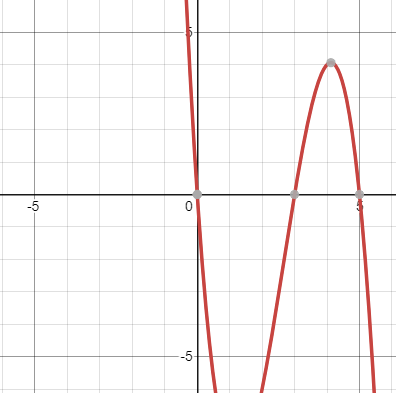
What are the zeroes of the function shown?

Use x={#, #, #} format, with exactly one space after each comma, no others. Use increasing order.

1

Which describes the value of the leading coefficient of the function with this graph, in standard form?