1
1
1
1
1
1
1
1
1
1
1
1
To review end behavior, watch this video.
To review positive and negative intervals, watch this video.
For other features, see the videos in Canvas.
To review end behavior, watch this video.
To review positive and negative intervals, watch this video.
For other features, see the videos in Canvas.
For interval notation, we use parenthesis when ;.
We use brackets when .
The first number is the .
The second number is the .
Categorize the functions according to their end behavior as x approaches negative infinity.
Use the chart in your notes. This question will only turn green when everything is in the right place.
f(x) = x2 + 3x -5
f(x) = -x
f(x) = x3
A polynomial of degree 6 with positive leading coefficent.
A polynomial of degree 181 with positive leading coefficient.
A polynomial of odd degree with negative leading coefficient.
A binomial with negative leading coefficient.
The function approaches +infinity. (4)
The function approaches -infinity. (2)
Not enough information. (1)
REVIEW:
Write
No spaces.
REVIEW:
Write
No spaces.
REVIEW
Write
No spaces.
As
As
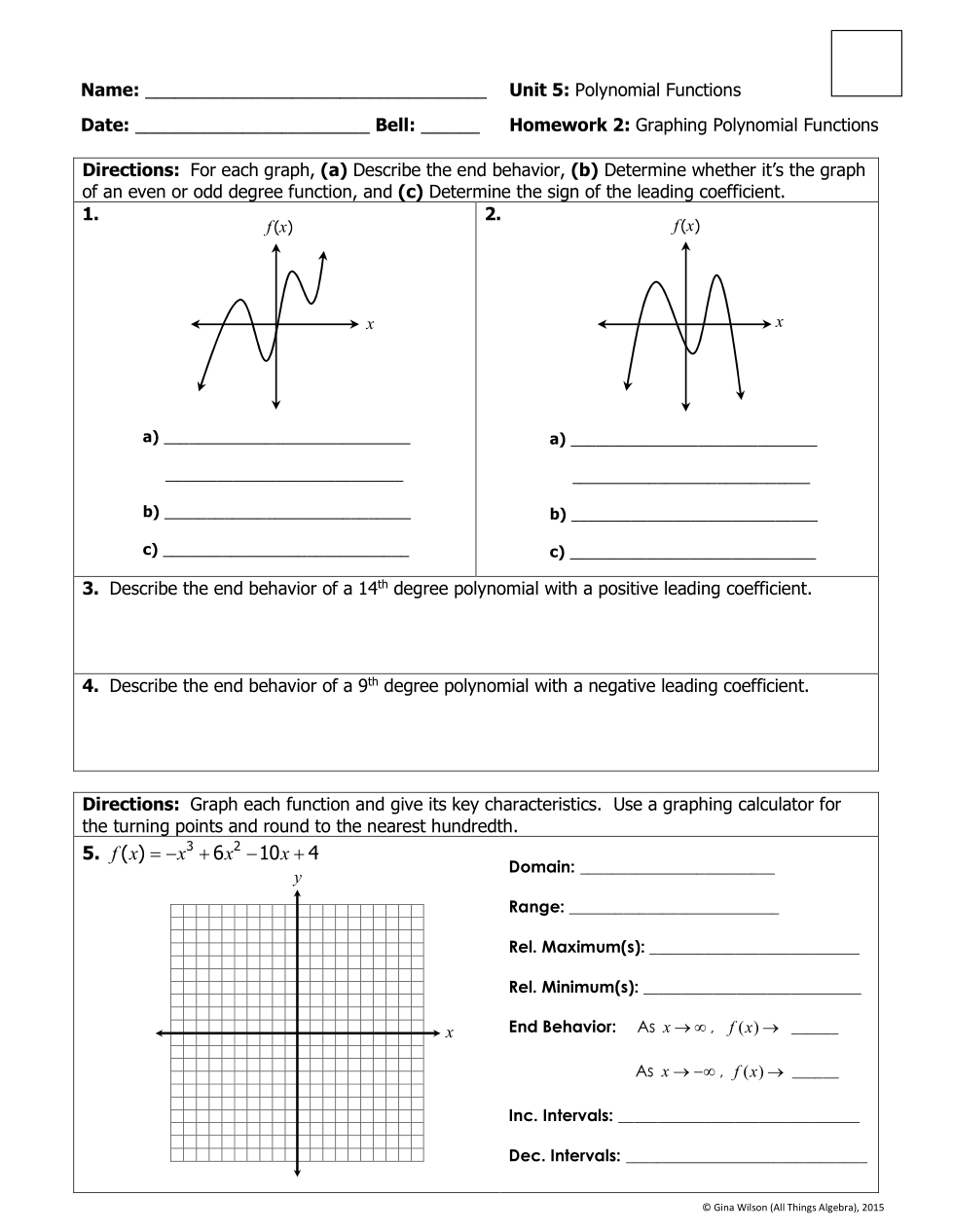
14th degree with positive leading coefficient.
Select two, one for each end.
9th degree with negative leading coefficient.
Select two, one for each end.
What is the domain?
Use interval notation, (#, #) with one space after the comma. For
What is the range?
Use interval notation, (#, #) with one space after the comma. For
Relative maximum?
Use (x, y) format, with exactly one space after the comma. Round to the nearest hundredth (2 decimal places).
Relative minimum?
Use (x, y) format, with exactly one space after the comma. Round to the nearest hundredth (2 decimal places).
As x approaches infinity, f(x) approaches what value?
As x approaches negative infinity, f(x) approaches what value?
On what interval is the function increasing?
Use (x1, x2) format, with exactly one space after the comma. Round any decimals to the nearest hundredth (2 decimal places).
On what interval(s) is the function decreasing? You may list either interval, but not both.
Use (x1, x2) format, with exactly one space after the comma. Round any decimals to the nearest hundredth.