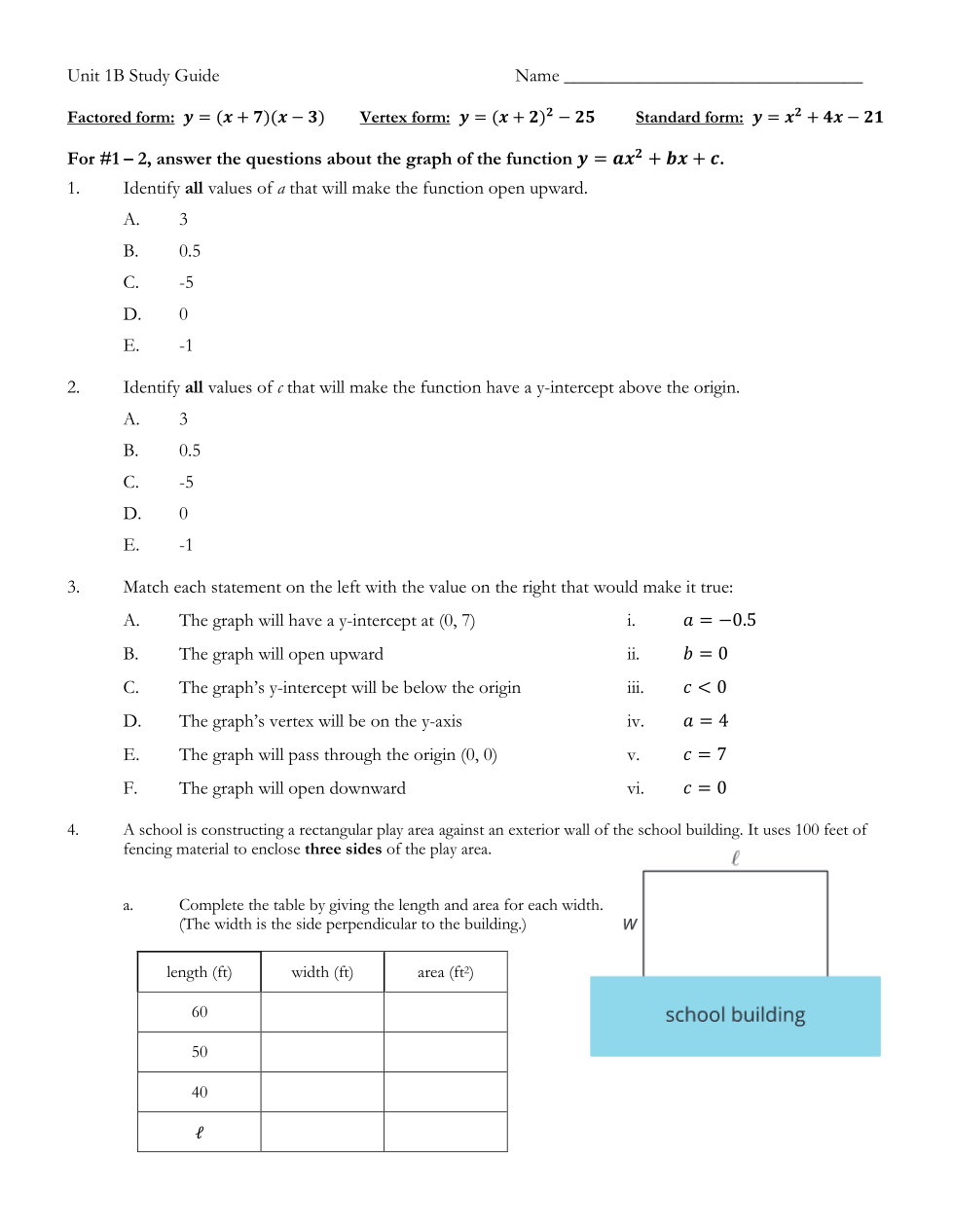
1
1
1
1
1
1
1
1
1
1
1

Identify all values of a that will make the function open upward.
Identify all values of c that will make the function have a y-intercept above the origin.
Match each statment on the left with the value on the right that would make it true:
| Draggable item | arrow_right_alt | Corresponding Item |
|---|---|---|
The graph will open upward | arrow_right_alt | c = 7 |
The graph will open downward | arrow_right_alt | a = 4 |
The graph will pass through the origin (0,0) | arrow_right_alt | c < 0 |
The graph's y-intercept will be below the origin | arrow_right_alt | b = 0 |
The graph will have a y-intercept at (0,7) | arrow_right_alt | c = 0 |
The graph's vertex will be on the y-axis | arrow_right_alt | a = -0.5 |
What is the width if the length is 60?
What is the width if the length is 50?
What is the width if the length is 40?
Write an expression for the width as a function of l, the length in feet.
What is the area if the length is 60?
What is the area if the length is 50?
What is the area if the length is 40?
Write an expression for the area as a function of l, the length in feet.
Write an equation to represent w, the width of the play area, as a function of l, the length in feet.
Write an equation to represent A, the area in ft2, as a function of l, the length in feet.
Write a function for a in factored form.
Write a function for a in vertex form.
Write a function for a in standard form.
The graph for b(x) opens _______.
The graph for b(x) has a _______.
The graph for b(x) has a min./max. at ________.
The graph for b(x) has a vertex at ________.
If I wanted to shift b(x) up 8 units, the new function would be b(x) = ____________.
If I wanted to shift b(x) right 2 units, the new function would be b(x) = ____________.
If I wanted make b(x) open upward, the new function would be b(x) = ____________.
Which factor of c(t) can be used to find when the ball hits the ground?
When does the ball hit the ground?
How high is the ball 2 seconds after Molly threw it?
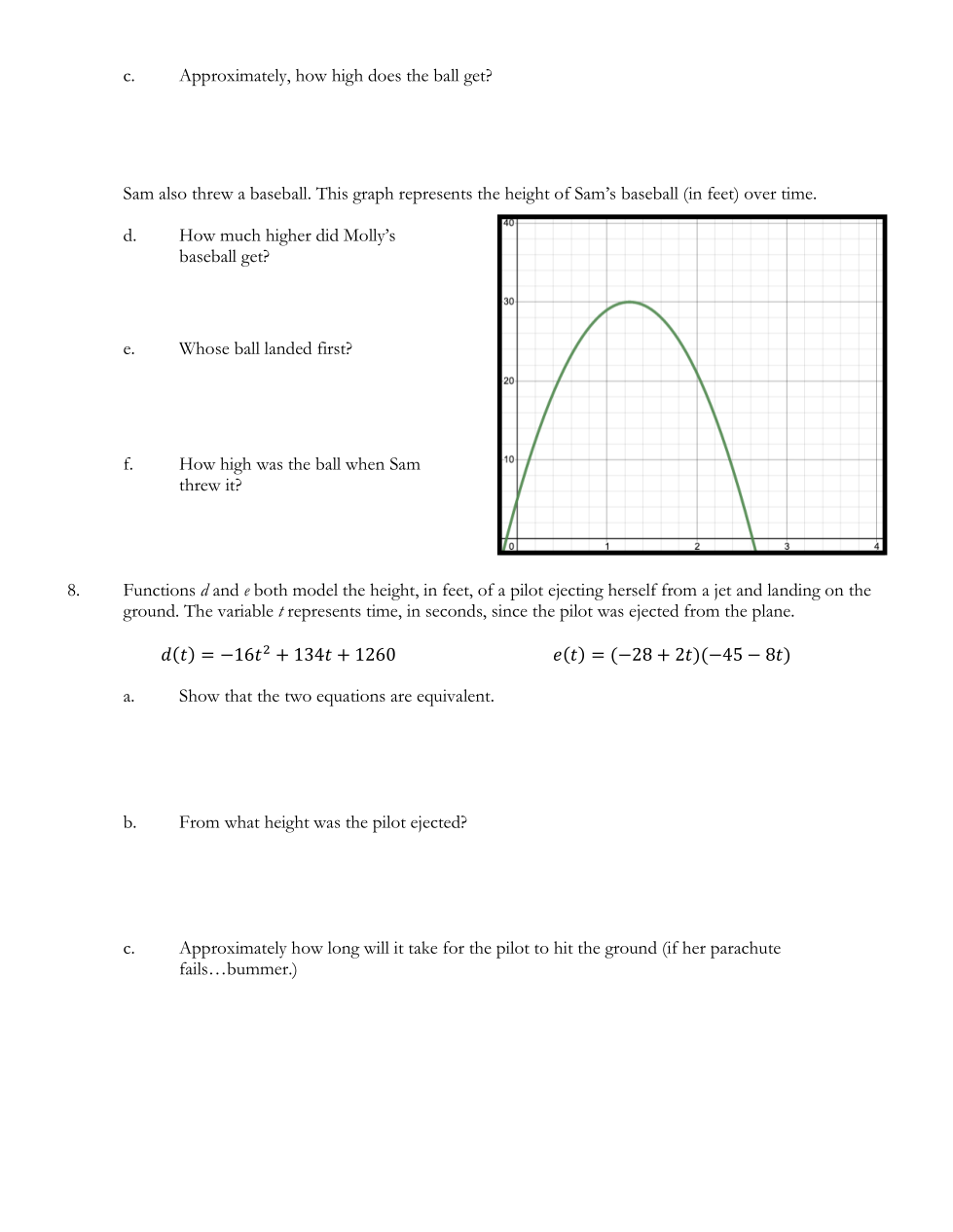
Approximately how high does the ball get?
How much higher did Molly's baseball get?
Whose ball landed first?
How high was the ball when Sam threw it?
Can you do this?
From what height was the pilot ejected?
Which factor can be used to tell you when the pilot will hit the ground?
Approximately how long will it take for the pilot to hit the ground (if her parachute fails)?
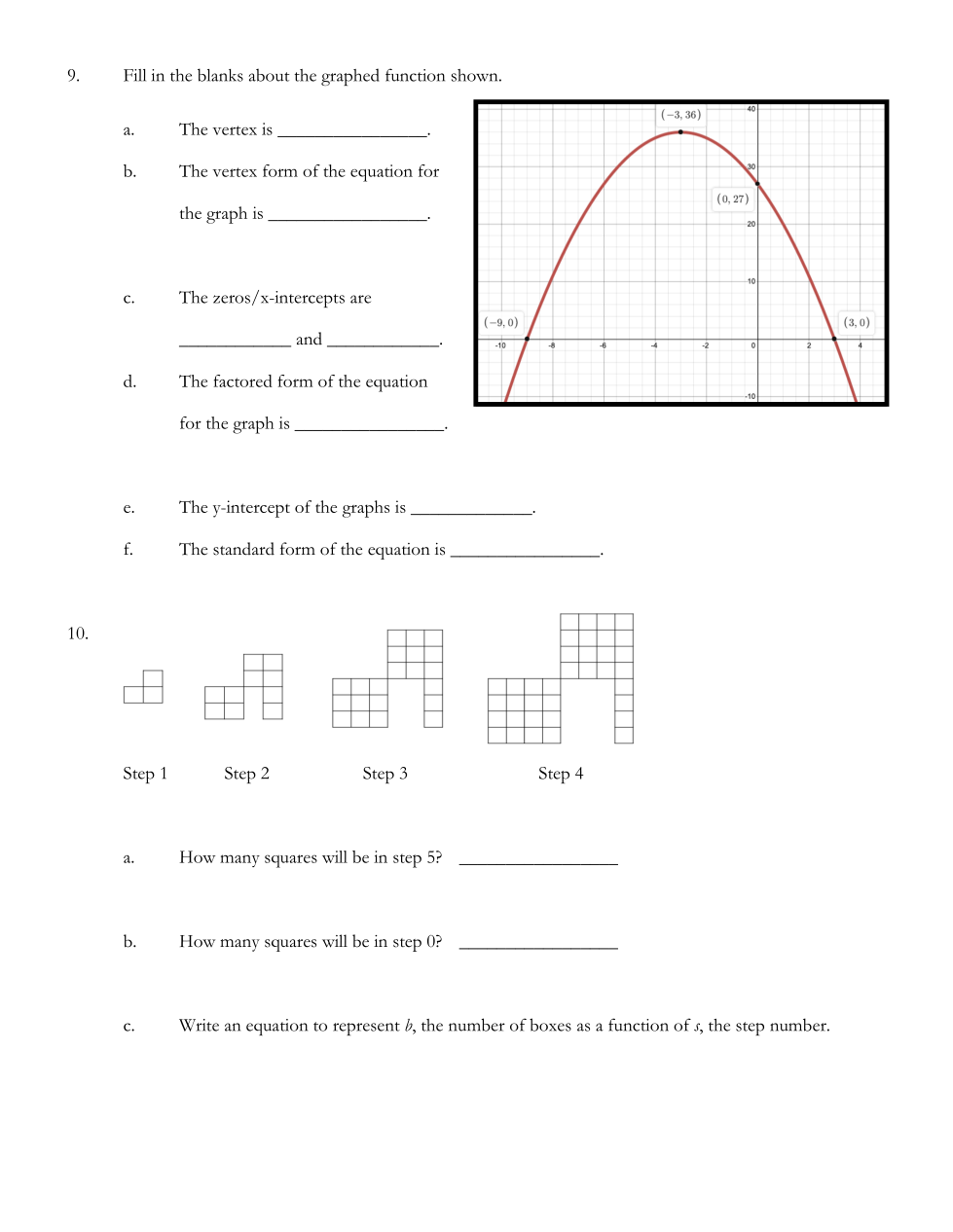
The coordinate for the vertex is ________.
The vertex form of the equation of the graph is ________.
One coordinate of a zero/x-intercept of the graph is _______.
The other coordinate of a zero/x-intercept of the graph is _______.
The factored form of the equation of the graph is _______.
The coordinate of the y-intercept of the graph is _________.
The standard form of the graph of the equation is _________.
How many squares will there be in step 5?
How many squares will there be in step 0?
Write an equation to represent b, the number of boxes as a function of s, the step number.