according to Kepler's second law,
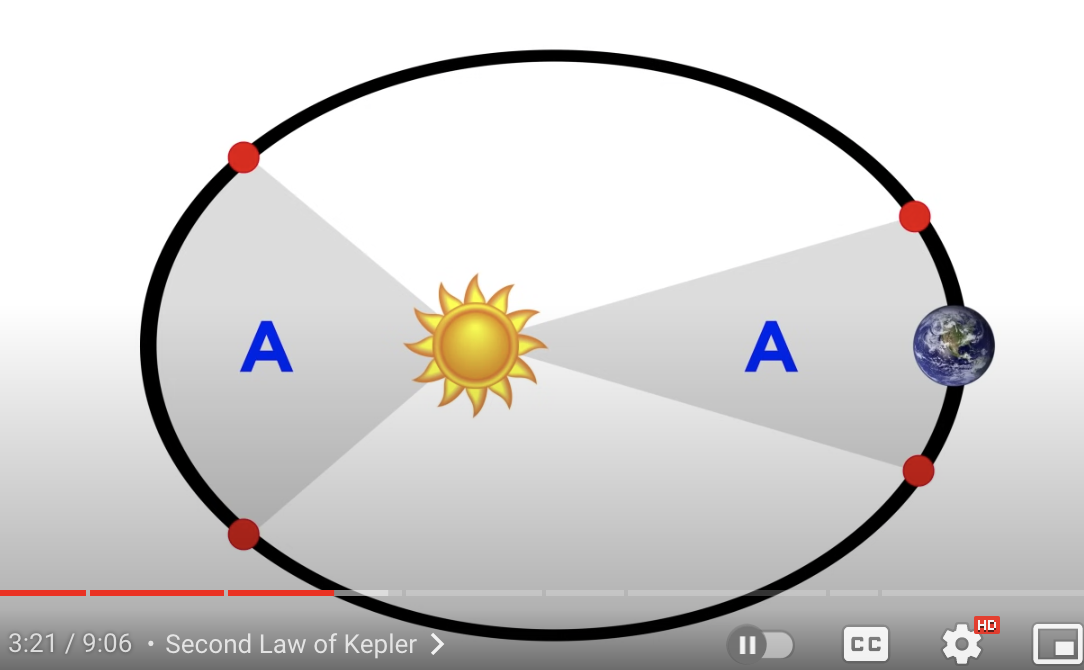
according to Kepler's second law,
match vocabulary to definition
| Draggable item | arrow_right_alt | Corresponding Item |
|---|---|---|
astronomical unit | arrow_right_alt | a regular oval shape, traced by a point moving in a plane so that the sum of its distances from two other points (the foci) is constant |
ellipse | arrow_right_alt | finding the angle between the line of site from one side of an object to another |
period | arrow_right_alt | the distance from the center of an ellipse to furthest point |
semi-major axis | arrow_right_alt | the average distance from the earth to the sun |
angular size | arrow_right_alt | the time interval of a repeating cycle |
Which of the following is newtons first law of motion
Match the vocab to the definitions
| Draggable item | arrow_right_alt | Corresponding Item |
|---|---|---|
retrograde motion | arrow_right_alt | slow rotation of the axis of a planet around another axis |
epicycle | arrow_right_alt | how the position of an object changes with respect to its background when seen from different positions |
precession | arrow_right_alt | the idea that the earth is the center of the solar system |
parallax | arrow_right_alt | how planets seem to move backwards in their orbits |
geocentrism | arrow_right_alt | a small circular orbit whose center moves around a larger circular orbit |
Match the term: rotatation of an object with its orbit.
| Draggable item | arrow_right_alt | Corresponding Item |
|---|---|---|
Synchronous rotation | arrow_right_alt | Deformation caused by gravitational forces between celestial bodies |
Tidal bulge | arrow_right_alt | Temporary dimming of one celestial body by another |
Eclipse | arrow_right_alt | Gradual slowing down of rotation due to tidal forces |
Tidal braking | arrow_right_alt | Rotates at the same rate as orbit |
according to Kepler's second law,
In visible light, changing the wavelength will change the
Waves carry _________ from one place to another
Using the doppler shift, we should be able to tell if a star is moving
Which of the following travels the fastest?
Now that exhibition is over we are going to start putting aspects of light together. so first - some review: below is a list of things we can glean from light from a star. From what you already know, try to match the aspect of a star we can learn
| Draggable item | arrow_right_alt | Corresponding Item |
|---|---|---|
doppler shift of the spectral analysis | arrow_right_alt | pattern of the light tells us the makeup of the outermost layer of the earth |
Brightness of the star | arrow_right_alt | whether the star is moving towards or away from the earth |
size of the star | arrow_right_alt | how much light is observed from earth |
the mass of a star | arrow_right_alt | light output of the star based on light observed from earth and calculated distance to the star |
spectral analysis of the light | arrow_right_alt | parallax, speed of doppler shift, |
luminosity of the star | arrow_right_alt | uh... we can't really tell that about an individual star. we have theories about stars in general. |
Age of a star | arrow_right_alt | angular diameter, and then calculate the linear measurement with the distance found with parallel. (there are other methods of making more precise measurement as well) |
distance of the star | arrow_right_alt | from measuring the speed of the orbits of the stars planets |
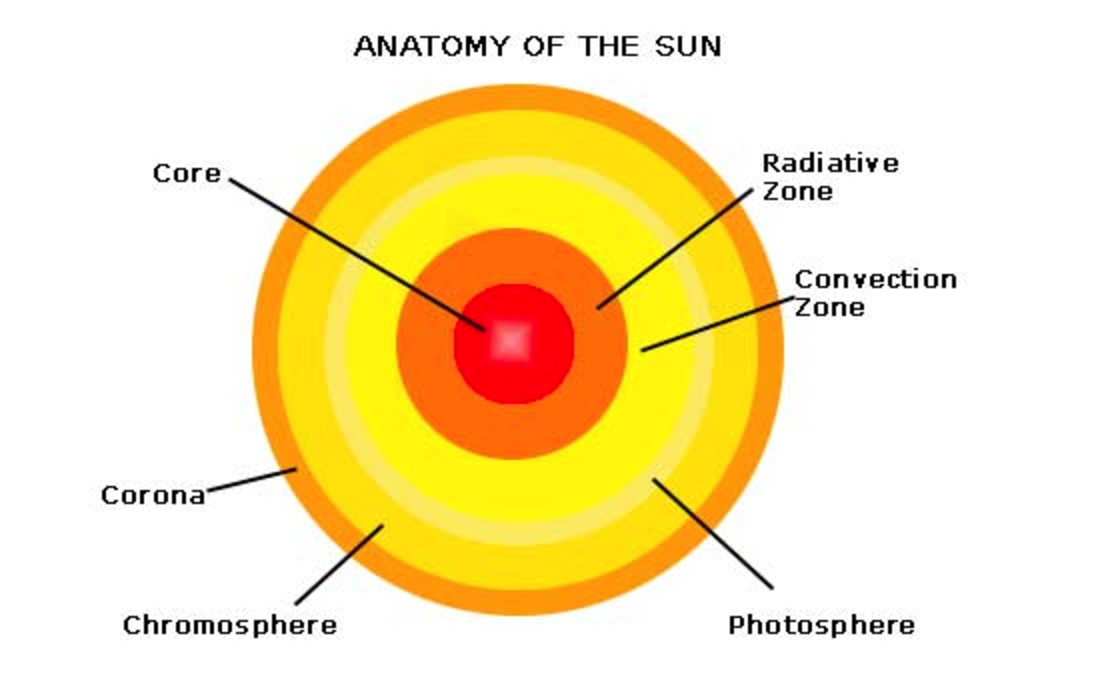
Match the layer of the sun to an aspect of that layer
| Draggable item | arrow_right_alt | Corresponding Item |
|---|---|---|
Chromosphere | arrow_right_alt | Energy is released by fusion |
Core | arrow_right_alt | Energy is moved by photons being released, reabsorbed, and released again |
Radiative zone | arrow_right_alt | Energy is carried by moving atoms rather than photons |
corona | arrow_right_alt | transition layer where gases move from being transparent to opaque |
photosphere | arrow_right_alt | thin layer with strong red-emission lines that can be seen during an eclipse |
Convection zone | arrow_right_alt | third hottest layer of the sun that has lowest amount of energy because of its low density |
review question: What is a neutrino
What is a binary star system?
Quantum tunnelling explains why fusion happens in stars despite the pressure and temperature being less than what is required to overcome the potential barrier between protons. The potential barrier refers to
| Draggable item | arrow_right_alt | Corresponding Item |
|---|---|---|
Pulsar | arrow_right_alt | A rotating disk of gas, dust, and other matter that forms around massive objects in space due to gravity pulling material toward it |
Supernova: | arrow_right_alt | The maximum mass (about 1.4 times the mass of our Sun) that a white dwarf star can have before it collapses under its own gravity |
Neutron star: | arrow_right_alt | A quantum mechanical force that prevents certain types of stars from collapsing, created by electrons or neutrons being squeezed too close together |
Chandrasekhar limit: | arrow_right_alt | An extremely dense stellar remnant composed almost entirely of neutrons, formed when a massive star explodes and its core collapses |
Accretion disk: | arrow_right_alt | A powerful explosion that occurs at the end of a massive star's life, briefly outshining entire galaxies and spreading heavy elements into space |
Degeneracy pressure | arrow_right_alt | A rapidly rotating neutron star that emits regular pulses of radiation from its magnetic poles, acting like a cosmic lighthouse |
I would prefer the session 4 final to be