Friction and practice decomposing and adding vectors
star
star
star
star
star
Last updated 3 months ago
12 questions
1 point
1
Question 1
1.
If two objects of different weights are dropped in a vaccuum
1 point
1
Question 2
2.
If one object falls in a freefall and another sits at the top of an incline, Which has more potetial energy at the top?
Remember potential energy = mass * height*gravitation acceleration
1 point
1
Question 3
3.
If one object falls in a freefall, and another slides down a frictionless surface at an incline
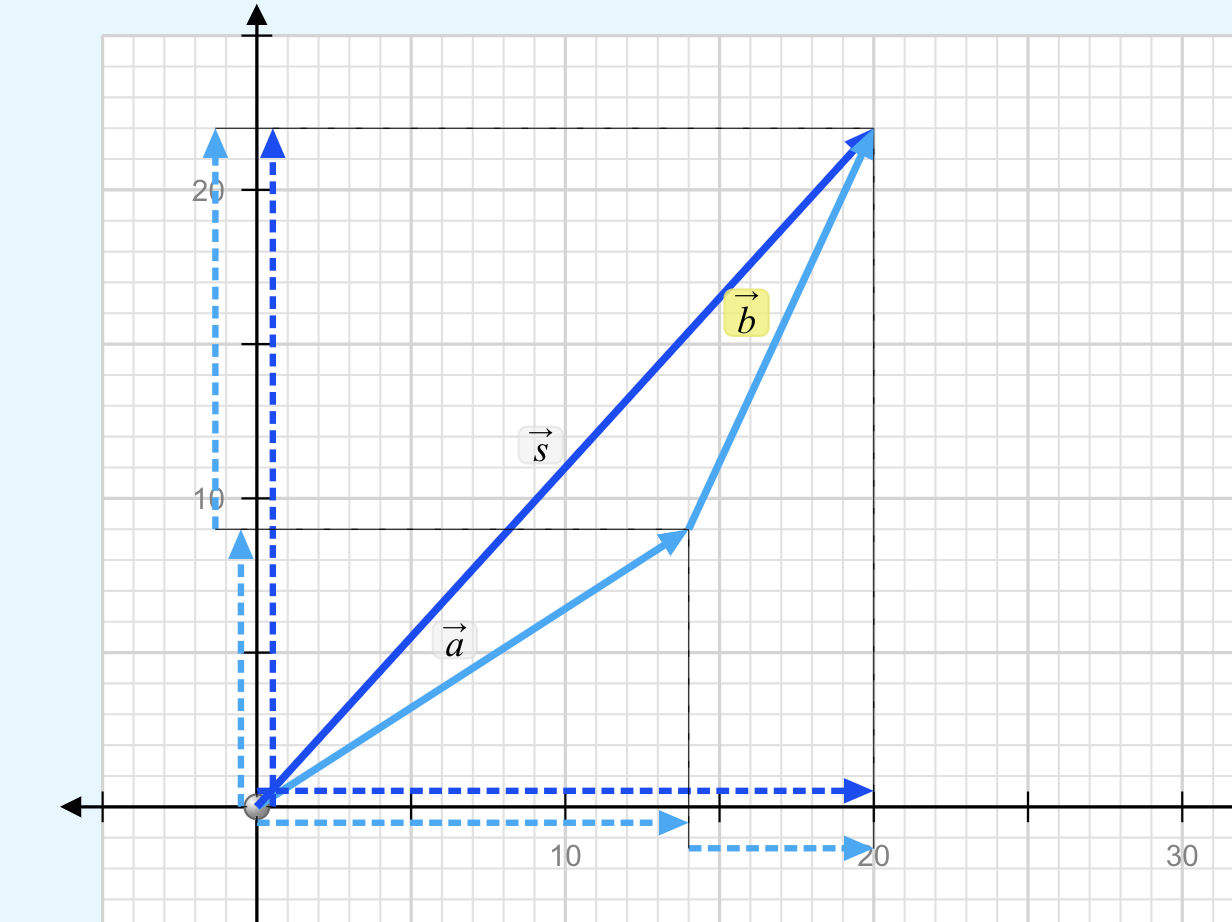
To make sense of the forces in 2d of a block sliding down an incline, we have to think about how to decompose vectors. every vector can be broken into a sum of other vectors, just like any number can be broken into an addition problem. The most convinient way to do this is to break a vector into x and y components.
here you can see
Play with the tool below, add vectors in 1d and 2d. notice the tool to turn on components. see how the x and y components of the sum vector are just the sums of the xs and ys of the added vectors.
1 point
1
Question 4
4.
Decompose the following vectors. HONORS STUDENTS ONLY: use trig functions to find the lengths of the components. Remember - Sine=opposite/hypotenuse and cosine=adjacent/hypotenuse
1 point
1
Question 5
5.
Add the following vectors graphically. If two vectors are not already placed tip to tail, redraw it in the right place, and lable it, then add the vectors.
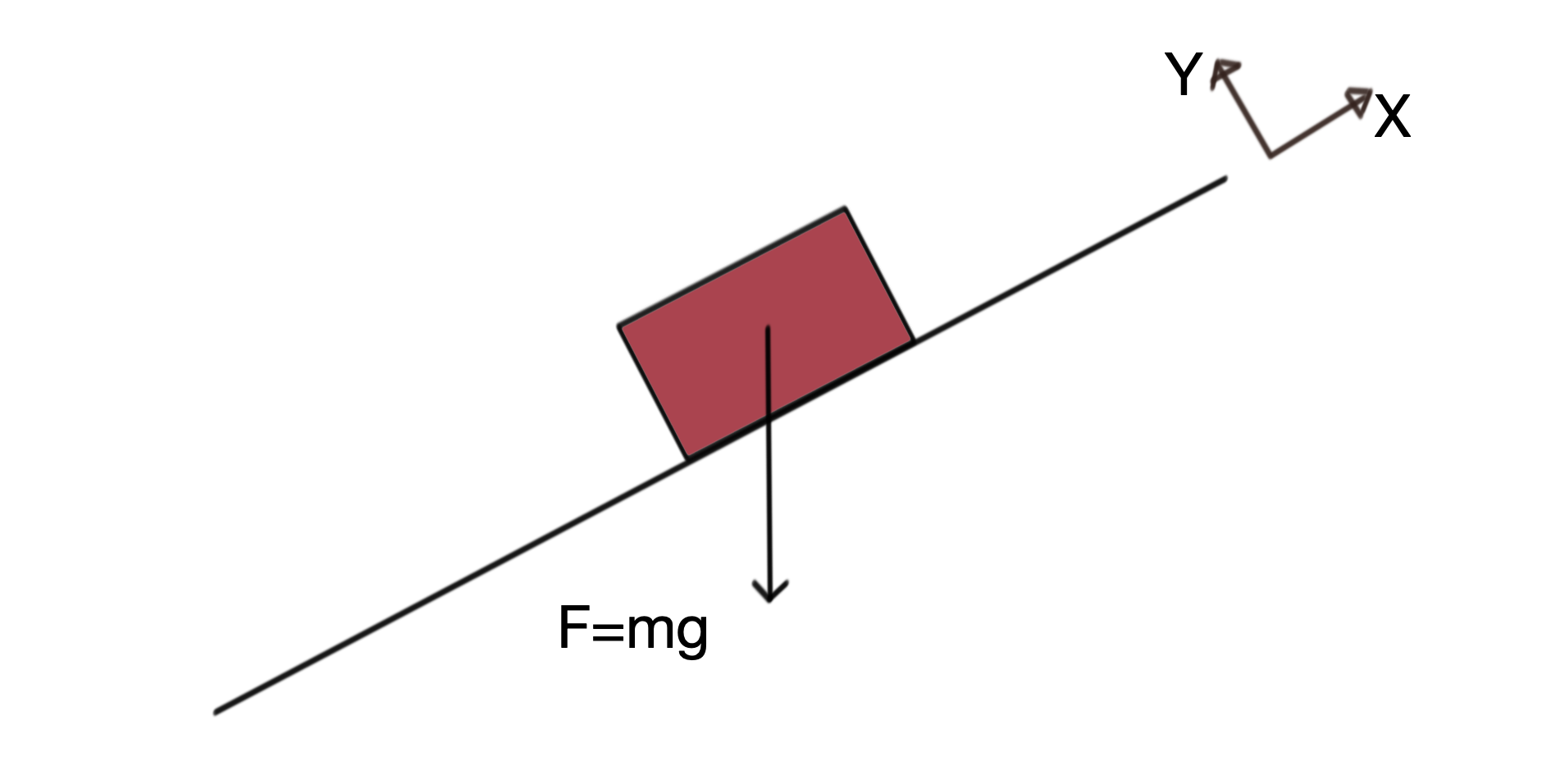
When we think of an inclined plane, we want to make life easy, so we set the x axis along the inclined plane, and the y axis perpendicular to that line.
Notice that the force of gravity doesn't care about the inclined plane. It is pulling straight down to the center of the earth, just like it always does.
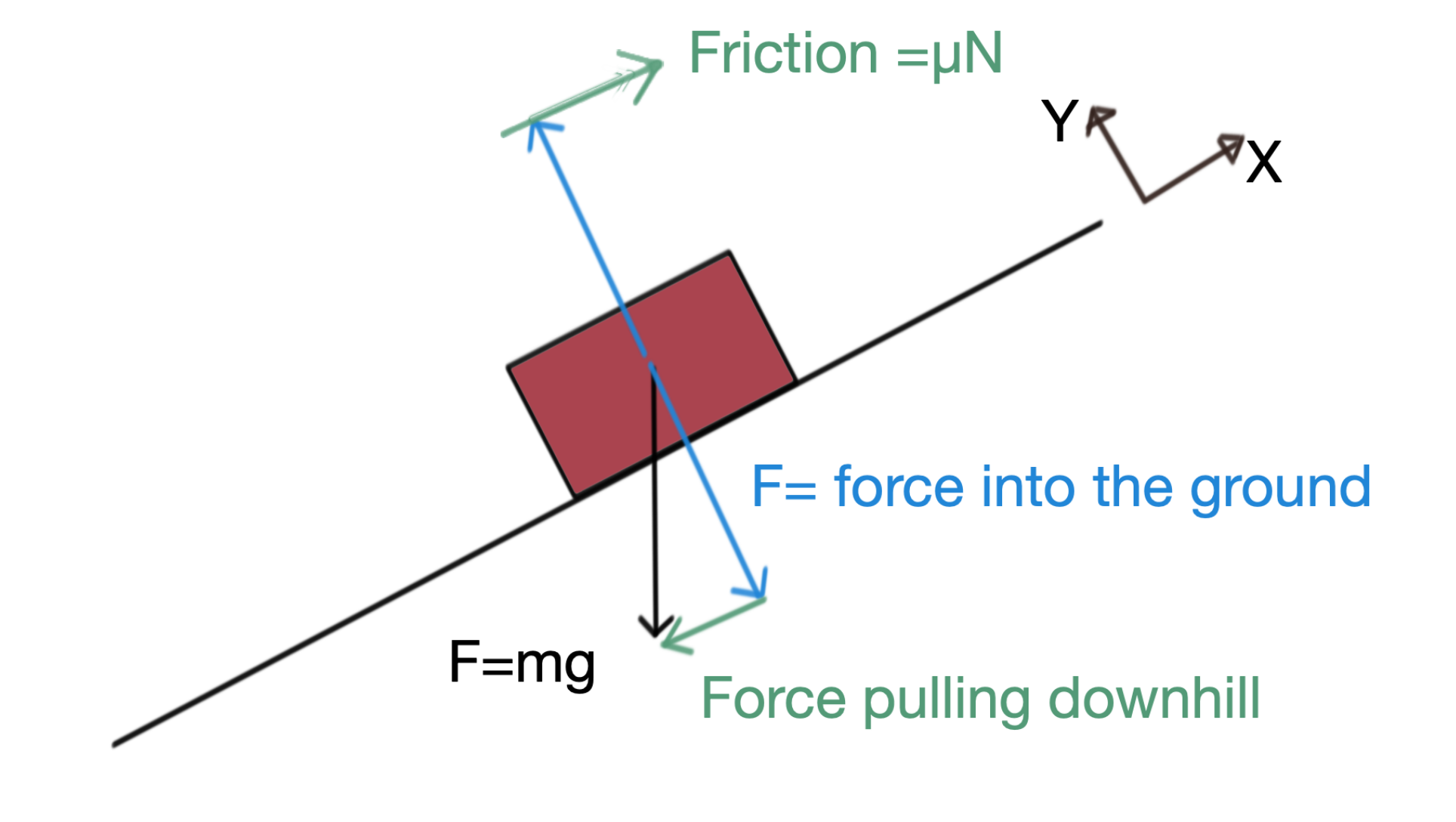
We can decompose that force on the block to show us what the force is that is making the block move. because we have set x to be along the incline, we now have one decomposed vector pointing in the direction that our block is moving.
1 point
1
Question 6
6.
What is the equal and opposite force to the force into the ground?
1 point
1
Question 7
7.
We know that even though gravity is pulling straight down, not all of that force is going into accelerating our block. How do we know that?
1 point
1
Question 8
8.
The steeper the incline, the faster the block will slide. Decompose the force vector in each of these instances. x is always along the incline, and y is perpendicular to that incline.
1 point
1
Question 9
9.
The equation for friction is F=µN, where µ is some number that has to do with the two materials that are in contact, and N is the normal force (normal just means perpendicular, but to a plane instead of a line). Knowing that the normal force is equal and opposite to the component of gravity that goes in perpendicular to the ground, would the friction force be larger for the block on the steeper incline, or flatter incline?
1 point
1
Question 10
10.
If there is no force on an object in one direction there is no friction in that direction. A box lying on the flat ground won't move with no other forces acting on it. So, the equation above, F=µN represents the max amount of force friction can provide. In this case µN is greater than the component of F. What will happen to the block
1 point
1
Question 11
11.
Find something heavy in your house or your yard that is ok for you to move, but will be hard to move. Push on it and slowly increase the force you are using until it moves as soon as you get it to move push as little as you can to keep it moving. Which did you experience
1 point
1
Question 12
12.
The µ of two surfaces in contact is based on a whole lot more math than we want to talk about. While velocity isn't really a factor of µ, it does matter if Velocity is 0. So, for any two objects being pushed past each other there are two coefficients of friction. µ static (the coefficient when velocity is 0) is always larger than µ dynamic (the coefficient when the velocity ≠0). Think through pushing a large heavy box across a carpet, and how much force it takes to get it moving, and how much force it takes to keep it moving. How does this information fit with your experiences.