1
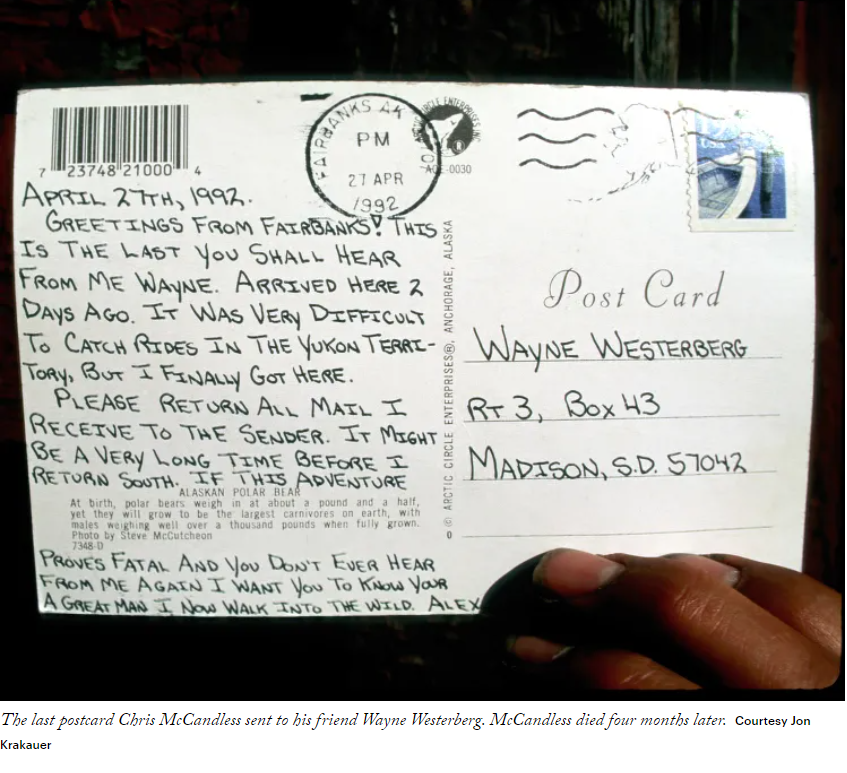
Based on the postcard above, Why does McCandless tell Wayne to return all mail to sender?
Based on the postcard above, Why does McCandless tell Wayne to return all mail to sender?
1
1
1
Objective: Demonstrate your understanding of key concepts discussed in class and your overall understanding of the American classic, Krakauer’s Into the Wild by applying yourself to check and application questions.
Please sign the honor pledge by writing your full name here.
Chris felt a(n) ___________ desire to adventure in Alaska.
Which of the following vocab words fits best considering the greater context of Into the Wild?
McCandless was completely ___________ about his self-reliance vision of his quest into Alaska and refused assistance from Gallien.
Which of the following vocab words fits best considering the greater context of Into the Wild?
Krakauer's Into the Wild is, in many ways, a(n) _________ for McCandless and his life.
Which of the following vocab words fits best considering the greater context of Into the Wild?
Based on the postcard above, Why does McCandless tell Wayne to return all mail to sender?
Directions: The following passages are all epigraphs from throughout Into the Wild. Consider the questions below as you read through these excerpts:
______________________________________________________
The dominant primordial beast was strong in Buck, and under the fierce conditions of trail life it grew and grew. Yet it was a secret growth. His newborn cunning gave him poise and control.
- Jack London, The Call of Wild
All Hail the Dominant Primordial Beast!
Alexander Supertramp
May 1992
(Graffiti found inside the abandoned bus on the Stampede trail)
__________________________________________________
"Dark spruce forest frowned on either side the frozen waterway. The trees had been stripped by a recent wind of their white covering of frost, and they seemed to lean toward each other, black and ominous, in the fading light. A vast silence reigned over the land. The land itself was a desolation, lifeless, without movement, so lone and cold that the spirit of it was not even that of sadness. There was a hint in it of laughter, but of a laughter more terrible than any sadness—a laughter that was mirthless as the smile of the Sphinx, a laughter cold as the frost and partaking of the grimness of infallibility. It was the masterful and incommunicable wisdom of eternity laughing at the futility of life and the effort of life. It was the Wild, the savage, frozen-hearted Northland Wild."
- Jack London,White Fang
Jack London is King
Alexander Supertramp
May 1992
(Graffiti carved into a piece of wood found at the site of McCandless's death)
________________________________________________
Words like "hail" and "king" here show that...
Directions: The following passages are from a Letter to Ron, from Chirs McCandless. Consider the questions below as you read through these excerpts:
"Ron, I really enjoy all the help you have given me and the times that we spent together. I hope that you will not be too depressed by our parting. It may be a very long time before we see each other again. But providing that I get through this Alaskan Deal in one piece you will be hearing from me again in the future. I'd like to repeat the advice I gave you before, in that I think you really should make a radical change in your lifestyle and begin to boldly do things which you may previously never have thought of doing, or been too hesitant to attempt. So many people live within unhappy circumstances and yet will not take the initiative to change their situation because they are conditioned to a life of security, conformity, and conservatism, all of which may appear to give one peace of mind, but in reality nothing is more damaging to the adventurous spirit within a man than a secure future. The very basic core of a man's living spirit is his passion for adventure. The joy of life comes from our encounters with new experiences, and hence there is no greater joy than to have an endlessly changing horizon, for each day to have a new and different sun. If you want to get more out of life, Ron, you must lose your inclination for monotonous security and adopt a helter-skelter style of life that will at first appear to you to be crazy. But once you become accustomed to such a life you will see its full meaning and its incredible beauty. ... I fear you will follow the same [patterns] in the future and thus fail to discover all the wonderful things that God has placed around us to discover. Don't settle down and sit in one place. Move around, be nomadic, make each day a new horizon. ... it would be a shame if you did not take the opportunity to revolutionize your life and move into an entirely new realm of experience. ... We just have to have the courage to turn against our habitual lifestyle and engage in unconventional living." - Letter to Ron, from Chris (Krakauer 56-57).
SHORT ANSWER RESPONSE: Based on the letter above explain: Why did McCandless walk out of modernity? Why did he walk into the wild? Give 1 specific detail or evidence from the letter for both his push and pull factors in your response (1 each, 4+ sentences)
Directions: The following passages are from the Author's Note in Into the Wild. Consider the questions below as you read through these excerpts:
"I won't claim to be an inpartial biographer. McCandless's strange tale struck a personal note that made a dispassionate rendering of the tragedy impossible. Through most of the book, I have tried - and largely succeeded, I think - to minimize my authorial presence. But let the reader be warned: I interrupt McCandless's story with fragments of a narrative drawn from my own youth. I do so in the hope that my experiences will throw some oblique light on the enigma of Chris McCandless.
He was an extremely intense young man and possed a streak of stubborn idealism that did not mesh readily with modern existance. ... When the boy headed off into the Alaska bush, he entertained no illusions that he was trekking into a land of milk and honey; peril, adversity, and Tolstoyan renunciation were precisely what he was seeking. And that is what he found, in abundance. For most of his 16 week ordeal, nevertheless, McCandless more than held his own. Indeed, were it not for one or two seemingly insignficant blunders, he would have walked out into the woods in August 1992 as anonymously as he had walked into them in April. Instead, his innocent mistakes turned out to be pivotal and irreversible, his name became the stuff of tabloid headlines, and his bewildered family was left clutching the shards of a fierce and painful love.
... Some readers admired the boy immensely for his courage and nobel ideals; others fulminated that he was a reckless idiot, a wacko, a narcissist who perished out of arrogance and stupiditiy-- and was undeserving of the considerable media attention he received. My convictions should be apparent soon enough, but I will leave it to the reader to form his or her own opinion of Chris McCandless." - Jon Krakauer, Author's Note, Into the Wild
Which of the following is TRUE about Romanticism?
Which of the following is NOT a key characteristic of Romanticism?
Which of the following is TRUE about Transcendentalism?
Which of the following is NOT a key characteristic of Transcendentalism?
The Tables Turned
BY WILLIAM WORDSWORTH
Up! up! my Friend, and quit your books;
Or surely you'll grow double:
Up! up! my Friend, and clear your looks;
Why all this toil and trouble?
The sun above the mountain's head,
A freshening lustre mellow
Through all the long green fields has spread,
His first sweet evening yellow.
Books! 'tis a dull and endless strife:
Come, hear the woodland linnet,
How sweet his music! on my life,
There's more of wisdom in it.
And hark! how blithe the throstle sings!
He, too, is no mean preacher:
Come forth into the light of things,
Let Nature be your teacher.
She has a world of ready wealth,
Our minds and hearts to bless—
Spontaneous wisdom breathed by health,
Truth breathed by cheerfulness.
One impulse from a vernal wood
May teach you more of man,
Of moral evil and of good,
Than all the sages can.
Sweet is the lore which Nature brings;
Our meddling intellect
Mis-shapes the beauteous forms of things:—
We murder to dissect.
Enough of Science and of Art;
Close up those barren leaves;
Come forth, and bring with you a heart
That watches and receives.
Which of the following lines in the poem "Tables Turned" is NOT Romantic?
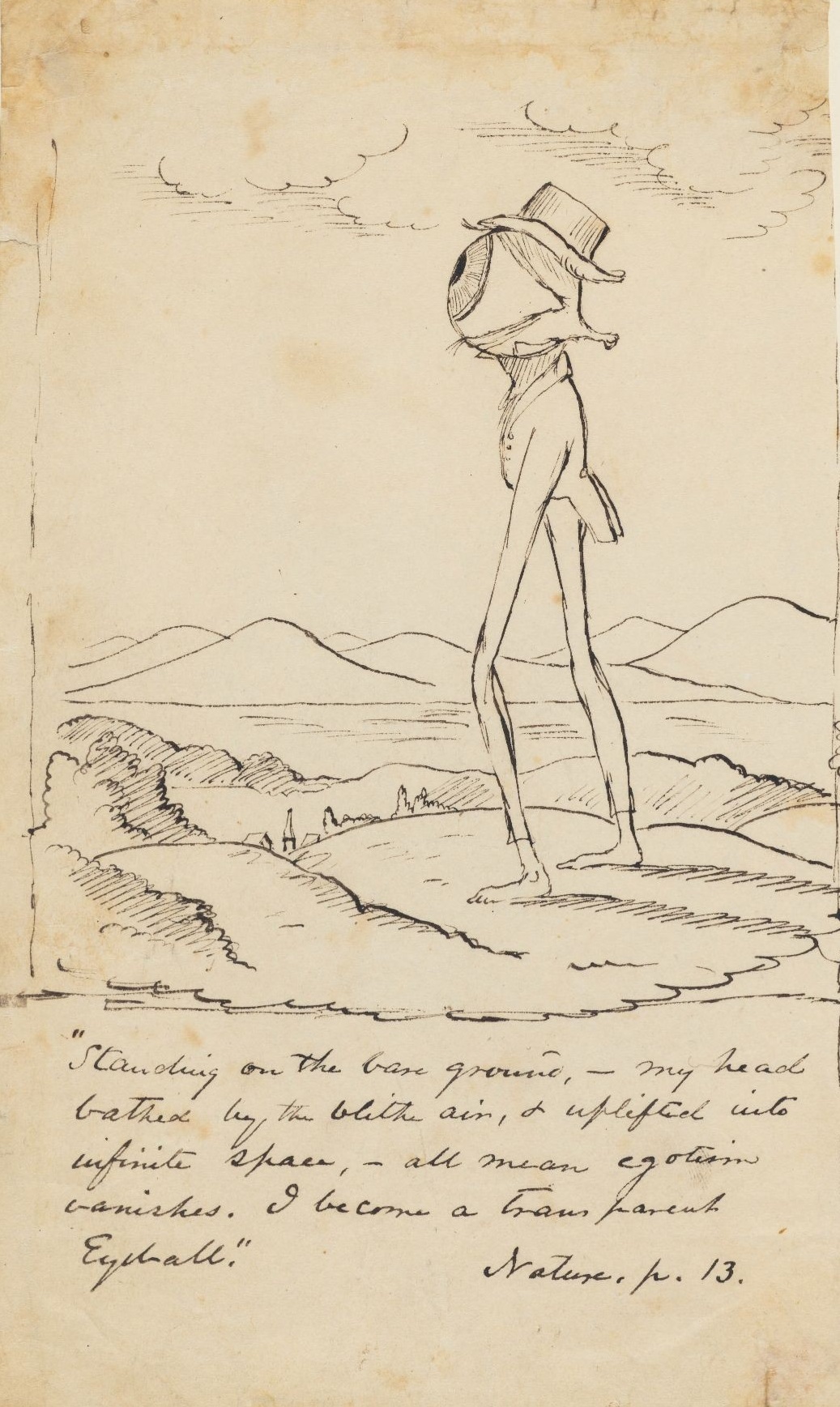
What did Emerson mean by "...become the transparent Eyeball"?
Directions: The following passages were annotated/highlighted in Chris McCandless's copy of Henry David Thoreau's book Walden: Or, Life in the Woods (1854). This book was found with him in the bus. Consider the questions below as you read through these excerpts from Walden:
"No man ever followed his genius till it misled him. Though the result were bodily weakness, yet perhaps no one can say that the consequences were to be regretted, for these were a life in conformity to higher principles. If the day and the night are such that you greet them with joy, and life emits a fragrance like flowers and sweet-scented herbs, is more elastic, more starry, more immortal, -- that is your success. All nature is your congratulation, and you have cause momentarily to bless yourself. The greatest gains and values are farthest from being appreciated. We easily come to doubt if they exist. ... They are the highest reality... the true harvest of my daily life is somewhat as intangible and indescribable as the tints of mornings and evening. It is a little star-dust caught, a segment of the rainbow which I have clutched."
"Rather than love, than money, than fame, give me truth. I sat at a table where were rich food and wine in abundance... but sincerity and truth there were not; and I went away hungry from the inhospitable board. The hospitality was cold as the ices."
"I went to the woods because I wished to live deliberately, to front only the essential facts of life, and see if I could not learn what it had to teach, and not, when I came to die, discover that I had not lived. I did not wish to live what was not life, living is so dear; nor did I wish to practise resignation, unless it was quite necessary. I wanted to live deep and suck out all the marrow of life, to live so sturdily and Spartan-like as to put to rout all that was not life, to cut a broad swath and shave close, to drive life into a corner, and reduce it to its lowest terms, and, if it proved to be mean, why then to get the whole and genuine meanness of it, and publish its meanness to the world; or if it were sublime, to know it by experience, and be able to give a true account of it in my next excursion."
Directions: The following excerpt is the graffiti Chris McCandless carved inside the bus, on a sheet of plywood over a broken window. The underlining is his emphasis:
"Two years he walks the earth. No phone, no pool, no pets, no cigarettes. Ultimate freedom. An extremist. An aesthetic voyager whose home is the road. Escaped from Atlanta [Emory College]. Thou shalt not return, 'cause "the west is the best." And now after two rambling years comes the final and greatest adventure. The climactic battle to kill the false being within and victoriously conclude the spiritual revolution. Ten days and nights of freight trains and hitchhiking bring him to the Great White North. No longer to be poisoned by civilization he flees, and walks alone upon the land to become lost in the wild." - Alexander Supertramp (May 1992)
SHORT ANSWER
Using one piece of evidence from Walden as support, explain your answer to the previous question. (1 quote, 3+ sentences)
The text Walden is best described as... because...
30 points - In a complete AEC paragraph, compare Thoreau's Walden to McCandless's bus graffiti credo. How is McCandless' ideology similar/different to Thoreau's in Walden?
Cite evidence from BOTH Walden and the credo from Into the Wild at least ONCE each in your response.
"If this adventure proves fatal and you don't ever hear from me again, I want you to know you're a great man."
Here, McCandless comes across as...
"I now walk into the wild."
What does this quote from the postcard capture about McCandless's ideology?
Jon Krakauer starts off his book Into the Wild with this postcard as an epigraph in order to...
Jack London and Chris McCandless would agree that...
The purple excerpt from the letter to Ron shows McCandless's...
By "monotonous security" Chris means...
The green excerpt from the letter to Ron shows McCandless's...
According to Krakauer, why did McCandless walk into the wild?
Which quote from the Author's Note best supports your answer to the previous question?
How does Krakauer feel about Chris?
Which quote from the Author's Note best supports your answer to the previous question?
What is the purpose of this Author's Note?
The Romantic meaning of this poem is...
How is the "Transparent Eyeball" the ideal realization of Transcendentalism?
In Walden, Thoreau goes into the woods to...
Thoreau's Walden is best described as: