Background:
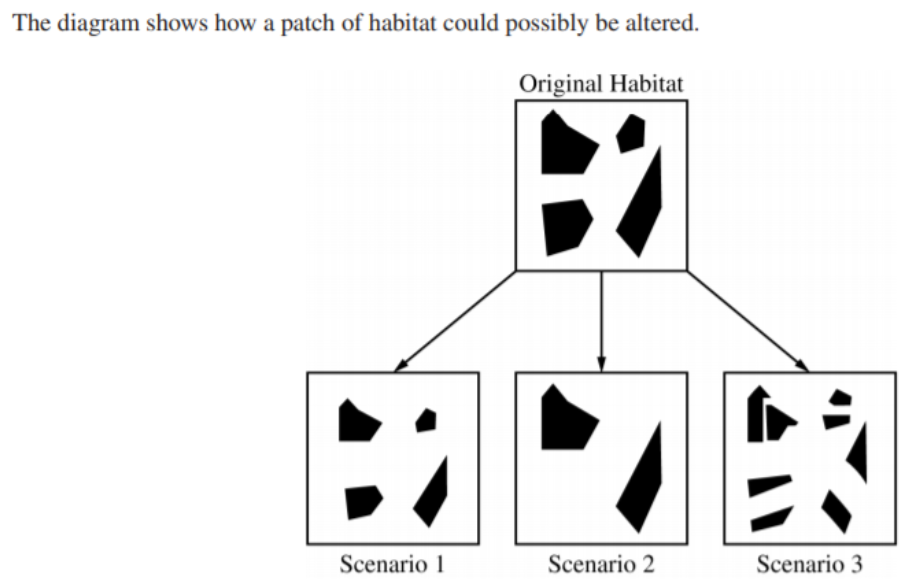
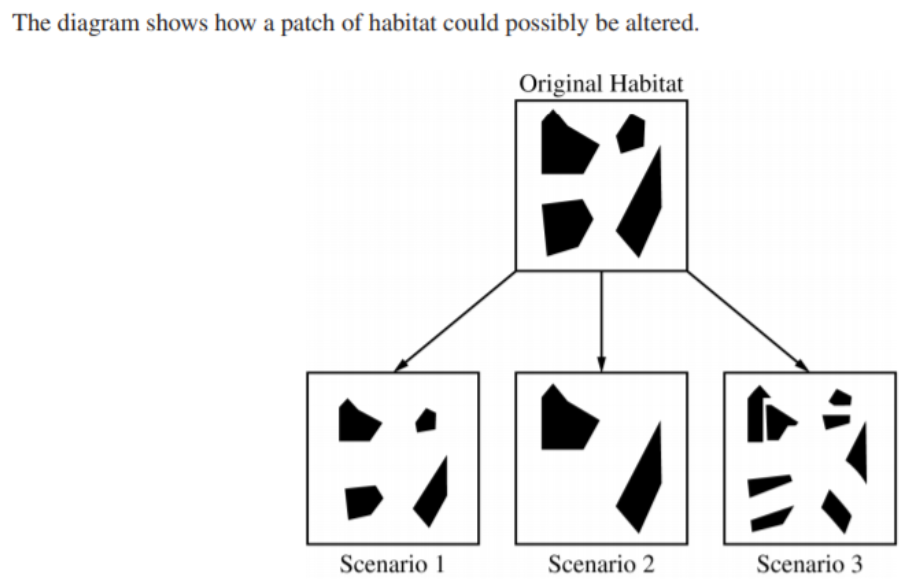
Habitats, of various types, once covered thousands of acres of land in the United States and many other countries. These habitat areas are being reduced to small fractions of their original size as humans turn more wildlands into urban and suburban areas, farms and pastures, highways, and other developed lands. These small fractions, or habitat “patches” are like islands of safety for the animals and plants that live there. When a habitat is fragmented like this, it becomes a series of little habitat islands that are various sizes and distances from each other. There is often a larger habitat area that serves as a source of new individuals for smaller habitat islands; much like the mainland does to islands in the ocean. Examples of these biological islands might include forest fragments, mountaintops, isolated lakes, or actual islands in the ocean.
Biological islands usually show differences in species richness. To explain these differences, Robert MacArthur and E.O. Wilson proposed the theory of island biogeography or species equilibrium model. This model states that the number of species (richness) found on an island is determined by the interactions of two factors: the rate at which new species immigrate to the island and the rate at which species become extinct locally on the island. Two features of an island determine the immigration and extinction rates: island size and an island’s distance from the mainland.
Your group has been appointed by the government to determine what kind of forest islands are the most desirable to save native fauna and flora, which may migrate between habitat islands.
Your choices are:
A. islands that are near the source population and small in size (Purple Island)
B. islands that are near the source population and large in size (Pink Island)
C. islands that are far away from the source population and small in size (Blue Island)
D. islands that are far away from the source population and large in size (Orange Island)