10/1 Succession
star
star
star
star
star
Last updated about 1 year ago
12 Nsɛmmisa
1
1
1
1
1
1
1
1
1
1
1
1
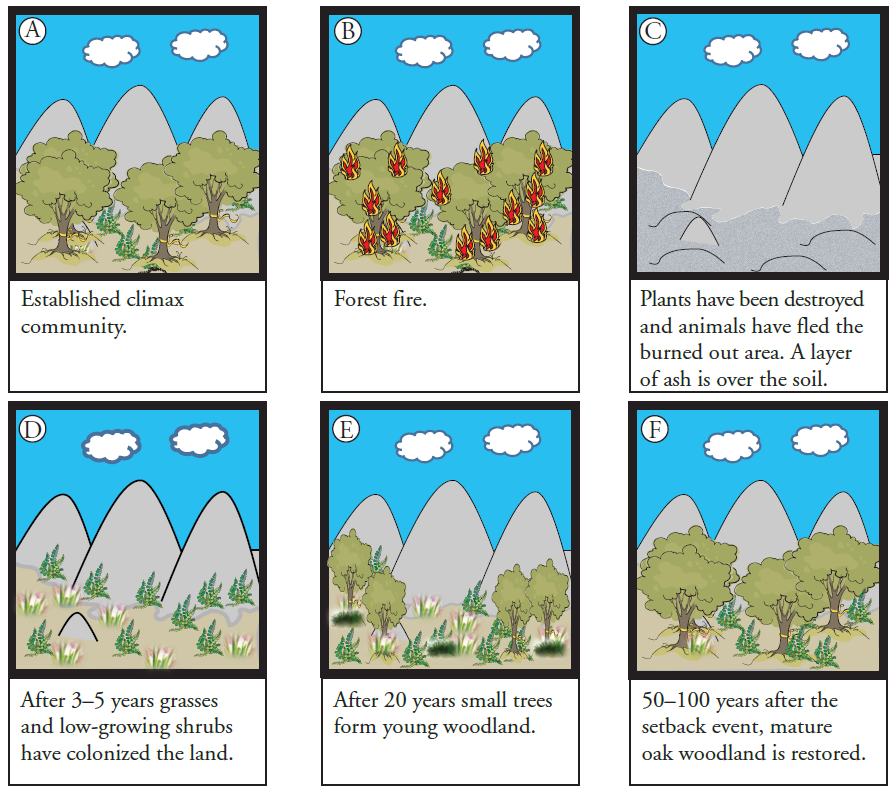
On May 18, 1980, Mount St. Helens in the state of Washington erupted with the force of a hydrogen bomb. The volcano had been dormant for over 120 years, but now 57 people were dead and forests and lakes were totally destroyed, including nearby Spirit Lake, which became a mud hole. The blast leveled trees in areas over 10 miles from the crater and ash deposits suffocated life on the mountain. However, within weeks, mammals that had taken shelter underground started to reappear in the area, and now, over thirty years later, many areas of the mountain are colonized with a large variety of plant and animal life. How does an area move from a sterile, barren wilderness to one full of life?
What does primary succession start with?
What does secondary succession start with?
The term pioneer species is used to describe the species that first colonize new habitats created by disturbance. Although the term is usually applied to plants, microbial and invertebrate pioneer species are also sometimes recognized. For terrestrial habitats two groups of pioneers can be distinguished: those that colonize sites lacking developed organic soil and initiate primary succession and those that initiate secondary succession, often via recruitment from species that are transported from far away.
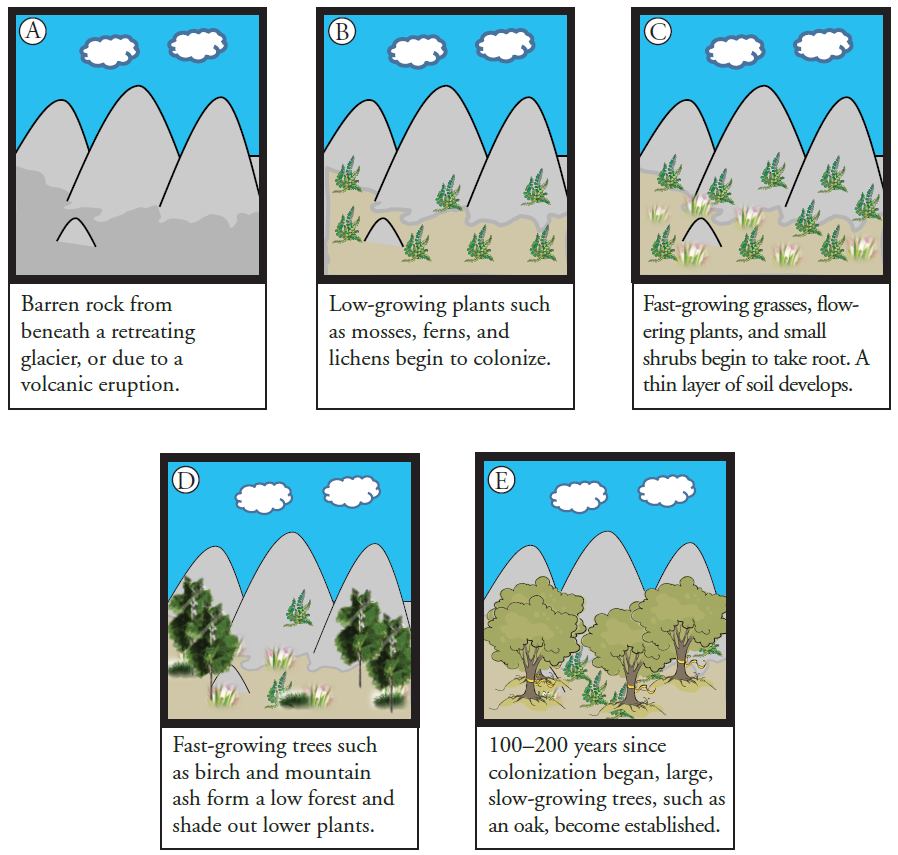
Primary succession begins in barren areas, such as on bare rock exposed by a retreating glacier. The first inhabitants are lichens or plants—those that can survive in such an environment. Over hundreds of years these “pioneer species” convert the rock into soil that can support simple plants such as grasses. These grasses further modify the soil, which is then colonized by other types of plants. Each successive stage modifies the habitat by altering the amount of shade and the composition of the soil. The final stage of succession is a climax community, which is a very stable stage that can endure for hundreds of years.
Describe a pioneer species.
A keystone in an arch's crown secures the other stones in place. Keystone species
play the same role in many ecological communities by maintaining the structure
and integrity of the community.
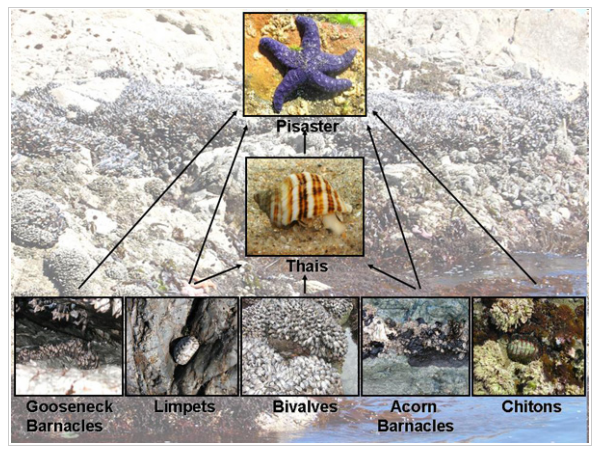
The term keystone species was first coined by Robert Paine (1966) after extensive studies
examining the interaction strengths of food webs in rocky intertidal ecosystems in the Pacific
Northwest. One of his study sites, located at Mukkaw Bay, contained a community consistently
dominated by the same species of mussels, barnacles, and the starfish, Pisaster ochraceus, which preys
upon the other species as a top predator (figure above 1).
Paine (1966) had observed that the diversity of organisms in rocky intertidal ecosystems declined as
the number of predators in those ecosystems decreased. He hypothesized that some of these
consumers might be playing a greater role than others in controlling the numbers of species
coexisting in these communities. He tested his hypothesis in an experiment that involved selecting
a "typical" piece of shoreline at Mukkaw Bay, about 8 meters long by 2 meters wide, that was kept
free of starfish. This area was compared to an adjacent, undisturbed control area of equal size.
Paine observed dramatic changes in the temperate intertidal ecosystem after Pisaster was artificially
removed compared with the control area that remained unchanged in its species number and
distribution. The intertidal area where Pisaster had been removed was characterized by many
changes. Remaining members of the ecosystem's food web immediately began to compete with
each other to occupy limited space and resources. Within three months of the Pisaster removal, the
barnacle, Balanus glandula, occupied 60 to 80% of the available space within the study area. Nine
months later, Blanus glandula had been replaced by rapidly growing populations of another barnacle
Mitella and the mussel Mytilus. This phenomenon continued until fewer and fewer species occupied the
area and it was dominated by Mytilus and a few adult Mitella species. Eventually, the succession of
species wiped out populations of benthic algae. This caused some species, such as the limpet, to
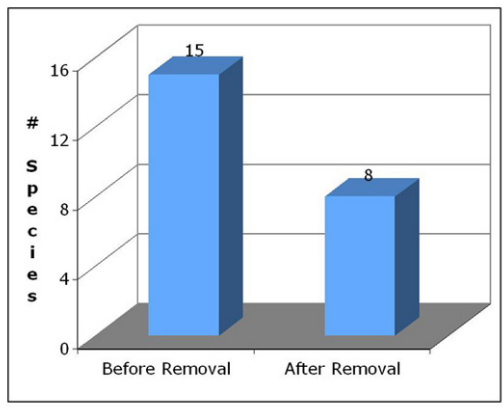
emigrate from the ecosystem because of a lack of food and/or space. Within a year of the starfish's
removal, species diversity significantly decreased in the study area from fifteen to eight species.
In his seminal paper that followed this work, Paine (1969) derived the term keystone species to
describe the starfish in these intertidal ecosystems. Of these species, he commented: "The species
composition and physical appearance were greatly modified by the activities of a single native
species high in the food web. These individual populations are the keystone of the community's
structure, and the integrity of the community and its unaltered persistence through time."
Paine went on to describe the criteria for a keystone species. A keystone species exerts top‐down
influence on lower trophic levels and prevents species at lower trophic levels from monopolizing
critical resources, such as competition for space or key producer food sources. This paper
represented a watershed in the description of ecological relationships between species. In the
twenty years that followed its publication, it was cited in over ninety publications. Additionally, the
original paper describing the intertidal areas was cited in over 850 papers during the same time
period (Mills et al. 1993).
Describe the importance of a keystone species.
We define an indicator in biology as an organism that the presence, or lack thereof, provides a clear signal about the environmental conditions. Depending on the organism, its appearance can signal both a healthy ecosystem or an unhealthy one. These indicators can reveal information about many factors in an environment, including pollution levels, salinity, temperature, and nutrient or food availability.
Indicator species, —often a microorganism or a plant—that serves as a measure of the environmental conditions that exist in a given locale. For example, greasewood indicates saline soil; mosses often indicate acid soil. Tubifex worms indicate oxygen-poor and stagnant water unfit to drink. The presence of certain species of plants suggests how well other species might grow in the same place.
Describe the role of an indicator species.
As you select organisms to colonize your island, fill out the table in order
Run through the Secondary Succession simulation quickly.
Return to the main menu and complete the Quiz. Enter your score here.
What are the first organisms that appear in an ecological community?
What is a stable ecological community that has reached maturity?
Take a picture of primary succession on campus
Take a picture of secondary succession on campus