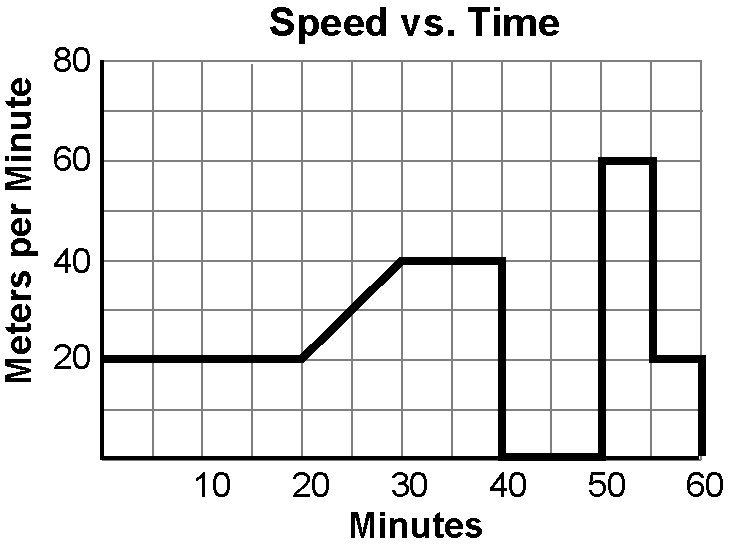
For the following graph, find the following: velocity
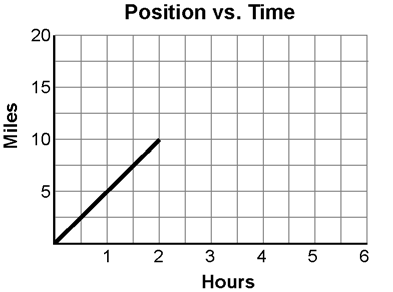
For the following graph, find the following: velocity
Speed is...
One possible unit of speed is
When you look at the speedometer in a moving car, you can see the car's
Acceleration is defined as the CHANGE in
Suppose you are in a car that is going around a curve. The speedometer reads a constant 30 miles per hour. Which of the following is NOT true?
A cyclist travels 13 meters in the 1st second of travel, 13 meters again during the 2nd second of travel, and 13 meters again during the 3rd second. Its acceleration is
Suppose an object is in free fall. Each second the object falls
A ball tossed vertically upward rises, reaches its highest point, and then falls back to its starting point. During this time the acceleration of the ball is always
As an object falls freely in a vacuum, its
In the absence of air resistance, objects fall at constant
A ball is thrown upwards and caught when it comes back down. In the absence of air resistance, the speed of the ball when caught would be
If you drop a feather and a coin at the same time in a tube filled with air, which will reach the bottom of the tube first?
If you drop a feather and a coin at the same time in a vacuum, which will reach the bottom of the tube first?
Consider drops of water leaking from a water faucet. As the drops fall they
The hang time (time one's feet are off the ground in a jump) for most athletes is
When a basketball player jumps to make a shot, once the feet are off the floor, the jumper's acceleration
When something falls to the ground, it accelerates. This acceleration is called the acceleration due to gravity and is symbolized by the letter g. What is the value of g on Earth's surface?
If a freely falling object were somehow equipped with a speedometer, its speed reading would increase each second by
Acceleration is defined as
A jet on an aircraft carrier can be launched from 0.00 to 50.00 m/s in 2.00 seconds. What is the acceleration of the jet?
A peachfalls from a tree and 20 seconds later hits the ground. How fast is the peach falling when it hits the ground?
A crate falls from an airplane flying horizontally at an altitude of 1810m. Neglecting air drag, how long will the crate take to strike the ground?
If a projectile fired beneath the water, straight up, breaks through the surface at a speed of 14.0 m/s, to what height above the water will it ascend?
A caterpillar crawling up a leaf slows from 0.75 cm/s to 0.50 cm/s at a rate of -0.05 cm/s². How long does it take the caterpillar to make the change?
Perhaps sometime in the future, NASA will develop a program to land a human being on Mars. If you were the first Mars explorer and discovered that when you dropped a hammer it took 0.68 s to fall 0.90 m to the ground, what would you calculate for the gravitational acceleration on Mars?
EXTRA CREDIT: In 1945, the Enola Gay, a B-29 bomber, dropped the atomic bomb from a height of 9450. m over Hiroshima, Japan. If the plane carrying the bomb were traveling with a horizontal velocity of 67.0 m/s, how far horizontally would the bomb have traveled between the point of release and the point where it exploded 513 m above the ground? (To avoid being above the bomb when it exploded, the Enola Gay turned sharply away after the bomb’s release.)
The Kentucky Derby, the first leg of horse racing’s Triple Crown, was won on May 5, 2007 by Street Sense with a time of 120.17s. If the race covers 2011.25m, what was Street Sense’s average speed in m/s?
For the following graph, find the following: velocity
For the following graph, find the following: distance travelled
For the following graph, find the following: time
For the following graph, find the following: initial velocity
For the following graph, find the following: final velocity
For the following graph, find the following: distance travelled
For the following graph, find the following: maximum velocity
For the following graph, find the following: minimum velocity
For the following graph, find the following: time