Preskoči na glavni sadržaj
Prijava
Sign up for FREE
arrow_back
Biblioteka

Chapter 5 Test Physics--Projectile Motion

star
star
star
star
star
Posljednje ažuriranje almost 4 years ago
36
2
2
2
2
2
2
2
2
2
2
2
2
2
2
2
2
2
2
2
2
2
5
5
5
5
5
5
5
5
5
5
5
5
5
5
8
Pitanje 1
1.

A vector is a quantity that has

Pitanje 2
2.

Which of the following would NOT be considered a projectile?

Pitanje 3
3.

The horizontal component of a projectile's velocity is independent of

Pitanje 4
4.

In the absence of air friction, the vertical component of a projectile's velocity doesn't change as the projectile moves.

Pitanje 5
5.

In the absence of air friction, the horizontal component of a projectile's velocity doesn't change as the projectile moves.

Pitanje 6
6.

A ball thrown in the air will never go as far as physics ideally would predict because

Pitanje 7
7.

A ball is thrown into the air at some angle. At the very top of the ball's path, its velocity is

Pitanje 8
8.

At the instant a ball is thrown horizontally with a large force, an identical ball is dropped from the same height. Which ball hits the ground first?

Pitanje 9
9.

In the absence of air resistance, the angle at which a thrown ball will go the farthest is

Pitanje 10
10.

At what part of a path does a projectile have minimum speed?

Pitanje 11
11.

A cannonball is launched from the ground at an angle of 40 degrees above the horizontal and a speed of 40 m/s. Ideally (no air resistance) the ball will land on the ground with a speed of

Pitanje 12
12.

A projectile launched horizontally hits the ground in 1.1 seconds. If it had been launched with a much higher speed in the same direction, it would have hit the ground (neglecting Earth's curvature and air resistance) in

Pitanje 13
13.

A projectile is fired horizontally in a vacuum. The projectile maintains its horizontal component of speed because it

Pitanje 14
14.

An object is dropped and falls freely to the ground with an acceleration of g. If it is thrown upward at an angle instead, its acceleration would be

Pitanje 15
15.

After a rock that is thrown straight up reaches the top of its path and is starting to fall back down, its acceleration is (neglecting air resistance)

Pitanje 16
16.

A soccerball at some angle into the air. In the first second it moves 20 meters horizontally. Assuming it doesn't hit the ground and air resistance is negligible, how far does it move horizontally in the next second?

Pitanje 17
17.

An airplane flying into a head wind loses ground speed, and an airplane flying with the wind gains ground speed. If an airplane flies at right angles to the wind, then ground speed is

Pitanje 18
18.

A ball is hurled into the air at an angle of 20 degrees above the horizontal and lands on a target that is at the same level as that where the started. The will also land on the target if it is thrown at an angle of

Pitanje 19
19.

A cannonball is launched horizontally from a tower. If the cannon has a barrel velocity of 80.0 m/s, where will the cannonball be 1 second later? (Neglect air resistance.)

Pitanje 20
20.

In the absence of air resistance, at what other angle will a thrown ball go the same distance as one thrown at an angle of 40 degrees?

Pitanje 21
21.

A cannon with a barrel velocity of 110 m/s launches a cannonball horizontally from a tower. Neglecting air resistance, how far vertically will the cannonball have fallen after 2 seconds ?

Pitanje 22
22.

Alex throws a ball horizontally from the top of a building that is 45.0 m high. He hopes the ball will reach a swimming pool that is at the bottom of the building, 15.0 m horizontally from the edge the building. If the ball is to reach the pool, with what initial speed must throw it with?

Pitanje 23
23.

A ball is thrown horizontally from the top of a tall cliff. Neglecting air drag, what vertical distance has the ball fallen 5.00 seconds later?

Pitanje 24
24.

The Essex county sheriff is trying to determine the speed of a car that slid off a small bridge on a snowy New England night and landed in a snow pile 5.92 m below the level of the road. The tire tracks in the snow show that the car landed 10.17 m measured horizontally from the bridge. How fast was the car going when it left the road?

Pitanje 25
25.

A long jumper leaves the ground with an initial velocity of 12.888 m/s at an angle of 27.33-degrees above the horizontal. Determine the time of flight

Pitanje 26
26.

A long jumper leaves the ground with an initial velocity of 12.888 m/s at an angle of 27.33-degrees above the horizontal.

the horizontal distance

Pitanje 27
27.

A long jumper leaves the ground with an initial velocity of 12.888 m/s at an angle of 27.33-degrees above the horizontal.

Find the peak height of the long-jumper.

Pitanje 28
28.

While skiing, Ellen encounters an unexpected icy bump, which she leaves horizontally at 12.37 m/s. How far out, horizontally, from her starting point will Ellen land if she drops a distance of 8.14 m in the fall?

Pitanje 29
29.

A pool ball leaves a 0.61-meter high table with an initial horizontal velocity of 2.6 m/s. Predict the time required for the pool ball to fall to the ground.

Pitanje 30
30.

A pool ball leaves a 0.61-meter high table with an initial horizontal velocity of 2.6 m/s. Predict the horizontal distance between the table's edge and the ball's landing location.

Pitanje 31
31.

A ship fires its guns with a speed of 426.5 m/s at an angle of 40.35º with the horizontal. Find the range.

Pitanje 32
32.

A ship fires its guns with a speed of 426.5 m/s at an angle of 40.35º with the horizontal. Find the maximum altitude.

Pitanje 33
33.

A person kicks a rock off a cliff horizontally with a speed of 26.5 m/s. It takes 8.79 seconds to hit the ground, find:

a. height of the cliff

Pitanje 34
34.

A person kicks a rock off a cliff horizontally with a speed of 26.5 m/s. It takes 8.79 seconds to hit the ground, find:

b. final vertical velocity

Pitanje 35
35.

A person kicks a rock off a cliff horizontally with a speed of 26.5 m/s. It takes 8.79 seconds to hit the ground, find:

c. range

Pitanje 36
36.

Essay--Answer the essay question in the space provided. Use the following FCA’s:

1. Answer should contain at least two complete sentences and a picture.

2. Use science terminology in chapter 5.

3. Site specific examples from your notes, real-world, or book in your explanation.

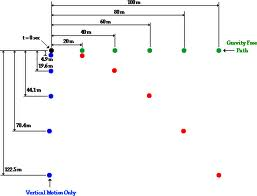
Figure below shows two balls released simultaneously from a mechanism that allows one ball to drop freely while the other is projected horizontally. Explain why the balls fall farther and farther each successive time interval. Explain why the projected ball has the same vertical location as the falling ball.