Log in
Sign up for FREE
arrow_back
Library

LNM1 Ch 3 Study Guide

star
star
star
star
star
Last updated almost 4 years ago
38 questions
1
1
1
1
1
1
1
1
1
1
1
1
1
1
1
1
1
1
1
1
1
1
1
1
1
1
1
1
1
1
1
1
1
1
1
1
1
1
Question 1
1.

Question 2
2.

Question 3
3.

Question 4
4.

Question 5
5.

Question 6
6.

What is Terence’s full name?

Question 7
7.

Question 8
8.

Question 9
9.

Question 10
10.

Question 11
11.

Question 12
12.

Question 13
13.

Question 14
14.

Question 15
15.
Draggable itemarrow_right_altCorresponding Item
arrow_right_alt
arrow_right_alt
arrow_right_alt
arrow_right_alt
arrow_right_alt
arrow_right_alt
arrow_right_alt
arrow_right_alt
arrow_right_alt
arrow_right_alt
Question 16
16.

Question 17
17.

Question 18
18.

Question 19
19.

Question 20
20.

Question 21
21.

Question 22
22.

Question 23
23.

Question 24
24.

Question 25
25.

Question 26
26.

Question 27
27.

Question 28
28.

Question 29
29.

Question 30
30.

Question 31
31.

Question 32
32.

Question 33
33.

Question 34
34.

Question 35
35.

Question 36
36.

Question 37
37.

Question 38
38.

Homō sum: hūmānī nihil ā mē aliēnum putō means “I am a human being: I think that nothing human is foreign to me.”
True
False
The quotation at the beginning of Chapter 3 commences with the words Homō sum. Which of the following completes the quote correctly?
nōn hūmānum aliēnum ā mē putās
hūmānī nihil ā mē aliēnum putō
hūmānī nunc ā mē aliēnum putat
nōlī hūmānum aliēnum ā mē putāre
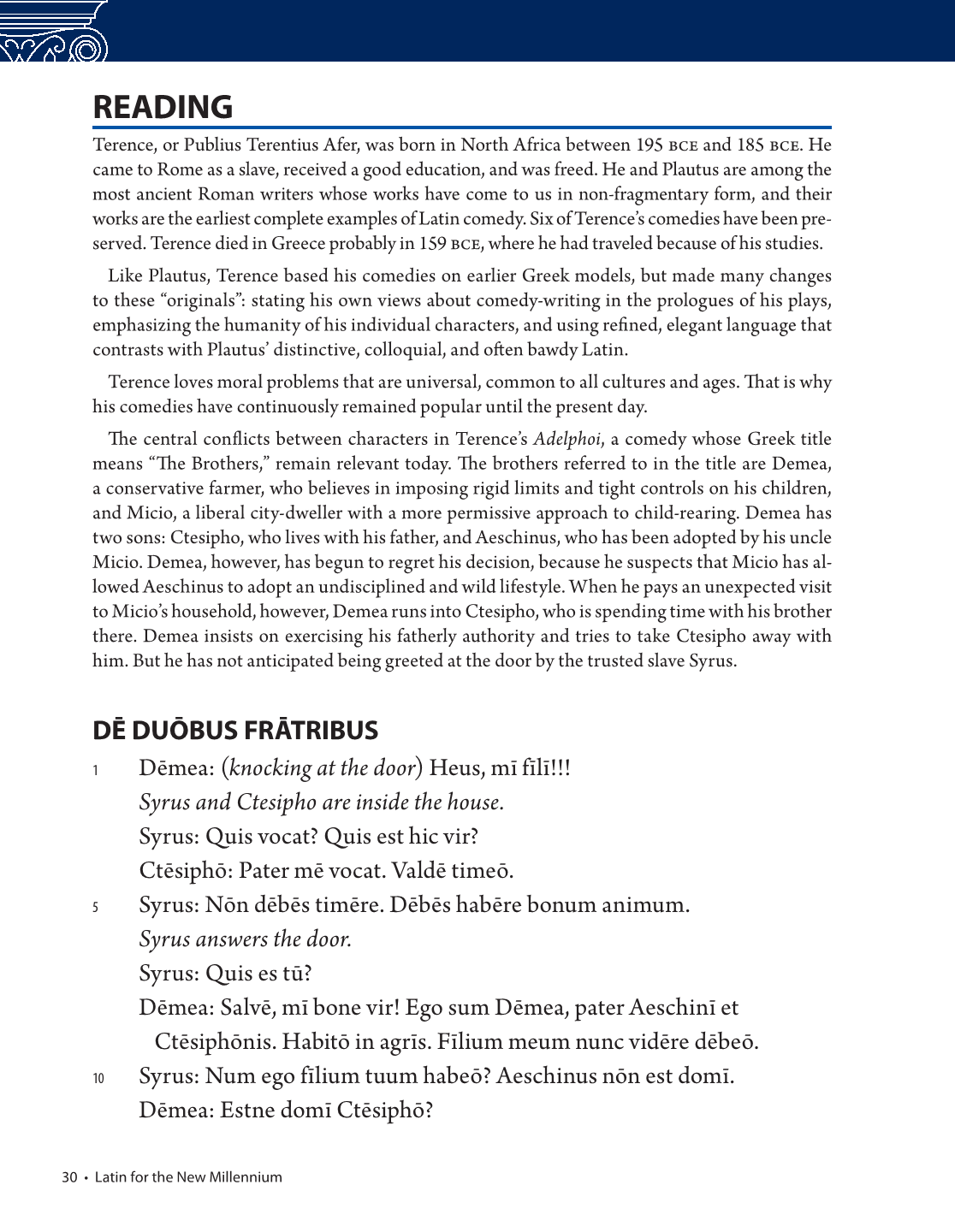
Who is the author of the quotation beginning Homō sum?
Demea
Terence
Sosicles
Plautus
Terence was born in Spain.
True
False
Terence wrote a play entitled Adelphoi, “The Brothers.”
True
False
The author of the Adelphoi wrote
philosophical essays
epics
histories
comedies
The play entitled Adelphoi has a Greek name meaning
sons
going to Delphi
inhabitants of Delphi
brothers
According to the story, who lives in agrīs?
Micio
Demea
Aeschinus
Syrus
The conflict in the Adelphi revolves around
the difficulties of city life
raising children
a generation gap
politics
According to Syrus, Ctesipho is visiting a friend who lives near a
hill
field
temple
river
The noun fīlius means “son.”
True
False
The verb timeō means “to hold.”
True
False
The preposition cum takes the ablative case.
True
False
in agrīs
with the son
casa agricolae
in the fields
Fīlium nōn videō.
on the road
animī poētārum
with friends
fīlius nautae
I do not love you.
cum amīcīs
the house of the farmer
Tē nōn amō.
I do not see (my) son.
cum fīliō
the son of a sailor
Quis es tū, amīce?
the souls of poets
in viā
Who are you, friend
Num, nautae, aquam timētis?
Do you not fear the water, sailor?
Sailors do not fear the water.
You do fear the water, sailor, don’t you?
Sailors, you do not fear the water, do you?
Virī in casā fīliōs agricolae vident.
The farmers see the sons of the men in the house.
The men in the house see the sons of the farmer.
The sons see the men of the farmer in the house.
The sons of the man in the house see the farmer.
What is the meaning of deinde?
afterwards
for a long time
then
strongly
Which of the following is NOT a meaning of animus?
mind
spirit
soul
friend
A domestic servant
babysits
works in the house
drives cars
does the gardening
Puerile behavior is
admirable
intelligent
loving
childish
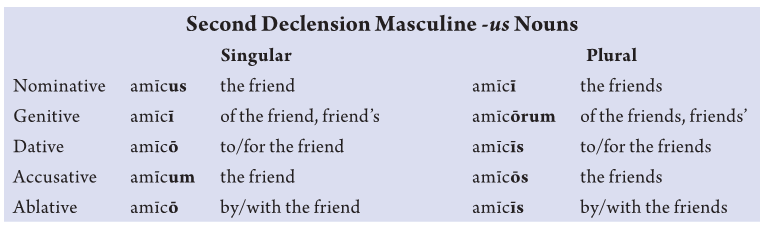
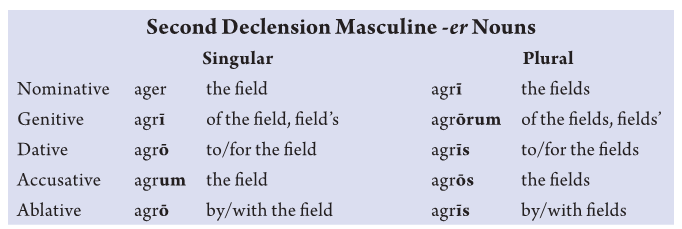
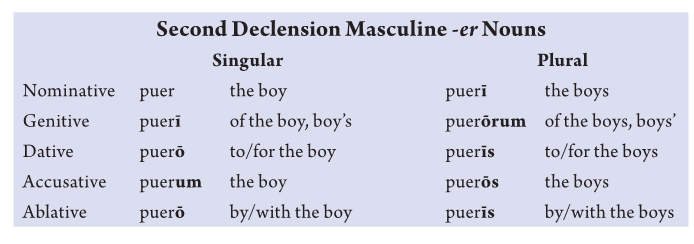
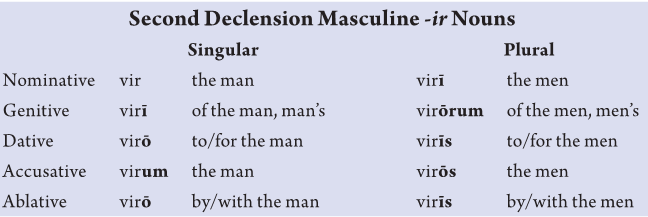
Second declension masculine nouns have nominatives that end in either –us or –r.
True
False
The genitive singular of ager is agrī.
True
False
Which two cases have the same singular ending in the second declension?
nominative and ablative
nominative and genitive
genitive and dative
dative and ablative
Which two cases have the same plural endings in both the first and second declension?
nominative and genitive
nominative and ablative
dative and ablative
genitive and dative
Which two forms in the second declension are the same?
nominative singular and accusative singular
nominative plural and accusative plural
genitive singular and nominative plural
genitive singular and dative singular
Which word is used to translate a noun in the genitive case?
by
to
of
with
Which case is used to show possession?
genitive
ablative
accusative
nominative
How are you, Marcus, my son?
Mārce, meī fīliī
Mārcus, meus fīlius
Mārce, mī fīlī
Mārcus, mee fīle
The son of (my) friend is a poet.
Amīcī poētae est fīliī.
Fīlius amīcī est poēta.
Amīcī fīlius est poētārum.
Fīliī amīcī est poētam.
Which of the following is NOT a vocative?
Tullia
agricolae
puer
Servius
A prepositional phrase consists of a preposition followed by a noun.
True
False
The preposition cum is always followed by the _____ case.
accusative
ablative
nominative
dative
A sailor works _____.
in aquā
in casam
in terrae
in viā
You should not fear the man in the river.
Virum in rīvō nōn timēre dēbēs.
In rīvō virī nōn. timeō dēbētis.
In rīvō virōs nōn timētis.
Vir in rīvum nōn timeō.
Which of the following would NOT be found in a classroom?
sellae
creta
scirpiculum
rīvī
What is a magistra?
teacher
tissue
chalk
board marker
How would a teacher tell his students to sit down?
Surgātis
Scrībātis
Cōnsīdātis
Veniātis