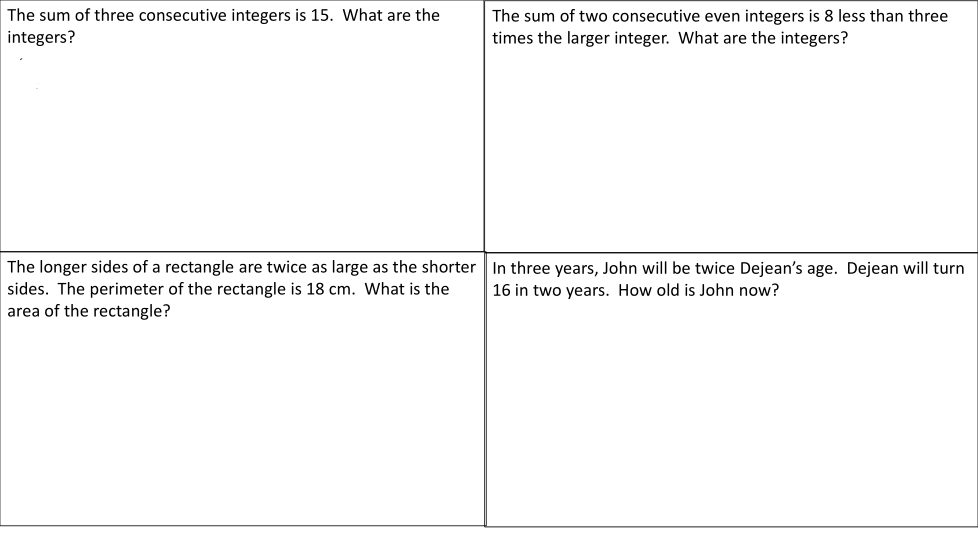
What is the largest integer?
What is the smallest integer?
What is the area, in
How old is John now? Write just the number.
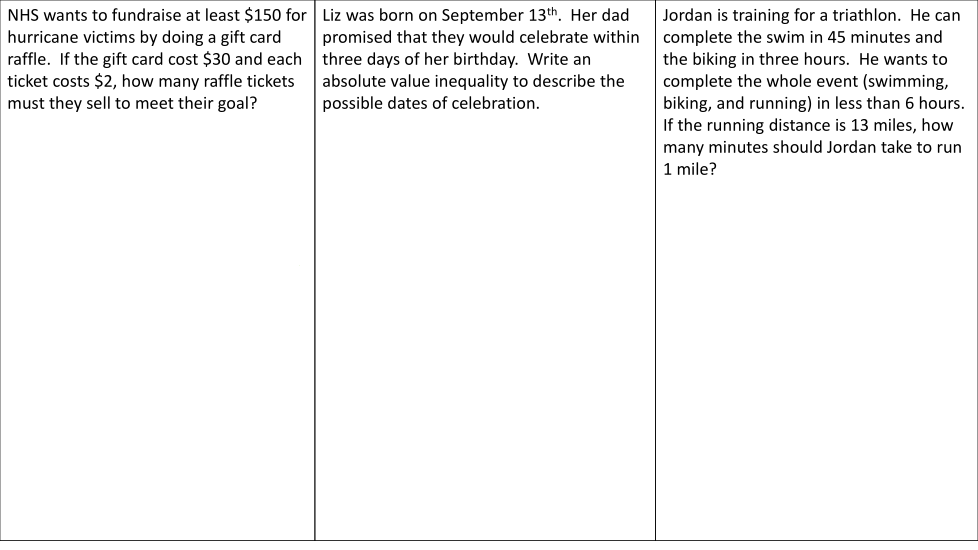
What is the minimum number of tickets?
Write the inequality. Use |x-#|<# format, no spaces.
What is the maximum time, to the nearest minute, that Jordan can take to meet his goal? Your answer should be an integer.
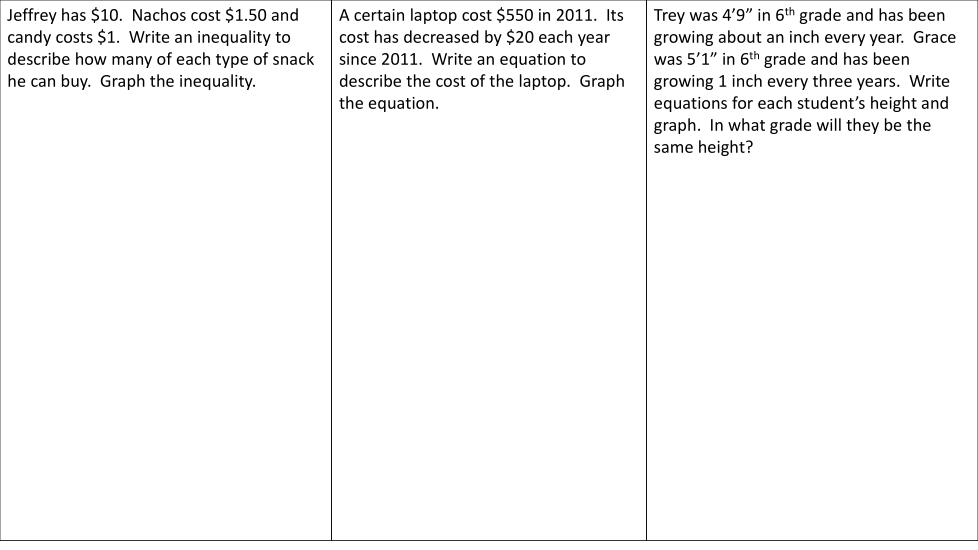
If c represents the cost of the laptop, and t describes years since 2011, which equation represents the cost of the laptop?
In what grade will they be the same height? Enter your answer as a number, no spaces.
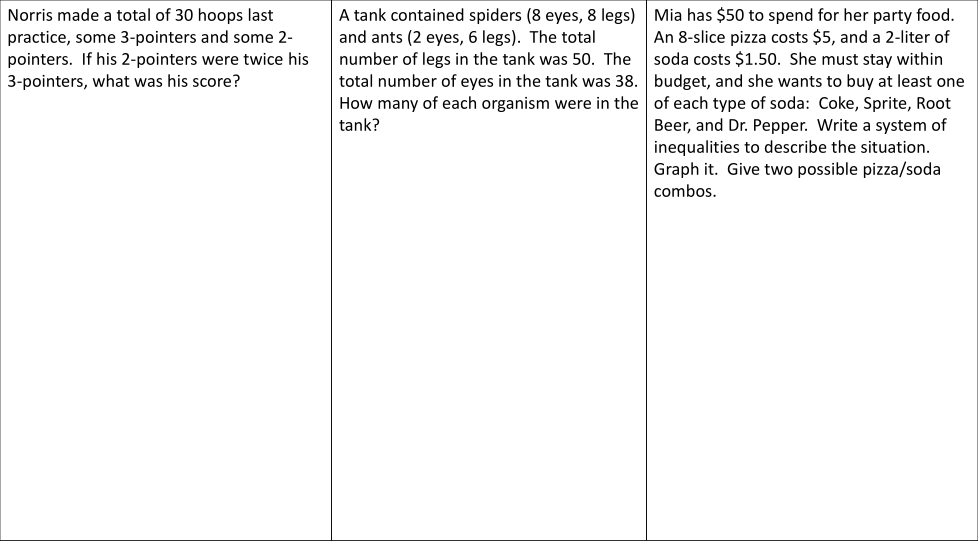
What was his score? Enter a number, no spaces.
How many organisms were in the tank? Enter your answer as (s, a), where s is the number of spiders and a is the number of ants.
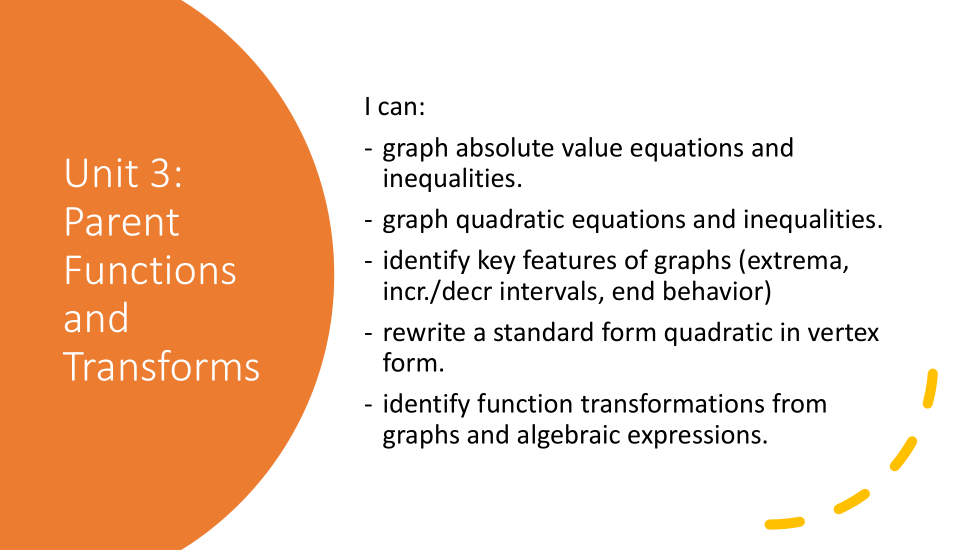
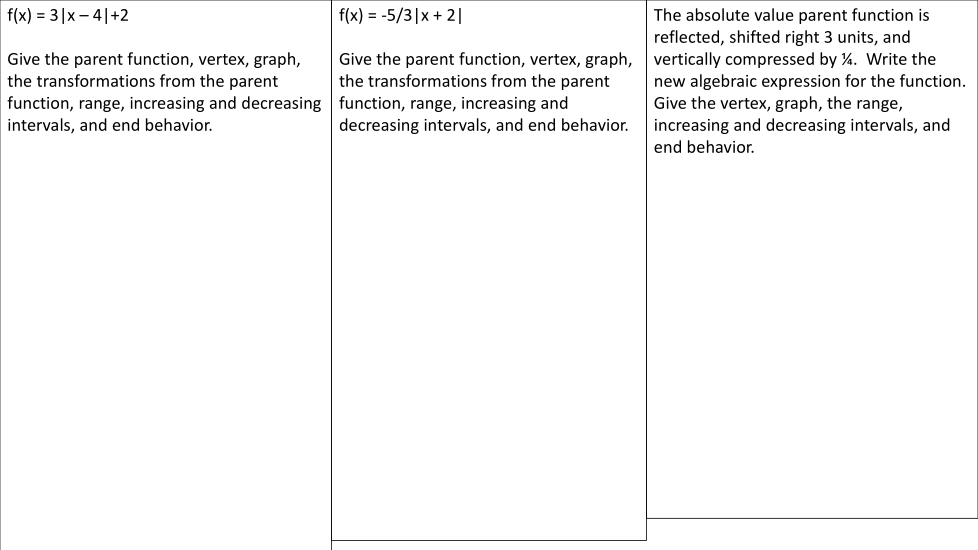
Give the vertex. Use (x, y) format.
f(x) = 3(x-4)2+2
Give the vertex. Use (x, y) format.
f(x) = -5/3(x+2)2
Give the increasing interval. Use (x1, x2) format with exactly one space after the comma.
f(x) = -5/3(x+2)2
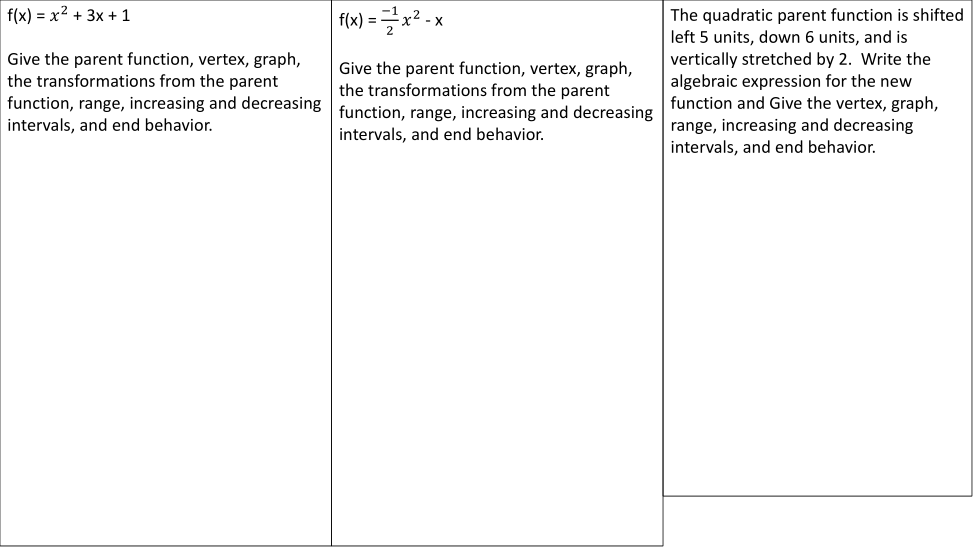
Give the vertex. Use (x, y) format, with exactly one space after the comma. Put your answers in fraction form.
Give the range of the function. Use interval notation, one space after the comma.
What is the vertex? Use (x, y) format, with exactly one space after the comma.
Write the new function in vertex form. Use y=a(x-h)2+k format, no spaces.
Find the inverse of
Use y=... format, no spaces.
Find the inverse of
Use y=... format, no spaces.
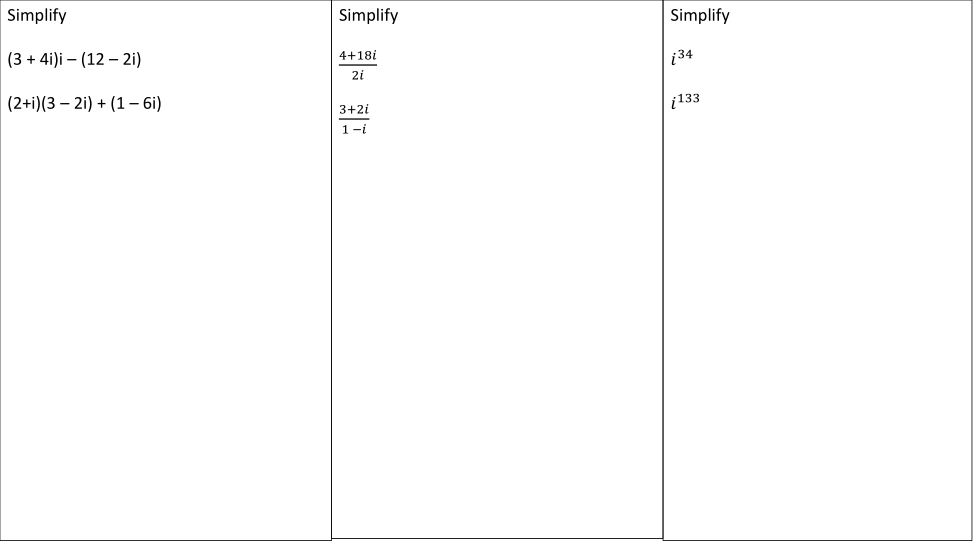
Simplify. Use a+bi format, where a and b are real numbers. No spaces.
Simplify. Use a+bi format, where a and b are real numbers. No spaces.
*MEMORIZE*
| Draggable item | arrow_right_alt | Corresponding Item |
|---|---|---|
discriminant is positive, but not a perfect square | arrow_right_alt | the quadratic has two real, rational solutions |
the discrimant is zero | arrow_right_alt | the quadratic has two real, irrational solutions |
the discriminant is negative | arrow_right_alt | the quadratic has one unique solution with multiplicity two |
discriminant is a positive perfect square | arrow_right_alt | the quadratic has two nonreal solutions |
*MEMORIZE
This won't turn green til all of them are right.
odd degree positive leading coefficient
-x2 + 22x4
x23 - x2
x2 + 5
even degree, positive leading coefficient
even degree negative leading coefficient
odd degree negative leading coefficient
5 - x
Select the combinations which are possible.
Select the transformations.
f(x) = 3(x-4)2+2
Give the decreasing interval. Use (x1, x2) format with exactly one space after the comma.
f(x) = -5/3(x+2)2
Give the new function. Use the square root function. Use y=... format, no spaces.
Select the transformations from the parent function.
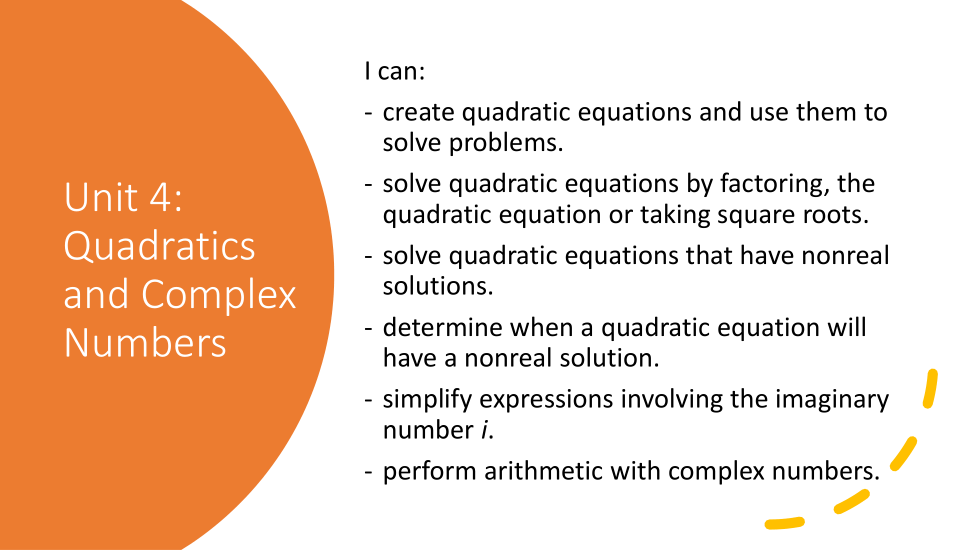
Find the discriminant.
Solve by factoring. Use p={#, #}, list the smallest value first.
Discriminant? Enter a number, no spaces.
Solutions? Use h={#, #} format, with exactly one space after the comma. List the smaller number first.
Solutions? Use r={#, #} format, with exactly one space after the comma. List the smaller number first.
Solutions? Use b={#, #} format, with exactly one space after the comma. List the smaller number first.
Solutions? Use c={#, #} format, with exactly one space after the comma. List the smaller number first.
Solutions? Use s={#, #} format, with exactly one space after the comma. List the smaller number first.
Simplify.
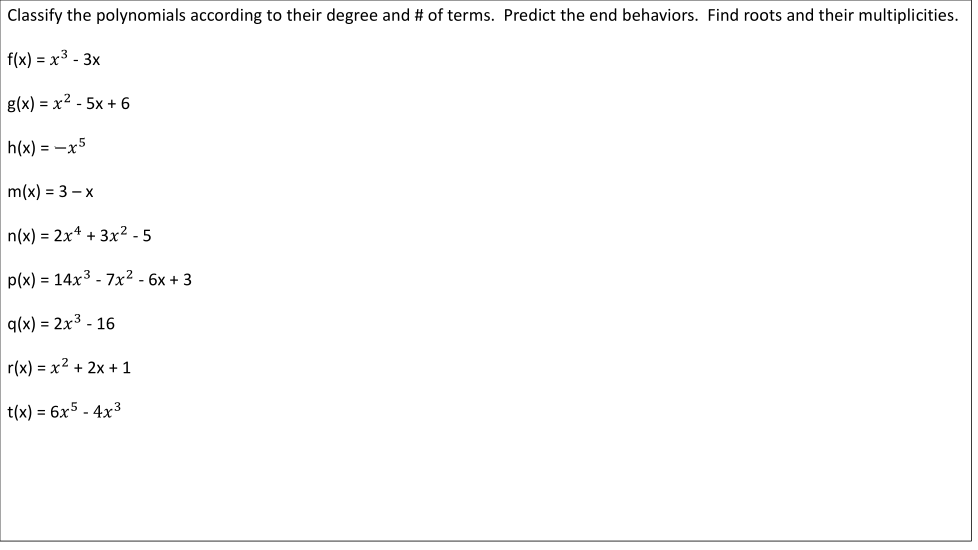
Roots? Use x={#, ...} format, with exactly one space after each comma. List real roots first in increasing order, then imaginary roots with the negative one listed first.
Roots? Use x={#, ...} format, with exactly one space after each comma. List real roots first in increasing order, then imaginary roots with the negative one listed first.
Roots? Use x={#, ...} format, with exactly one space after each comma.List real roots first in increasing order, then imaginary roots with the negative one listed first.
Roots? Use x={#, ...} format, with exactly one space after each comma.List real roots first in increasing order, then imaginary roots with the negative one listed first.
Roots? Use x={#, ...} format, with exactly one space after each comma.List real roots first in increasing order, then imaginary roots with the negative one listed first.
Roots? Use x={#, ...} format, with exactly one space after each comma.List real roots first in increasing order, then imaginary roots with the negative one listed first.
Roots? Use x={#, ...} format, with exactly one space after each comma.List real roots first in increasing order, then imaginary roots with the negative one listed first.
The graph of r(x) _______ at its root.
Roots? Use x={#, ...} format, with exactly one space after each comma.List real roots first in increasing order, then imaginary roots with the negative one listed first.
Which root of t(x) has a multiplicity of 3? Your answer should be a number, no spaces.