7.2.8
star
star
star
star
star
Last updated over 2 years ago
18 Nsɛmmisa
1
1
1
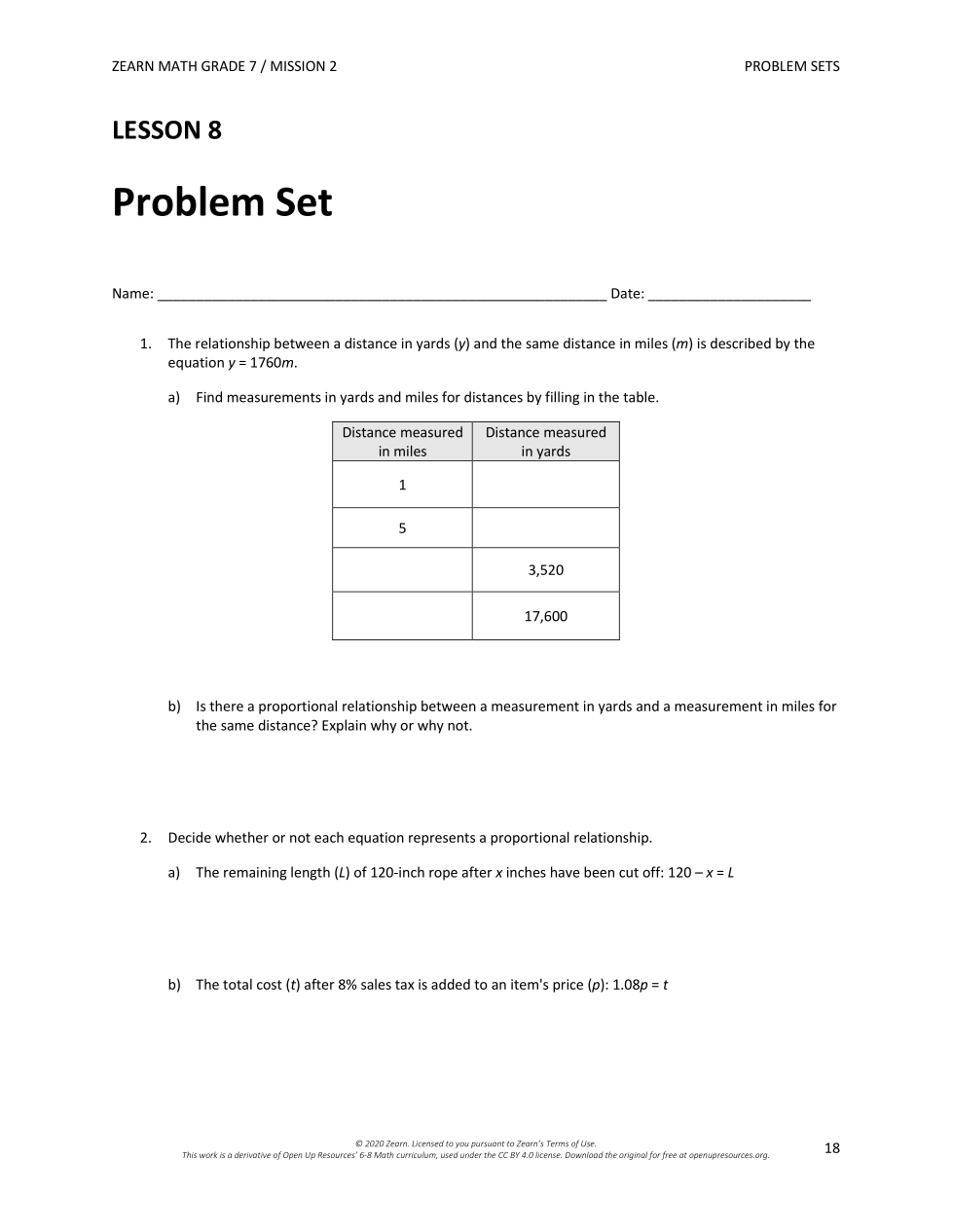
1a. Find the measurements in yards and miles for distances by filling in the table.
If you answered Yes above, type the constant of proportionality.
If you answered No, type N/A.
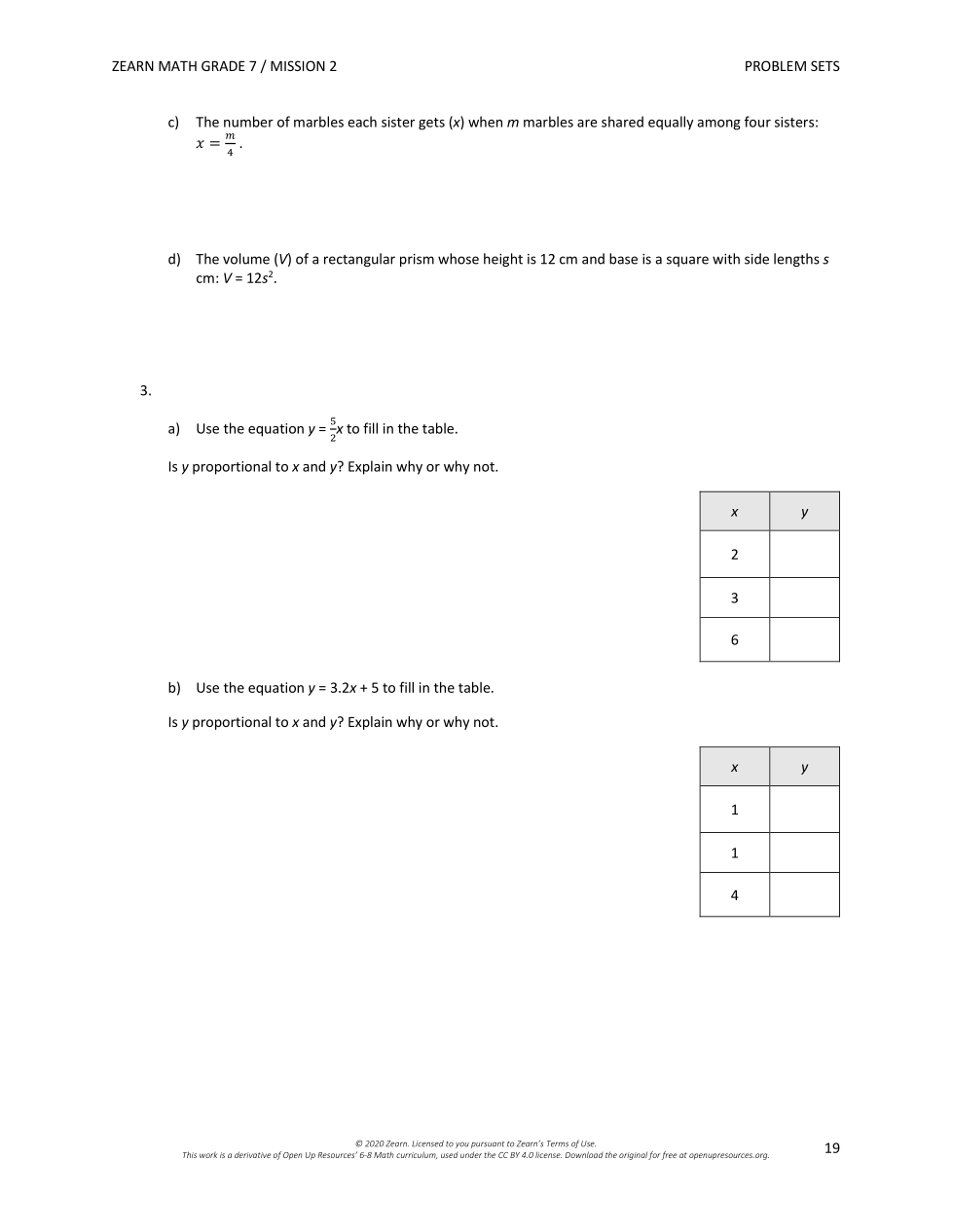
3a. Use the equation given to fill in the table.
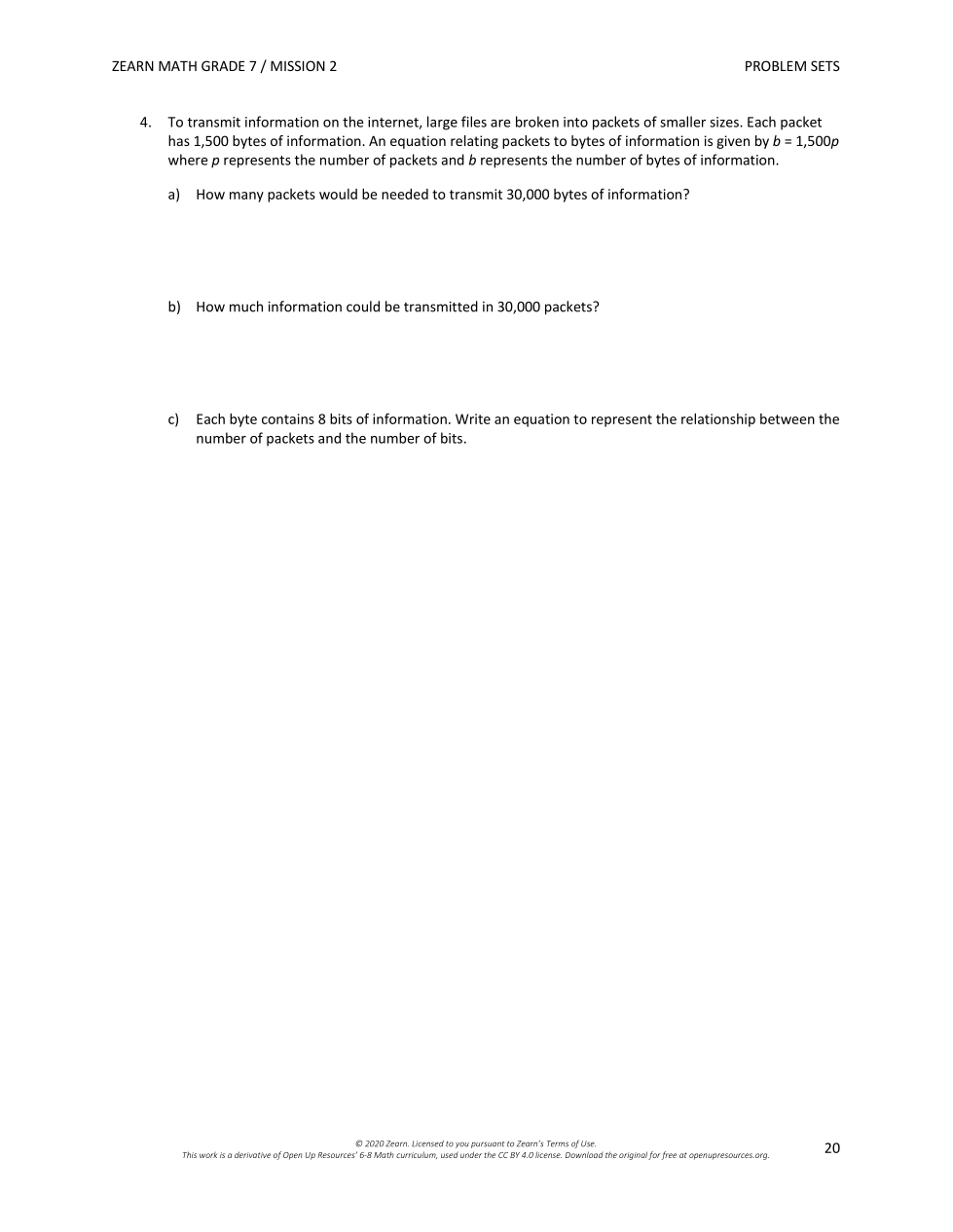
4a. How many packets would be needed to transmit 30,000 bytes of information?
4b. How much information could be transmitted in 30,000 packets?
4c. Each byte contains 8 bits of information. Write an equation to represent the relationship between the number of packets (p) and the number of bits (x).
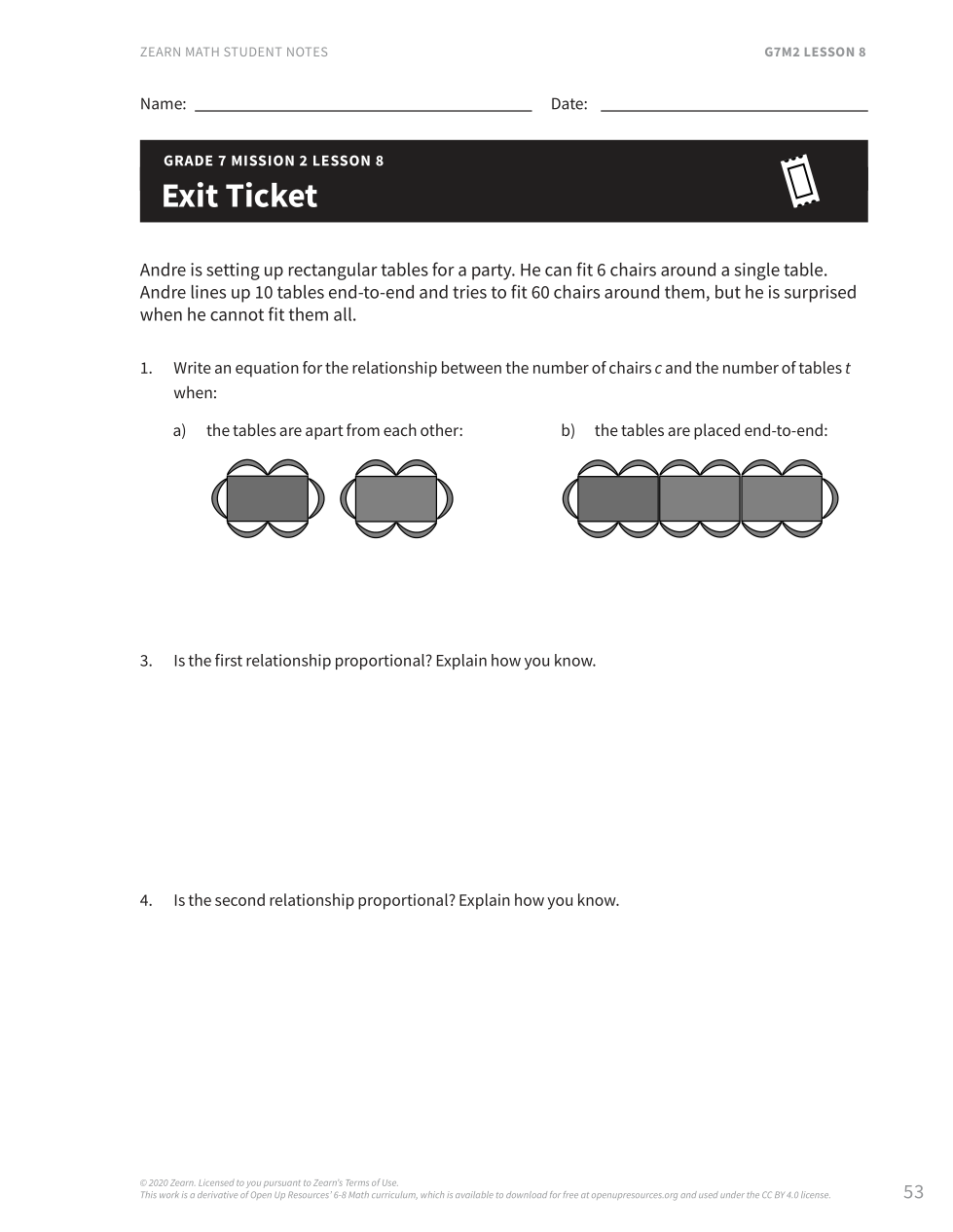
EXIT TICKET
1. Write an equation for the relationship between the number of chairs c and the number of tables t when:
a) The tables are apart from each other.
EXIT TICKET
1. Write an equation for the relationship between the number of chairs c and the number of tables t when:
b) The tables are placed end-to-end.
1b. Is there a proportional relationship between a mesaurement in yards and a measurement in miles for the same distance?
2. Decide whether or not each equation represents a proportional relationship.
a) The remaining length (L) of a 120-inch rope after x inches have been cut off: 120 - x = L
2. Decide whether or not each equation represents a proportional relationship.
b) The total cost (t) after 8% sales tax is added to an item's price (p): 1.08p = t
2. Decide whether or not each equation represents a proportional relationship.
c) The number of marbles each sister gets (x) when m marbles are shared equally among four sisters:
2. Decide whether or not each equation represents a proportional relationship.
d) The volume (V) of a rectangular prism whose height is 12 cm and base is a square with side lengths s cm:
3a. Is y proportional to x and x to y?
3b. Use the equation given to fill in the table.
3b. Is y proportional to x and x to y?
Is the first relationship proportional?
Explain how you know in the space provided.
Is the second relationship proportional?
Explain how you know in the space provided.