
One thousand
One million
One billion
One trillion
twenty-three thousand
256,000
(2.96 x 10⁷) + (1.0 x 10⁸)
Five hundred billion times thirty-five thousand
six thousand divided by 300 billion
one ten thousandth of three million
1200 watts = ____________ kW (kilowatts)
1200 kW = ____________ MW (megawatts)
500 km = ____________ meters
60 grams = ____________ milligrams
14,000 milliliters = ____________ liters
Gross primary production (GPP) is the total amount of carbon dioxide "fixed" by land plants per unit time through the photosynthetic reduction of CO2 into organic compounds. A substantial fraction of GPP supports plant autotrophic respiration (Ra), with the remainder allocated to the net primary production (NPP) of plant structural biomass in stems, leaves, and fruit, carbohydrates such as sugars and starch, and, to a much lesser extent, volatile organic compounds used in plant defense and signaling.
Terrestrial GPP, therefore, relates to NPP as follows:
NPP = GPP - Ra
Net Primary Productivity = Gross Primary Productivity - Energy used for respiration.
Production rates are usually expressed as grams of organic carbon per unit area per unit time.
A round pot measures 50 cm in diameter and in it 125 grams of lettuce grew in 95 days. Calculate the NPP of the lettuce in g/m2 per day.
A square flower box measures 22 cm on one side. After drying, 34 grams of flowers were grown in that flower box in 145 days. Calculate the NPP of the flowers in g/m2 per day.
The gross primary productivity of an ecosystem is 3.5 kgC/m2/year, and the energy needed by the producers for their own respiration is 3.0 kgC/m2/year. What is the net primary productivity of such an ecosystem? (include units in your answer)
The net annual primary productivity of a particular wetland ecosystem is found to be 2,000 kcal/m2. If respiration by the aquatic producers is 18,000 kcal/m2 per year, what is the gross annual primary productivity for this ecosystem, in kcal/m2 per year? (include units in your answer)
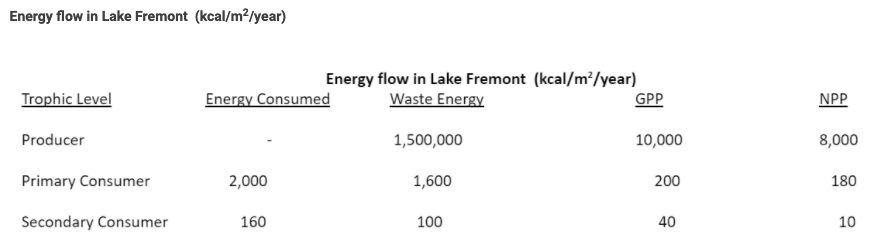
In the community described in the table above, which of the following represents the respiratory energy (kcal/m2/year) used by autotrophic organisms?