What could be the formula used to compute the value shown in cell B3?

What could be the formula used to compute the value shown in cell B3?
What could be the formula used to compute the value shown in cell B3?
What number will appear in cell B2 when the user presses Enter?
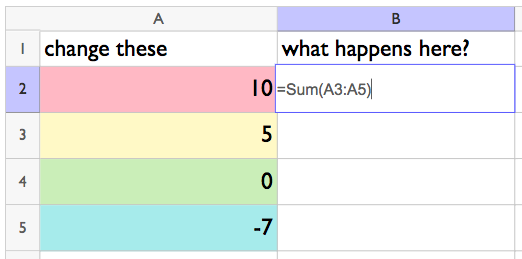
Select all the formulas that could be used to calculate the value in cell B4.

The formula in cell B2 is = Product(A2 : A5).

Describe a way to change the contents of column A so that the value in cell B2 becomes -70.
The dot plot displays the number of books read by students during the semester.

Which measure of center would you use given the shape of the distribution in the dot plot? Explain your reasoning.
The dot plot displays the number of books read by students during the semester.
Which measure of variability would you use? Explain your reasoning.
The dot plot displays the number of families living in different blocks of a town.

Which measure of center would you use, given the shape of the distribution in the dot plot? Explain your reasoning.
The dot plot displays the number of families living in different blocks of a town.
Which measure of variability would you use? Explain your reasoning.
This lesson is from Illustrative Mathematics. Algebra 1, Unit 1, Lesson 6. Internet. Available from https://curriculum.illustrativemathematics.org/HS/teachers/1/1/6/index.html ; accessed 26/July/2021.
IM Algebra 1, Geometry, Algebra 2 is © 2019 Illustrative Mathematics. Licensed under the Creative Commons Attribution 4.0 International License (CC BY 4.0).
The Illustrative Mathematics name and logo are not subject to the Creative Commons license and may not be used without the prior and express written consent of Illustrative Mathematics.
These materials include public domain images or openly licensed images that are copyrighted by their respective owners. Openly licensed images remain under the terms of their respective licenses. See the image attribution section for more information.