Twa kɔ nsɛm atitiriw so
Log in
Sign up for FREE
arrow_back
Laabri

Lesson 17 - Unit 6 - Algebra 1 - Illustrative Mathematics

star
star
star
star
star
Last updated over 3 years ago
19 Nsɛmmisa
1
F.BF.3
F.IF.7.a
1
F.BF.3
F.IF.7.a
1
F.BF.3
F.IF.7.a
1
F.BF.3
F.IF.7.a
Asemmisa {{asɛmmisaAhyɛnsode}}
1.

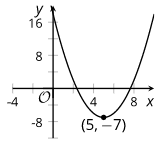
Here the graph of quadratic function f.

Andre uses the expression (x-5)^{2}+7 to define f.

Noah uses the expression (x-5)^{2}-7 to define f.

Do you agree with either of them? Explain your reasoning.

1
Asemmisa {{asɛmmisaAhyɛnsode}}
2.
1
Asemmisa {{asɛmmisaAhyɛnsode}}
3.
1
Asemmisa {{asɛmmisaAhyɛnsode}}
4.
Asemmisa {{asɛmmisaAhyɛnsode}}
5.

Which equation represents the graph of y=x^{2}+2x-3 moved 3 units to the left?

Asemmisa {{asɛmmisaAhyɛnsode}}
6.

Select all the equations with a graph whose vertex has both a positive x- and a positive y-coordinate.

1
Asemmisa {{asɛmmisaAhyɛnsode}}
7.
1
Asemmisa {{asɛmmisaAhyɛnsode}}
8.
1
Asemmisa {{asɛmmisaAhyɛnsode}}
9.
1
Asemmisa {{asɛmmisaAhyɛnsode}}
10.
1
Asemmisa {{asɛmmisaAhyɛnsode}}
11.
1
Asemmisa {{asɛmmisaAhyɛnsode}}
12.
Asemmisa {{asɛmmisaAhyɛnsode}}
13.

At 6:00 a.m., Lin began hiking. At noon, she had hiked 12 miles. At 4:00 p.m., Lin finished hiking with a total trip of 26 miles.

During which time interval was Lin hiking faster? Explain how you know.

1
Asemmisa {{asɛmmisaAhyɛnsode}}
14.
1
Asemmisa {{asɛmmisaAhyɛnsode}}
15.
1
Asemmisa {{asɛmmisaAhyɛnsode}}
16.
1
Asemmisa {{asɛmmisaAhyɛnsode}}
17.
1
Asemmisa {{asɛmmisaAhyɛnsode}}
18.
1
Asemmisa {{asɛmmisaAhyɛnsode}}
19.

This lesson is from Illustrative Mathematics. Algebra 1, Unit 6, Lesson 17. Internet. Available from https://curriculum.illustrativemathematics.org/HS/teachers/1/6/17/index.html ; accessed 26/July/2021.

IM Algebra 1, Geometry, Algebra 2 is © 2019 Illustrative Mathematics. Licensed under the Creative Commons Attribution 4.0 International License (CC BY 4.0).

The Illustrative Mathematics name and logo are not subject to the Creative Commons license and may not be used without the prior and express written consent of Illustrative Mathematics.

These materials include public domain images or openly licensed images that are copyrighted by their respective owners. Openly licensed images remain under the terms of their respective licenses. See the image attribution section for more information.