
1
Asemmisa {{asɛmmisaAhyɛnsode}}
1.
1
Asemmisa {{asɛmmisaAhyɛnsode}}
2.
1
Asemmisa {{asɛmmisaAhyɛnsode}}
3.
1
Asemmisa {{asɛmmisaAhyɛnsode}}
4.

Mai is solving the equation
Han looks at her work and disagrees. He says that only
The graph shows the number of square meters, A, covered by algae in a lake w weeks after it was first measured.
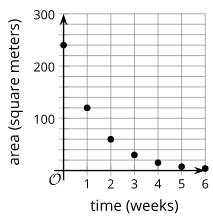
In a second lake, the number of square meters, B, covered by algae is defined by the equation
For which algae population is the area decreasing more rapidly? Explain how you know.
If the equation


This lesson is from Illustrative Mathematics. Algebra 1, Unit 7, Lesson 5. Internet. Available from https://curriculum.illustrativemathematics.org/HS/teachers/1/7/5/index.html ; accessed 26/July/2021.
IM Algebra 1, Geometry, Algebra 2 is © 2019 Illustrative Mathematics. Licensed under the Creative Commons Attribution 4.0 International License (CC BY 4.0).
The Illustrative Mathematics name and logo are not subject to the Creative Commons license and may not be used without the prior and express written consent of Illustrative Mathematics.
These materials include public domain images or openly licensed images that are copyrighted by their respective owners. Openly licensed images remain under the terms of their respective licenses. See the image attribution section for more information.