10/22 Population Growth and Resource Availability
star
star
star
star
star
Last updated about 1 year ago
24 Nsɛmmisa
1
1
1
1
1
1
1
1
1
1
1
1
1
1
1
1
1
1
1
1
1
1
1
1
Alaska contains over 127 million acres of untouched forest land. It is the largest state in the United States,
yet with a population of nearly 700,000 people, it has the same total population as Austin, Texas. New
Jersey is one of the smallest states and home to a population of nearly 9 million, but almost 1.8 million of
its 4.4 million total land acres are untouched natural woodland. What are the reasons for the ways populations
organize themselves, and what effect does this organization have on the environment?
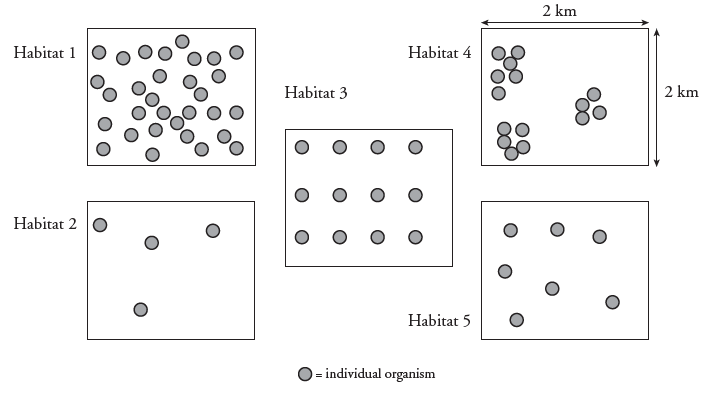
What do the dots in the diagrams represent?
What do the boxes in the diagrams represent?
Describe the arrangements of the dots in habitat 3
Describe the arrangements of the dots in habitat 4
Why would organisms have this arrangement?
Fill in the table below by counting the number of individuals in each habitat and
then calculate the area available per individual.
Which habitat shows a high population density?
Which habitat shows a low population density?
Compare and contrast the terms population density and population distribution.
Assuming the population size stays constant, propose at two factors that might cause a
population to shift from a low density habitat to a high density habitat?
Animals such as lions or wolves often show clumped distribution. Give a reason why this would
be advantageous for these animals. (more than 1)
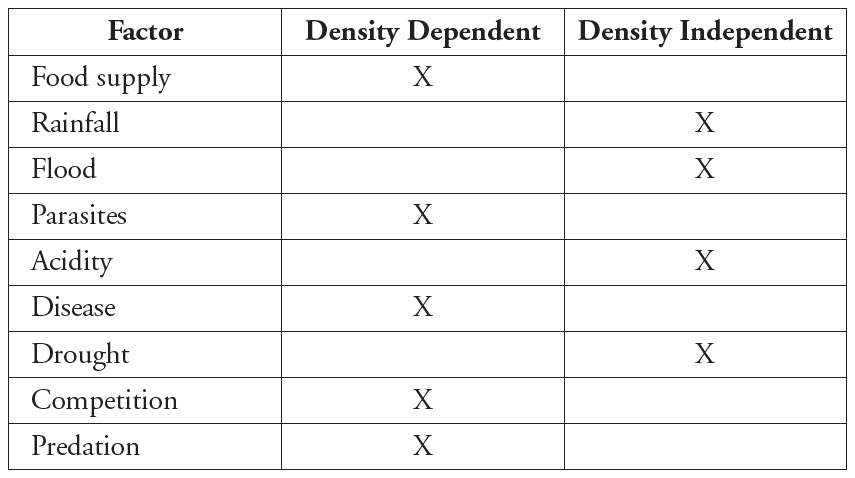
Which factors are dependent on the population density?
Northern pike (it’s a fish) feed on another fish, the yellow perch. An increase in the yellow perch population causes an increase in the northern pike population.
The BP oil spill in the gulf of Mexico has harmed many aquatic organisms that live in the gulf region.
A new strain of influenza (the flu) breaks out in Houston
A population of rabbits and a population of deer are not feeding off the same plants in the same habitat
Hurricane Katrina forced thousands of people to leave New Orleans
Due to humans putting increasing amount of greenhouse gases into the atmosphere and cutting down trees that would normally take up some of those gases, the Earth slowly gets warmer and changes climates around the globe. This effects the polar bear population.
Describe how the food supply would be affected by the population density.
Describe how the levels or spread of disease would be affected by population density.
What do all the density-independent factors have in common?
Density-dependent factors are
Density-independent factors are
Density-independent factors and density-dependent factors may be interrelated. For example, a
lack of rainfall that causes a drought will impact the food supply in a habitat. Propose another
pairing of a density-independent factor and density-dependent factor that might occur.