10/21 Carrying Capacity
star
star
star
star
star
Last updated about 1 year ago
14 Nsɛmmisa
1
1
1
1
1
1
1
1
1
1
1
1
1
1
Which of the following limit carrying capacity?
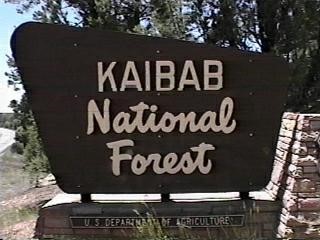
The Lesson of the Kaibab
Background:
The environment may be altered by forces within the biotic community, as well as by interactions between organisms and the physical environment. The carrying capacity of an ecosystem is the maximum number of organisms that an ecosystem can support on a sustained basis. The changing density of a population may produce such profound changes in the environment that the environment becomes unsuitable for the survival of that species. Humans can interfere with these natural interactions and have either a positive or negative effect.
What is carrying capacity?
Objectives (Purpose):
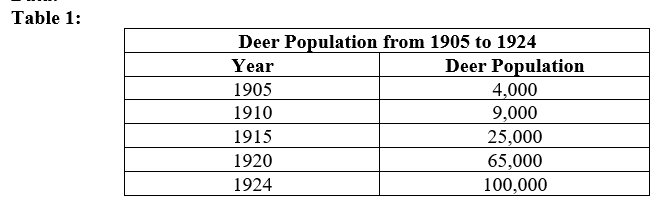
Graph the size of the Kaibab deer population of Arizona from 1905 to 1939.
Analyze the actions responsible for the changes in the deer population.
Propose a management plan for the Kaibab deer population.
Historical Facts:
Before 1905, the deer population on the Kaibab Plateau in Arizona was estimated to number about 4,000 on almost 300,000 hectares of range. The average carrying capacity of the range was estimated then about 30,000 deer. On November 28, 1906, President Theodore Roosevelt created the Grand Canyon National Game Preserve to protect the “finest deer herd in America.”
Unfortunately, by this time sheep, cattle, and horses had already overgrazed the Kaibab forest area. Most of the perennial grasses had been eliminated. The first step to protect the deer was to ban all hunting. In addition, in 1907, the Forest Service tried to exterminate the predators of the deer. Between 1907 and 1939 the following predators were killed: 816 mountain lions, 20 wolves, 7388 coyotes, and more than 500 bobcats.
Using the green line, draw and label a straight horizontal line across the graph to represent the average carrying capacity of the range.
Using the red line, graph the data in Table 1.
Answer conclusion questions 3-8.
Signs that the deer population was out of control began to appear as early as 1920. The range was beginning to deteriorate rapidly. The Forest Service reduced the number of livestock grazing permits. By 1923, the deer were reported to be on the verge of starvation, and the range conditions were described as “deplorable.”
A Kaibab Deer Investigating Committee recommended that all livestock not owned by local residents be removed immediately from the range and that the number of deer be cut in half as quickly as possible. Hunting was reopened, and during the fall of 1924, 675 deer were killed by hunters. However, these deer represented only one-tenth the number that had been born that spring.
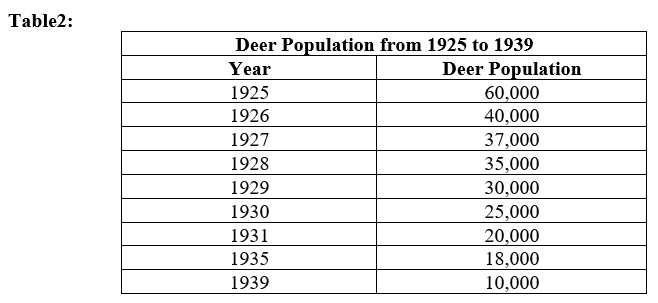
Using the red pencil, plot the data in Table 2 on your graph. Label the completed graph.
Answer conclusion questions 9-10.
Today, the Arizona Game Commission carefully manages the Kaibab area with regulations geared to specific local needs. Hunting permits are issued to keep deer populations in balance with their range. Predators are protected to help keep herds in balance with food supplies. Tragic winter losses can be checked only by keeping the number of deer near the carrying capacity of the range.
Answer conclusion questions 11-14.
Using the green line, draw and label a straight horizontal line across the graph to represent the average carrying capacity of the range.
Using the red line, graph the data in Table 1.
Using the red pencil, plot the data in Table 2 on your graph. Label the completed graph.
In 1906 and 1907, what two methods did the Forest Service decide to use to protect the Kaibab deer?
Approximately how many total predators were removed from the preserve between 1907 and 1930?
What was the relationship of the deer herd to the carrying capacity of the range in 1915?
What was the relationship of the deer herd to the carrying capacity of the range in 1920?
What was the relationship of the deer herd to the carrying capacity of the range in 1924?
Did the Forest Service program appear to be successful between 1905 and 1924? Explain your answer.
Why do you suppose the population of the deer declined in 1925 although the predators were being removed?
Why do you suppose the population of deer in 1905 was 4000 when the range had an estimated carrying capacity of 30,000?
Without the well-meaning interference of humans, what do you think would have happened to the deer population after 1905?
What major lessons were learned from the Kaibab deer experience?
What future management plan would you suggest for the Kaibab deer herd?