Log in
Sign up for FREE
arrow_back
Library

Element Builder Gizmo

star
star
star
star
star
Last updated over 4 years ago
17 questions
Note from the author:
Utilizes Explore Learning's Element Builder Gizmo to investigate the subatomic particles within an atom. Examines the effect of changing protons, neutrons, and electrons.
3
1
3
3
Use protons, neutrons, and electrons to build elements. As the number of protons, neutrons, and electrons changes, information for each element will be updated.
In this two-part lab, you will experiment with the three subatomic elements to determine their effect on atoms. Then we will look deeper and begin to apply our knowledge to the periodic table of elements.

Directions

  • Enter the Element Builder Gizmo
  • Follow the directions and observe all changes to the atom within the simulation.
  • Use your observations to answer all questions.
  • Take a screenshot of the final bitmoji
  • Submit the worksheet
  • Upload the bitmoji screenshot to the class
**Be sure to log into Gizmos with your school account to have unlimited time in the lab.
Class Code: XXXXXX

Gizmo Warm Up

Elements are pure substances that are made up of one kind of atom. Pizza is not an element because it is a mixture of many substances. Water is a pure substance, but it contains two kinds of atom: oxygen and hydrogen. Iron is an element because it is composed of one kind of atom.

Atoms are tiny particles of matter that are made up of three particles: protons, neutrons, and electrons. The Element Builder Gizmo shows an atom with a single proton. The proton is located in the center of the atom, called the nucleus.


  • Use the arrow buttons to add protons, neutrons, and electrons to the atom.
  • Press play (triangle button in controls) to animate atom.
Question 1
1.

Identify the location of each subatomic particle.

  • electrons
  • protons
  • neutrons
  • nucleus
  • orbit around nucleus
Question 2
2.

  • Turn on Show element name (make sure box is checked).
What causes the element name to change?

Experiment

  • Use the arrows to create an atom with two protons, two neutrons, and two electrons.
  • Turn on Show element name, Show element symbol, and Element notation.
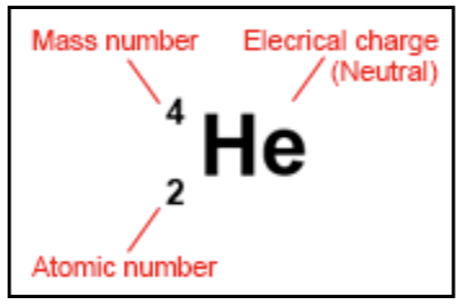
Three numbers surround the element symbol:
• the mass number (A),
• electrical charge (no number is displayed if the atom is neutral),
• the atomic number (Z).
Watch how the numbers change as you add or remove particles.
1
1
Question 5
5.

Match each subatomic particle to its charge.

Draggable itemarrow_right_altCorresponding Item
proton
arrow_right_alt
positive (+)
electron
arrow_right_alt
negative (-)
neutron
arrow_right_alt
neutral ( 0 )
An isotope is an alternative form of an element. Each isotope of an element has the same number of protons, but a different number of neutrons. The isotope is represented by the atomic symbol and mass number, such as He-4. Some isotopes are stable, while others are radioactive, which means the atoms decay over time and emit radiation.
2
2
2
Question 8
8.

Identify 2 radioactive isotopes of oxygen.

Use the arrow buttons to add and remove each subatomic particle in order to answer questions 9 - 13.
1
Question 9
9.

How many electrons are in a neutral atom of lithium?

1
Question 10
10.

How many neutrons are in an atom of Mg-25?

1
1
1
Question 13
13.

How many electrons are in O-2?

A nitrogen atom contains 7 protons, 7 neutrons and 7 electrons. What would be formed if one proton and 3 electrons are added to this atom?
3
Question 14
14.

Use the simulation to help answer the question. Add a screenshot of the result and element notation to support your answer.

Part B: Electrons

Get the Gizmo ready:
  • Create a neutral hydrogen atom with 1 proton, 0 neutrons, and 1 electron.
Question 15
15.

Add electrons to the atom until you have used all the available electrons. Write down 2 observations on how adding electrons affects the structure of the atom/ion.

Electrons are arranged in orbits called energy levels. The Gizmo shows all of the first two energy levels but only part of the third energy level.
1
Question 16
16.

How many electrons can fit in the first energy level?

1
Question 17
17.

How many electrons can fit in the second energy level?


Wrapping Up

  • Double-check all of your work.
  • Take a screenshot of the bitmoji
  • Submit the worksheet
  • Upload the bitmoji screenshot to the class
Question 3
3.

Which number is equal to the number of protons in the atom?

Question 4
4.

How can you calculate the number of neutrons (N) in an atom?

Question 6
6.

Identify the stable isotopes of carbon.

Question 7
7.

Identify the stable isotopes of nitrogen.

Question 11
11.

What is the mass number of an atom with 5 protons and 7 neutrons?

Question 12
12.

When at atom is charged, it is called an ion. How many electrons are in Mg2+?