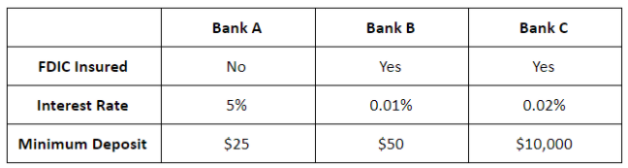
Comparing banks, what makes Bank B a better option than Bank A?
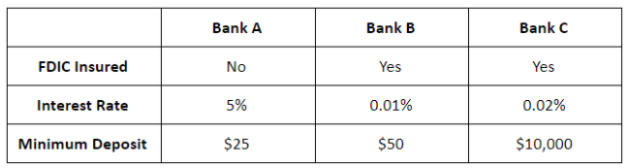
Comparing banks, what makes Bank B a better option than Bank A?
Here are the links for the calculators:
Simple interest: https://www.calculatorsoup.com/calculators/financial/simple-interest-plus-principal-calculator.php
Compound interest: https://www.investor.gov/financial-tools-calculators/calculators/compound-interest-calculator
Or Compound interest: https://www.nerdwallet.com/banking/calculator/compound-interest-calculator
Desmos calculator: https://www.desmos.com/scientific
When a bank says their savings account earns 1% interest, that typically means you will earn 1% interest over what period of time?
Stanley deposits $1,000 into a savings account that pays 1% interest per year. At the end of the first year, he's earned $10 in interest and there is $1,010 in the account. If the account has simple interest, the 1% interest for year two would be based off ____________. If the account has compounding interest, the 1% interest for year two would be based off ________________.(NOTE: The first choice goes in the first blank, the second choice goes in the second blank).
If you deposit $200 into a CD (Certificate of Deposit) with an interest rate of 1% for 3 years, how much simple interest will you earn after THREE years?
If you deposit $2000 into a savings account with interest compounded monthly at a rate of 2.5% for 3 years, how much interest will be in your account at the end of 3 years?
Juan saved $1,000 from his summer job cleaning pools. Which of these savings vehicles would work best for him if he doesn't need access to the money for a number of years AND wanted to earn the highest interest rate?
You are comparing two savings accounts based on the interest you would earn and the fees they charge. Assuming you have a savings account with an average balance of $500, which combination of interest rates and fees are a better deal? (Hint: Using a one year period, determine the balance that you would have at Bank A and Bank B).
Which of these statements about savings is INCORRECT?
Hector is 17 years old and just started his first job. He wants to open a savings account. Which of these will he need to bring to the local bank branch in order to start an account?
Comparing banks, what makes Bank B a better option than Bank A?
Comparing banks, what makes Bank B a better option than Bank C?
Kevin opens a new bank account at Northstone Savings. You see FDIC stickers around the bank, and the teller specifically mentions that Northstone Savings is "FDIC insured". A few months later, you hear on the radio that Northstone Savings is struggling to stay in business. Your savings balance is $500. What would happen to that money if Northstone Savings failed?
Which list includes the most important factors to consider when opening a savings account?
Which of the following is an effective strategy for personal saving?
What would be a good time to spend money from your Emergency Fund?
Which of the following statements about banks is FALSE?
You are developing a savings plan and using short-, medium- and long-term goals to motivate you. Which of the following might you pick as the most long-term goal?
You want to take earnings from your part-time job to pay for a new laptop. Your monthly take-home pay is $500 and the laptop costs $1,200. What percentage of your pay do you need to save in order to buy the laptop in 12 months?
Assume Sid the Saver is earning 0.5% interest on his savings account while inflation is running 2% per year. Which statement below is TRUE?
Which of the following statements is TRUE?
All of the following are good strategies to develop savings habits EXCEPT...
Which of the following individuals is the wealthiest?
If you used the 50-20-30 rule of budgeting, how much of your income should you be saving?
Which of the following is an example of delayed gratification as it pertains to saving?
Misty just secured her first job after college, and she's heard that it's important to start investing for her retirement. She can afford to put 5% of her monthly salary toward retirement. What type of account should she choose for this goal?
Kevin is working full-time and wants to make sure he's saving strategically for four specific goals: an emergency fund ($5000), a flight home to see his parents for the holidays ($450), a downpayment on a new car ($3000), and his retirement (2% of his monthly take-home pay). What's his best strategy?