Log in
Sign up for FREE
arrow_back
Library

Chemistry: Trends In Periodic Table Unit 3 Lesson 3.03

star
star
star
star
star
Last updated over 4 years ago
13 questions
1
9-12.PS1.A-1
1
9-12.PS1.A-1
1
9-12.PS1.A-1
1
9-12.PS1.A-1
2
9-12.PS1.A-1
1
9-12.PS1.A-1
1
9-12.PS1.A-1
1
9-12.PS1.A-1
1
9-12.PS1.A-1
1
9-12.PS1.A-1
1
9-12.PS1.A-1
1
9-12.PS1.A-1
1
You will need to watch this video and go through the questions until the end.
Question 1
1.

Question 2
2.

Question 3
3.

Question 4
4.

Question 6
6.

Question 7
7.

Question 8
8.

Question 9
9.

Question 10
10.

Question 11
11.

Question 12
12.

Question 13
13.

There are three trends in the Periodic Table. What are they? Pick 3.
Atomic radius
Ionization energy
Electronegativity
Bonding
Atomic radius is measured from the nucleus to the last and furthest electron.
True
False
Which atom from the list will have the largest atomic radius? List: H, Li, Na, K, Rb, Cs
Li
Na
Rb
K
H
Cs
Why does the atomic radii from left to right become smaller? Pick two from the choices that explains this trend.
The nucleus condenses inward due to the larger attraction between protons and electrons.
More electrons are added, thus making the atomic radius of the nucleaus smaller.
More protons are added from left t o right of the periodic tabl.
As more protons are added, electrons are added as well, causing attraction to become stronger between the proton and electron.
Which atom from the list will have show the most electronegativity? List: H, Li, C, F, Ne
C
H
Ne
F
Li
The trends in the periodic table are affected by_____. Pick all that applies.
The number of neutrons.
The size of the atom.
The number of electrons and protons.
The atomic mass.
The distance of the last and furthest electrons (valenc electrons) from the nucleus.
B, C, O, F, and N are p-block elements. What is the correct order of reactivity of these elements from greatest to least?
F > O> N > C > B
B > C > N >O > F
O > F > N > C > B
F > N > O > C > B
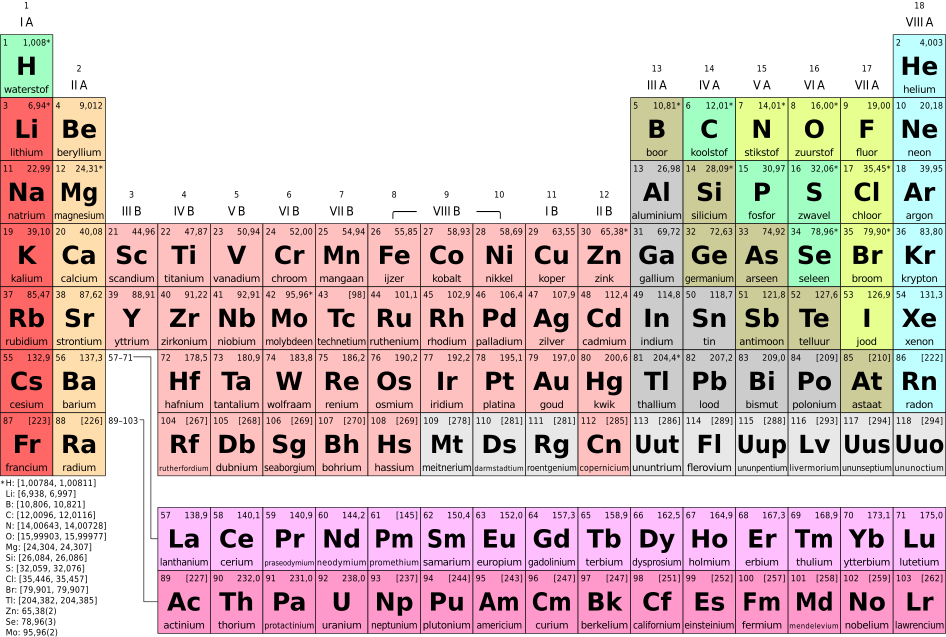
Based on periodic trends of electronegativity, what statement regarding the halogens is MOST accurate? Halogens are found in Group 17. Periodic Table link https://ptable.com/?lang=en#Properties
Flourine has the lowest electronegativity.
Iodine has the strongest tendency to attract electrons.
Fluorine has the strongest tendency to attract electrons.
Because of it's low electronegativity, iodine does not readily form compounds.
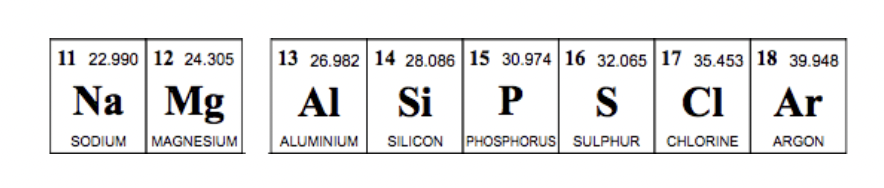
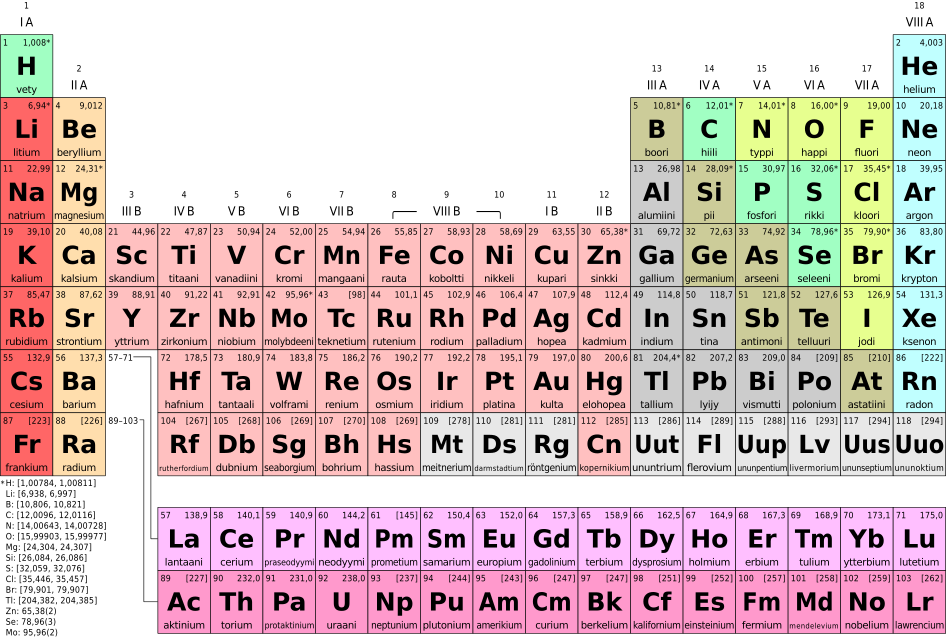
Consider the third period of the periodic table. Which element has the smallest atomic radius? Periodic Table link https://ptable.com/?lang=en#Properties
argon
scandium
silicon
sodium
Consider the single atoms of the elements listed. Which single atom would require the largest amount of energy to remove its outermost electron? Outermost electron is valence electron.
Ar
Cl
Mg
Na
Explain how the atomic radius of an element is related to its chemical reactivity and ionization energy.
Increasing atomic radii indicates increasing chemical reactivity due to decreasing ionization energy.
Chemical reactivity remains the same while the atomic radii decreases with increasing ionization energy.
Increasing both the ionization energy and the atomic radii results in increasing the chemical reactivity.
As the atomic radii of the element decrease, the ionization energy increases and the chemical reactivity decreases.
Go to the OMHS. Find the quiz associated with this activity. Complete that quiz in the OMHS and come back to this question and provide your answer to this question: Did you successfully complete and submit the OMHS quiz associated with this lesson?
Yes
No