1
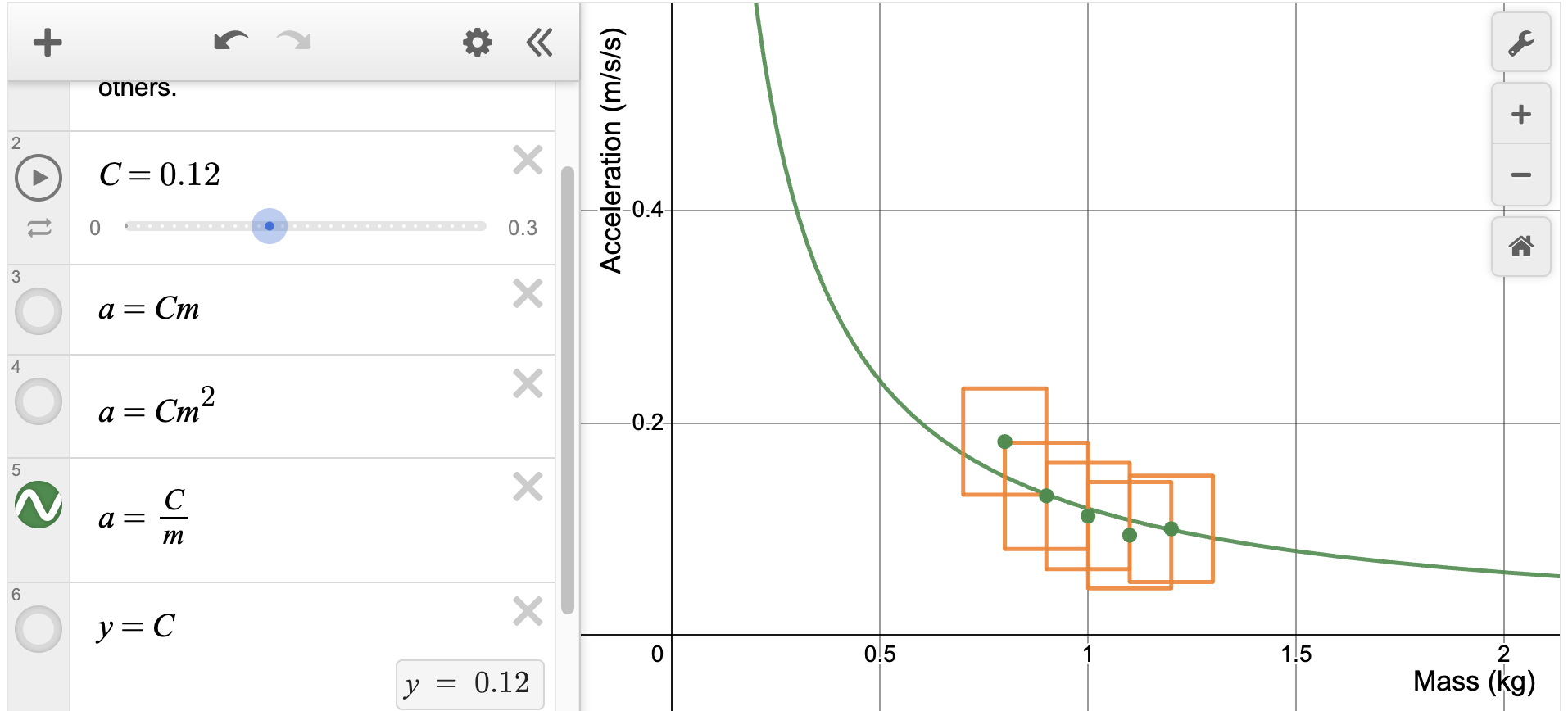
What pattern is shown on the graph to the left?
What pattern is shown on the graph to the left?
1
1
1
What pattern is shown on the graph to the left?
For your force diagrams, remember to identify which of the four scenarios match with the situation described in the question.
BAR = Balanced At Rest
BCV = Balanced Constant Velocity
USU = Unbalanced Speeding Up
USD = Unbalanced Slowing Down
Your hardworking physics teacher drags a cart of rocketry supplies across the rough pavement at a constant velocity. Draw a force diagram for this situation and identify the force scenario.
A bottle rocket is accelerated upward immediately after launch. Draw a force diagram for this situation and identify the force scenario.
After reaching its maximum height, a bottle rocket falls back down toward the ground. Draw a force diagram for this situation and identify the force scenario.
A bottle rocket that has a mass of 0.2 kg is partially filled with 0.2 kg of water and then launched. During the launch, the bottle pushes the water down while the water pushes the bottle up. Which of the following is true?
A bottle rocket that has a mass of 0.2 kg is partially filled with 0.8 kg of water and then launched. During the launch, the bottle pushes the water down while the water pushes the bottle up. Which of the following is true?
You kick a soccer ball. It rolls down the field, slower and slower, then stops. Why did it stop?
When the rocket is at its highest point and begins to fall, what is the value of the normal force?
An empty bottle rocket has a weight of 1.8 N. What is the mass of this rocket?
In the first 0.2 seconds of launch, a 0.12 kg bottle rocket feels a thrust force of 15 N. What is the change in the rocket's velocity during that time?
The SpaceX Falcon 9 rocket has a mass of 550,000 kg and an initial thrust force of 920,000 N. Three seconds after launch, it has a velocity of 25 m/s. What is the momentum of the rocket at this point?
A 0.16 kg bottle rocket is partially filled with 0.48 kg of water. The rocket is launched upward at 24 m/s. What is the velocity of the water as it leaves the bottle?
Three students watch a jet plane roar by over their heads at a constant velocity. Student A says that the force of the jet engines must be the same as the force of air resistance on the plane. Student B says that the force of the jet engines has to be larger than the force of air resistance because the plane is moving forward. Student C says that the plane must have turned off its jet engines for a moment because it is moving at a constant velocity.
Using a Claim, Evidence, Reasoning argument, determine which student is correct.
Write a haiku (5 syllables in the first line, 7 in the second, and 5 in the third) about forces.
Please write a 3 page essay describing how this class has changed your life for the better. Be sure it is positive, because it could be important.
Just kidding. Three sentences will do. Paragraphs would really impress me, though.
What is the mathematical model that best fits the data shown on the graph?
Using your mathematical model, predict the acceleration of a 3kg mass.
Using the graph to the left, how much force was applied to the masses in this lab?