Consider a deer that runs from point A to point B. The distance the deer runs can be greater than the magnitude of its displacement, but the magnitude of the displacement can never be greater than the distance it runs.
2 points
2
Question 2
2.
Suppose that an object travels from one point in space to another. Make a comparison between the magnitude of the displacement and the distance traveled by this object.
2 points
2
Question 3
3.
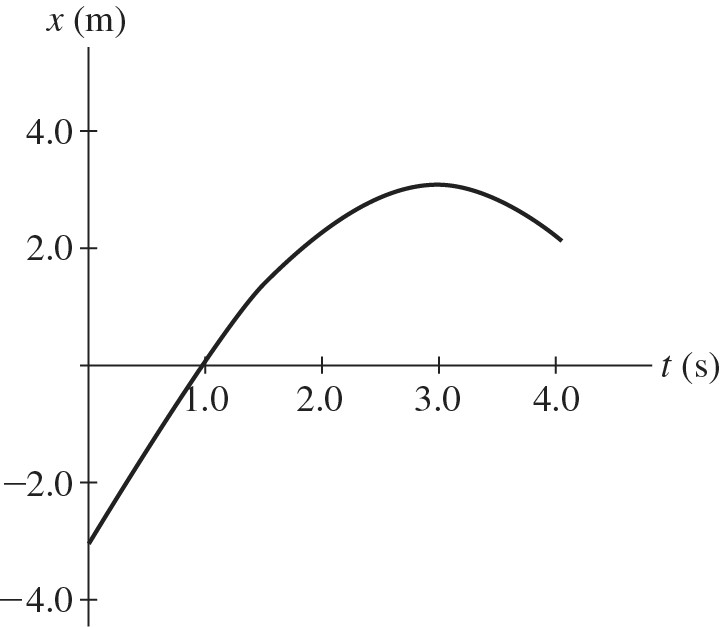
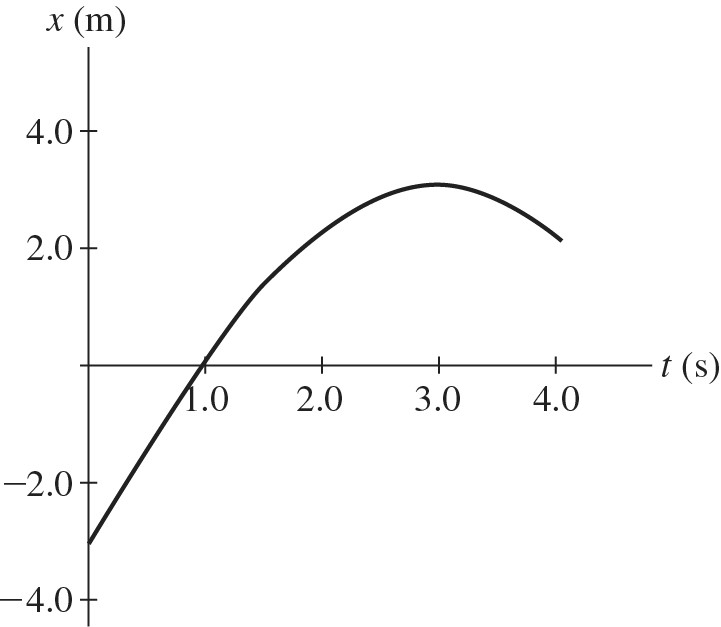
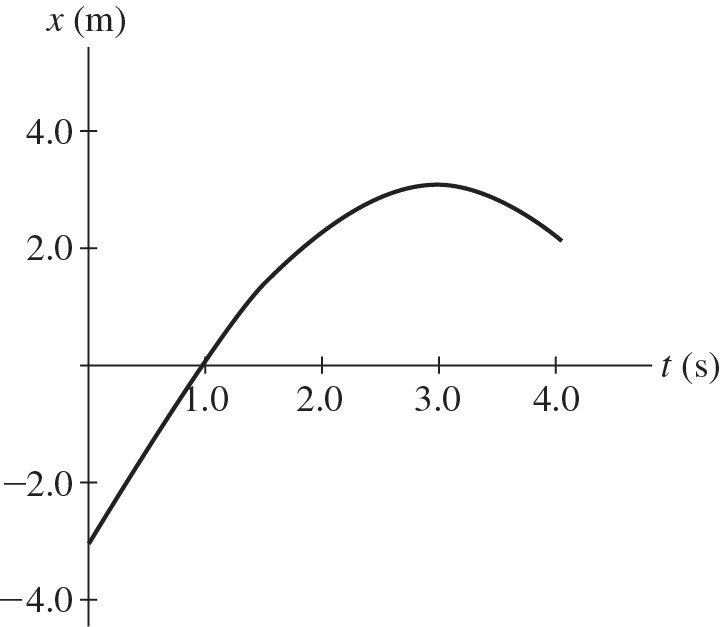
The graph in the figure shows the position of a particle as it travels along the x-axis.
At what value of t is the speed of the particle equal to 0 m/s?
2 points
2
Question 4
4.
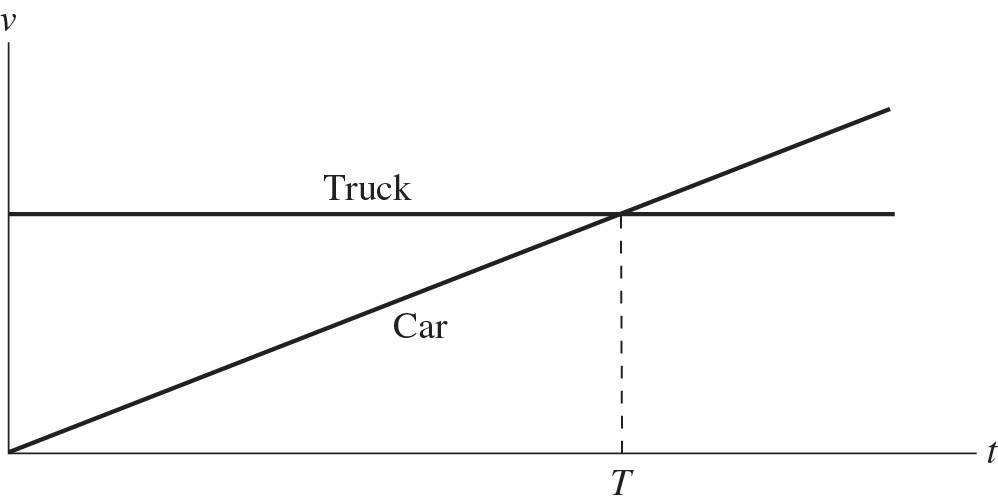
The motions of a car and a truck along a straight road are represented by the velocity-time graphs in the figure. The two vehicles are initially alongside each other at time t = 0.
At time T, what is true of the distances traveled by the vehicles since time t = 0?
2 points
2
Question 5
5.
Consider a car that travels between points A and B. The car's average speed can be greater than the magnitude of its average velocity, but the magnitude of its average velocity can never be greater than its average speed.
2 points
2
Question 6
6.
Which of the following quantities has units of a velocity? (There could be more than one correct choice.)
2 points
2
Question 7
7.
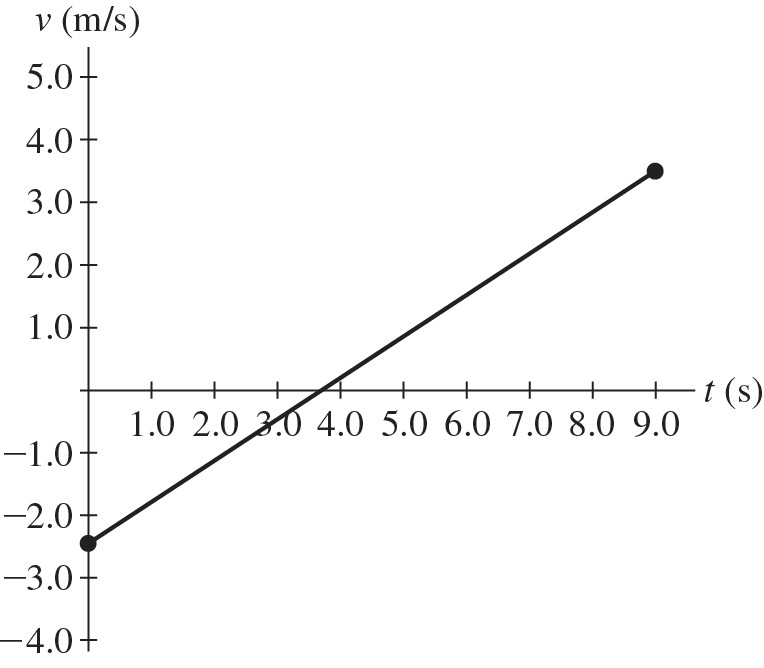
The motion of a particle is described in the velocity vs. time graph shown in the figure.
Over the nine-second interval shown, we can say that the speed of the particle
2 points
2
Question 8
8.
When is the average velocity of an object equal to the instantaneous velocity?
2 points
2
Question 9
9.
You drive 6.0 km at 50 km/h and then another 6.0 km at 90 km/h. Your average speed over the 12 km drive will be
2 points
2
Question 10
10.
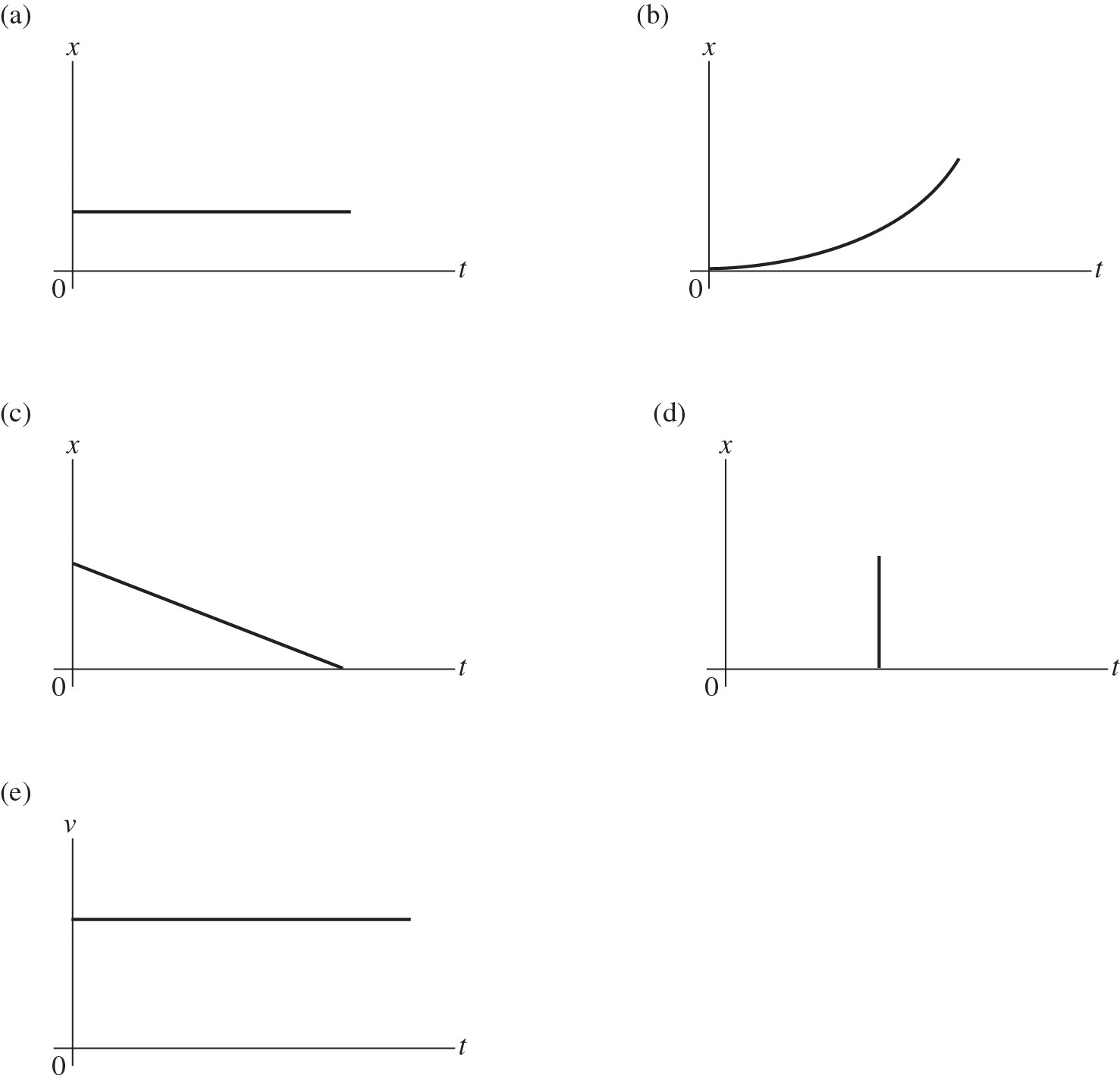
Which of the following graphs represent an object at rest? (There could be more than one correct choice.)
2 points
2
Question 11
11.
An object moves 15.0 m north and then 11.0 m south. Find both the distance it has traveled and the magnitude of its displacement.
2 points
2
Question 12
12.
What must be your average speed in order to travel 350. km in 5.15 h?
2 points
2
Question 13
13.
A runner ran the marathon (approximately 42.0 km) in 2 hours and 57 min. What was the average speed of the runner in m/s?
2 points
2
Question 14
14.
A light-year is the distance that light travels in one year. The speed of light is 3.00 x 10⁸ m/s. How many miles are there in one light-year? (1 mi = 1609 m, 1 y = 365. d)
2 points
2
Question 15
15.
If you are driving 72 km/h along a straight road and you look to the side for 4.0 s, how far do you travel during this inattentive period?
2 points
2
Question 16
16.
A polar bear starts at the North Pole. It travels 1.0 km south, then 1.0 km east, and then 1.0 km north to return to its starting point. This trip takes 45 min. What was the bear's average velocity?
2 points
2
Question 17
17.
You are driving home on a weekend from school at 55 mi/h for 110 miles. It then starts to snow and you slow to 35 mi/h. You arrive home after driving 4 hours and 15 minutes. How far is your hometown from school?
2 points
2
Question 18
18.
A motorist travels 160 km at 80 km/h and 160 km at 100 km/h. What is the average speed of the motorist for this trip?
2 points
2
Question 19
19.
An airplane travels at 300 mi/h south for 2.00 h and then at 250 mi/h north for 750 miles. What is the average speed for the trip?
2 points
2
Question 20
20.
A runner runs around a track consisting of two parallel lines 96 m long connected at the ends by two semicircles with a radius of 49 m. She completes one lap in 100 seconds. What is her average speed?
2 points
2
Question 21
21.
The graph in the figure shows the position of a particle as it travels along the x-axis. What is the magnitude of the average speed of the particle between t = 1.0 s and t = 4.0 s?
4 points
4
Question 22
22.
A race car circles 10 times around a circular 8.0-km track in 20 min. Using SI units
(a) what is its average speed for the ten laps?
4 points
4
Question 23
23.
A race car circles 10 times around a circular 8.0-km track in 20 min. Using SI units
(b) what is its average velocity for the ten laps?
4 points
4
Question 24
24.
If, in the figure, you start from the Bakery, travel to the Cafe, and then to the Art Gallery
(a) what distance you have traveled?
4 points
4
Question 25
25.
If, in the figure, you start from the Bakery, travel to the Cafe, and then to the Art Gallery
(b) what is your displacement?
4 points
4
Question 26
26.
If, in the figure, you start from the Bakery, travel to the Cafe, and then to the Art Gallery in 2.00 hours, what is your
(a) average speed?
4 points
4
Question 27
27.
If, in the figure, you start from the Bakery, travel to the Cafe, and then to the Art Gallery in 2.00 hours, what is your
(b) average velocity?
4 points
4
Question 28
28.
The graph in the figure shows the position of a particle as a function of time as it travels along the x-axis.
(a) What is the magnitude of the average velocity of the particle between t = 1.0 s and t = 4.0 s?
4 points
4
Question 29
29.
The graph in the figure shows the position of a particle as a function of time as it travels along the x-axis.
(b) What is the average speed of the particle between t = 1.0 s and t = 4.0 s?
4 points
4
Question 30
30.
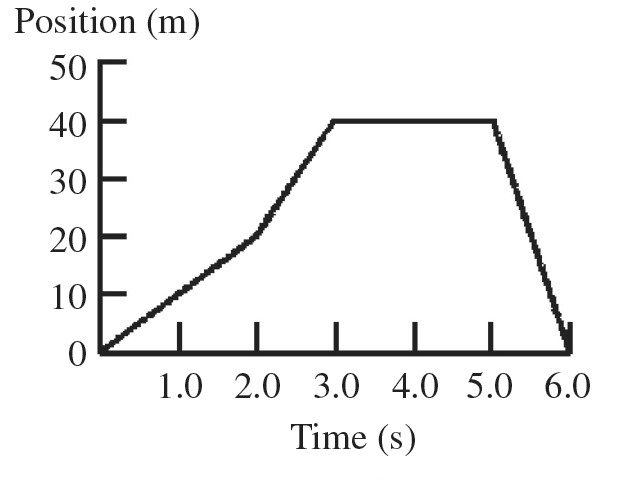
The figure shows a graph of the position of a moving object as a function of time.
(a) What is the average velocity of the object from t = 0 s to t = 2.0 s?
4 points
4
Question 31
31.
The figure shows a graph of the position of a moving object as a function of time.
(b) What is the average velocity of the object from t = 0 s to t = 5.0 s?
4 points
4
Question 32
32.
If you run a complete loop around an outdoor track of length 400 m in 100 s, find your
(a) average velocity and
4 points
4
Question 33
33.
If you run a complete loop around an outdoor track of length 400 m in 100 s, find your
(b) average speed.
4 points
4
Question 34
34.
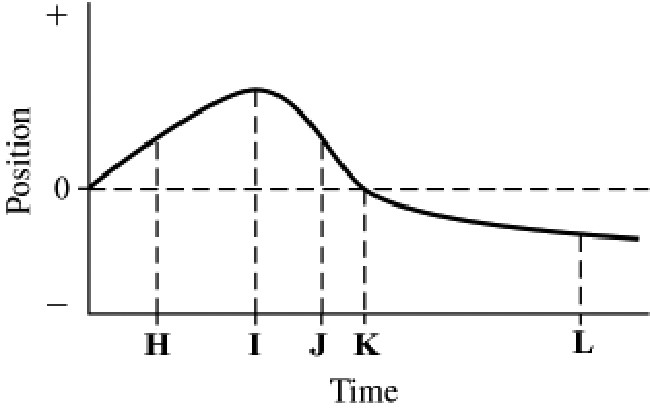
The graph in the figure shows the position of an object as a function of time. The letters H-L represent particular moments of time.
(a) At which moment in time is the speed of the object the greatest?
4 points
4
Question 35
35.
The graph in the figure shows the position of an object as a function of time. The letters H-L represent particular moments of time.
(b) At which moment in time is the speed of the object equal to zero?
6 points
6
Question 36
36.
EXTRA CREDIT: A bat, flying toward the east at 2.0 m/s, emits a shriek that is reflected back to it from a wall that is 20.0 m in front of the bat at the instant the shriek is emitted. Sound travels at 340 m/s in the air. How many milliseconds after emitting the shriek does the bat hear the reflected echo from the wall?