For the following problems,
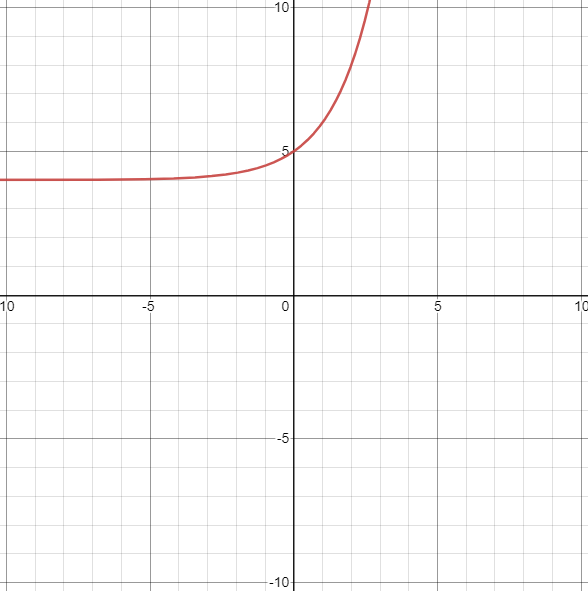
1
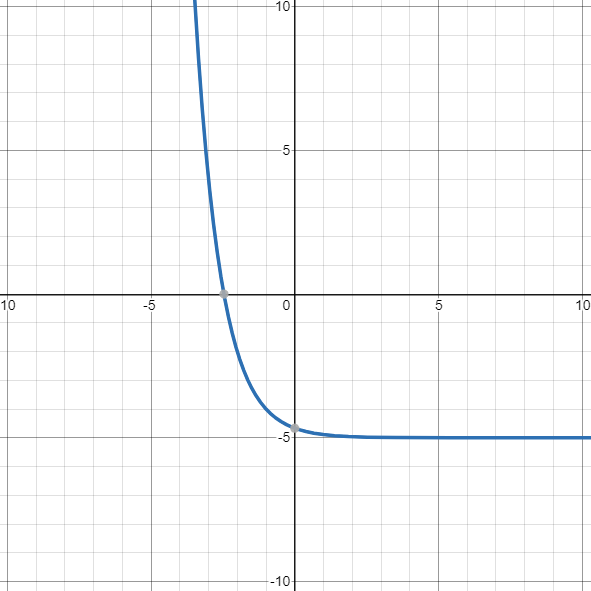
What is the y-intercept of f(x)?
What is the y-intercept of f(x)?
1
1
Directions:
0) Make sure you've turned in your study guide.
On your desk - paper, pencil, calculator
On your browser - this test, Desmos links below.
In your backpack - phones, electronics, notes.
1) Take the test. If you're struggling, come back to the directions and formulae. Give it your best shot, but keep moving through the questions.
2) Some questions allow you to show your work. For these, just type what steps you took to get your answer. I may be able to give you partial credit if some of your steps are correct. You do NOT have to show your work.
3) Check your answers. Pay careful attention that you gave what the question was asking for. Check formatting especially.
4) Submit the test. Let me know if GoGuardian blocks you.
5) Close your Chromebook. Read, draw, or work on paper schoolwork quietly.
Formulae
Change of Base:
Interest/Value:
Compound Interest:
Heating/Cooling Bodies:
Directions:
0) Make sure you've turned in your study guide.
On your desk - paper, pencil, calculator
On your browser - this test, Desmos links below.
In your backpack - phones, electronics, notes.
1) Take the test. If you're struggling, come back to the directions and formulae. Give it your best shot, but keep moving through the questions.
2) Some questions allow you to show your work. For these, just type what steps you took to get your answer. I may be able to give you partial credit if some of your steps are correct. You do NOT have to show your work.
3) Check your answers. Pay careful attention that you gave what the question was asking for. Check formatting especially.
4) Submit the test. Let me know if GoGuardian blocks you.
5) Close your Chromebook. Read, draw, or work on paper schoolwork quietly.
Formulae
Change of Base:
Interest/Value:
Compound Interest:
Heating/Cooling Bodies:
Which expressions represent exponential growth? Check all that apply.
As x approaches infinity, which of the following is true?
For the following problems,
What is the y-intercept of f(x)?
For the following problems,
What is the y-intercept of f(x)?
Use (x, y) format, with exactly one space after the comma. Round your answer to two decimal places or write in fraction form.
As x approaches +infinity, f(x) approaches what value?
Enter your answer as a number or the infinity symbol, no spaces.
As x approaches -infinity, f(x) approaches what value?
Enter your answer as a number or the infinity symbol, no spaces.
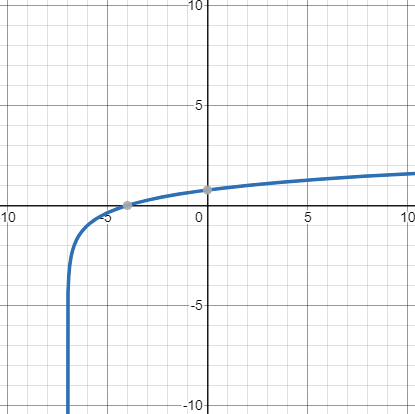
What is the x-intercept of f(x)?
As x approaches infinity, f(x) approaches what value?
Enter your answer as a number or the infinity symbol, no spaces.
Which is equivalent to the equation given below?
Which is equivalent to the equation given below?
Calculate
Calculate
Solve the equation.
Enter your answer as a number, no spaces.
Solve the equation.
Enter your answer as a number, no spaces.
Solve the equation.
Enter your answer as number rounded to the nearest hundredths place.
Solve the equation.
Enter your answer as a number rounded to the nearest hundredth.
Categorize each situation with the best model.
The amount of calories (y) consumed after eating a number (x) of snowcones.
The population of rabbits (y) after some time (x) with few predators.
The temperature (y) of the lasagne some time (x) after I take it out of a hot oven.
The height (y) of a ball some time (x) after it is thrown in the air.
The money (y) in my bank account after some time (x) collecting interest.
The distance (y) travelled by a car after some time (x) accelerating constantly
The money (y) in my bank account after I pay some months (x) of rent, assuming no other deposits or withdrawals.
Linear (
Quadratic (
Growing Exponential (y=Ce^{kt}+b)
Decaying Exponential (
Use the information below for the following problems.
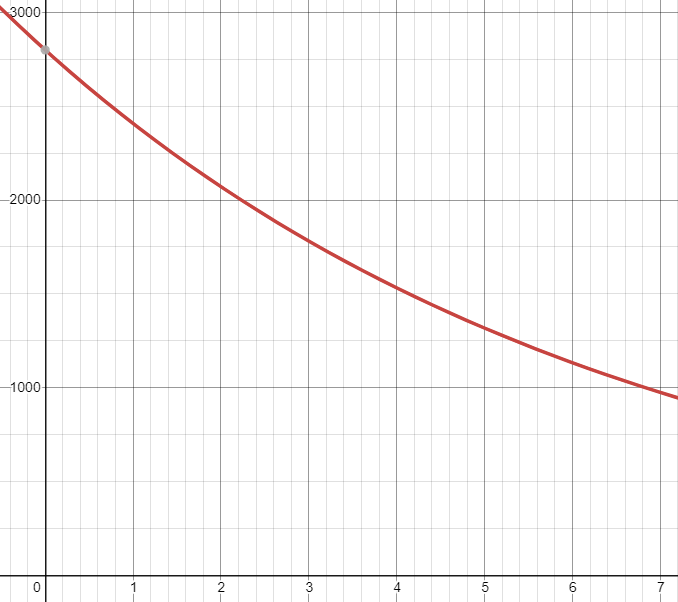
Jack bought a new car in 2014 for $28,000. The value of the car decreases by 14% each year. The value can be modelled with an exponential decay function.
The graph below shows the value (y) of the car some years (x) after 2014.
Which function describes the value of the car after x years since 2014?
In what year will the car have a value of $1000?
Enter your answer as a year, so a number between 2014 and 2050, rounded to the nearest year. Do not include spaces or decimals in your answer.
Use the information below for the following problems.
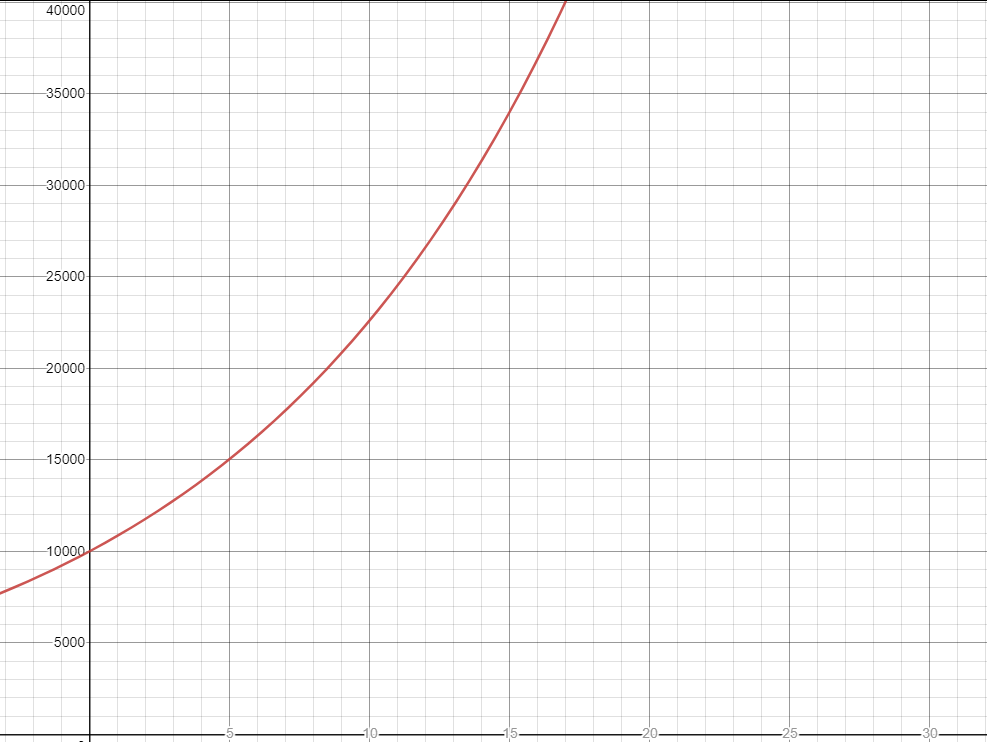
Tatiana invested $10,000 in an account that earns 8.5% yearly interest.
The graph below shows the value (y) of the account some years (x) after her investment.
Which function represents the value of her account after x years collecting interest?
Use the information below for the following problems.
To defrost my chicken, I take it from a 0oF freezer to a 40oF fridge and let it rest for some hours. The constant k in this scenario is 0.5.
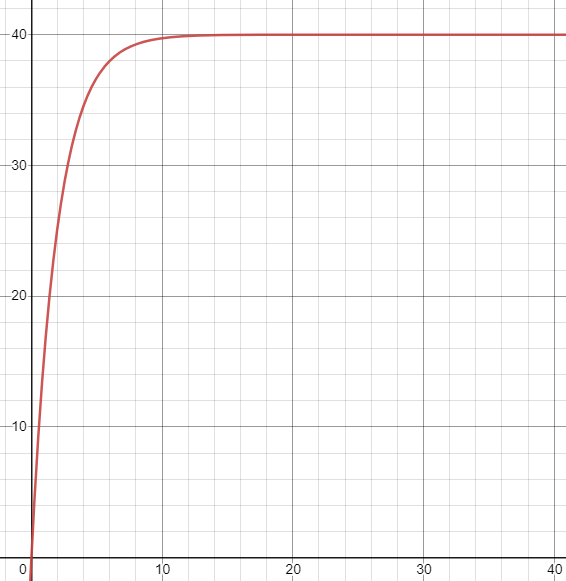
The graph below shows the temperature (y) of the chicken some hours (x) after moving the chicken to the fridge.
Which function represents the temperature of the chicken?
How long (in hours) will it take for the chicken to defrost? Note: the meat will be defrosted when it is 32oF.
Enter your answer as a number rounded to two decimal places.
The amount of money in Jamison's savings account can be modelled by the function
where f(x) is the amount of money after x years.
What amount did he start with (what was his principal)?
What is Jamison's equivalent monthly rate, as a percent?
Enter your answer as a number rounded to 2 decimal places.
If the annual interest rate is 6%, what is the equivalent monthly interest rate, as a percent?
Enter your answer as a number rounded to 2 decimal places.
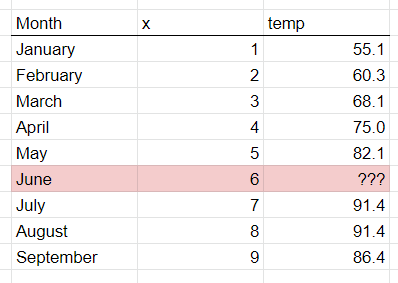
The data in the table below gives average high temperatures in Jackson, Mississippi each month.
The r-values for regressions are as follows:
Linear: 0.927
Quadr: 0.985
Expon: 0.922
Logar: 0.961
Based on the r-values, which of the following models bests suits this data?
Create a model for the data. Predict the temperature in June (x=6).
Enter your answer as a number rounded to the nearest tenth.
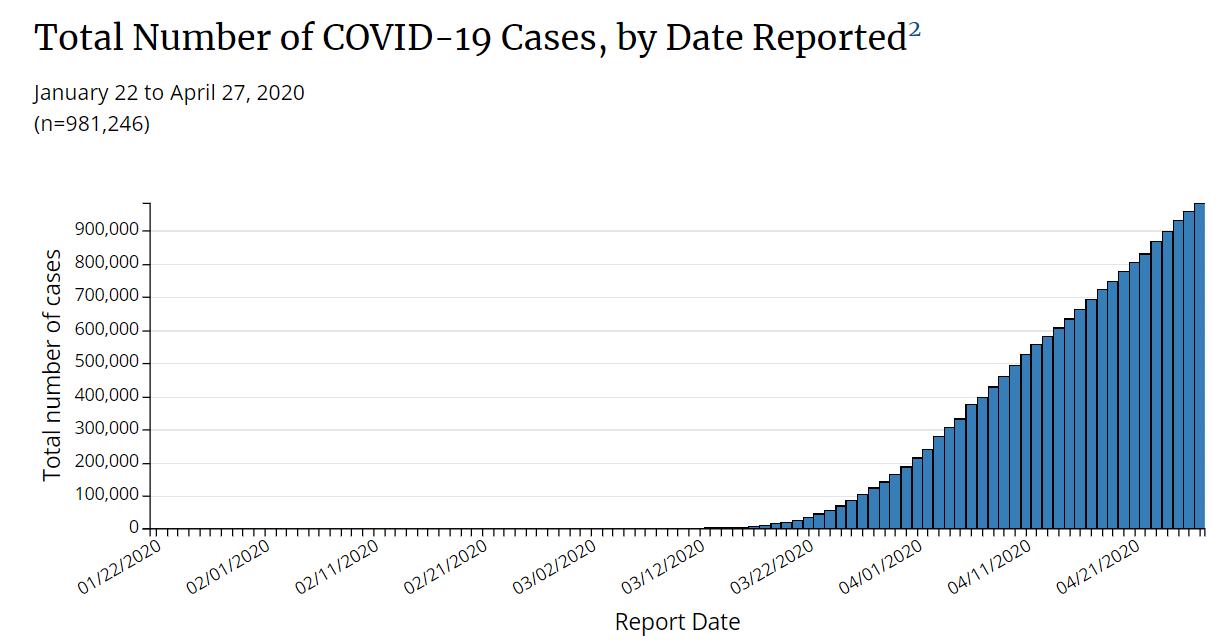
The chart below shows the number of COVID cases reported in the US during 2020.
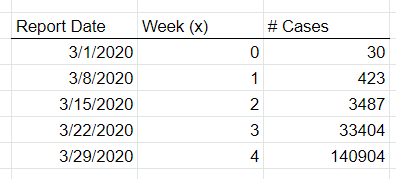
The data for each week of March are summarized in the table below.
The r-values for regressions are as follows:
Linear: 0.823
Quadr: 0.980
Expon: 0.995
Logar: 0.397
Source: CDC website
Based on the r-values, which of the following models bests suits this data?
Explain how you could use the model to predict the day at which the cases will exceed one million. Give your answer as a series of steps. Make sure to include what number(s) to plug in where, and how to interpret any numbers you get.
As x approaches +infinity, f(x) approaches what value?
As x approaches -infinity, f(x) approaches what value?
Find the amount of money ($) in the account in 15 years.
Enter your answer as a number rounded to two decimal places. Do not include $, commas, or spaces in your answer.
Suppose Tatiana's interest was compounded monthly.
Would you expect her to collect more or less interest if her interest was compounded monthly, rather than yearly?
Suppose Tatiana's interest was compounded monthly.
Find the amount of money ($) in the account in 15 years.
Enter your answer as a number rounded to two decimal places. Do not include $, commas, or spaces in your answer.
Suppose I defrosted the meat on my 72oF kitchen sink instead.
Would you expect the chicken to defrost faster or slower in the sink?
What is Jamison's annual interest rate, as a percent?
Enter your answer as an integer.