Log in
Sign up for FREE
arrow_back
Library

!!! P7.1: Exponential Function Features

star
star
star
star
star
Last updated about 4 years ago
35 questions
Note from the author:
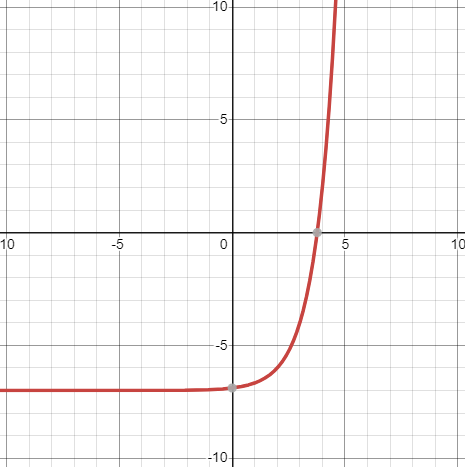
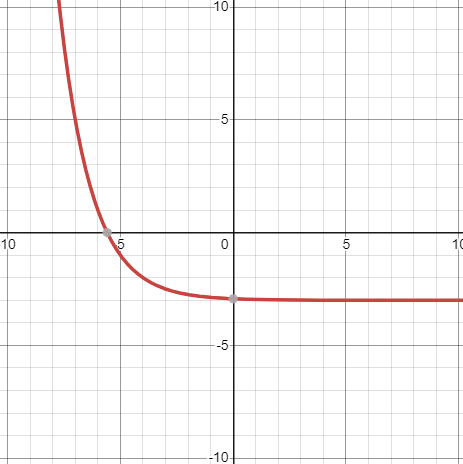
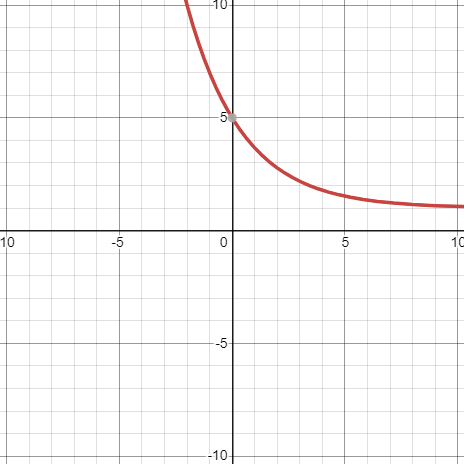
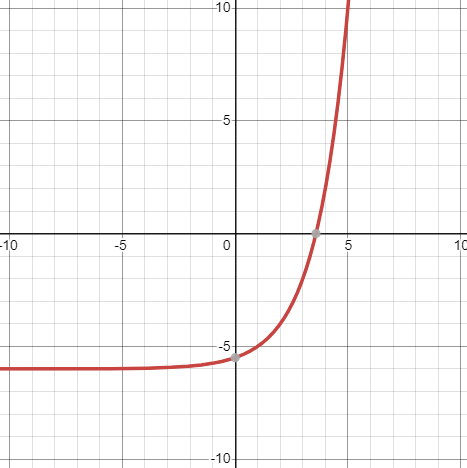
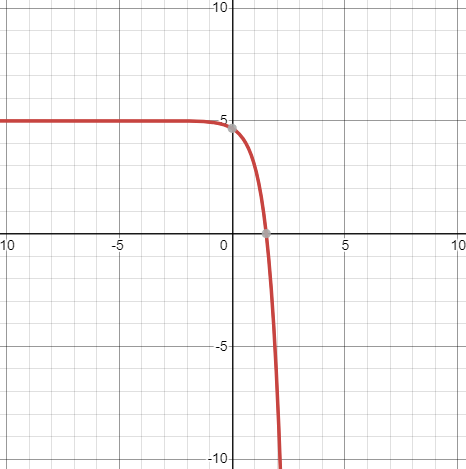
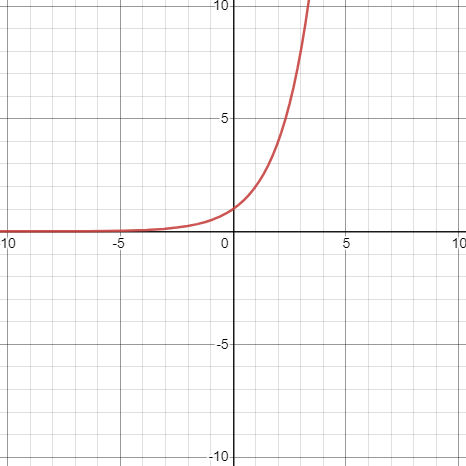
For each function, find the graph. Determine whether it represents growth or decay. Identify the asymptotes, intercepts, and end behaviors.

The assignment looks long, but it is really only 6 questions with 6 (fairly easy) parts each.

Round any decimals to the nearest hundredth (two decimal places).

For review on exponential function graphs, watch this video. Or this one.
For each function, find the graph. Determine whether it represents growth or decay. Identify the asymptotes, intercepts, and end behaviors.

The assignment looks long, but it is really only 6 questions with 6 (fairly easy) parts each.

Round any decimals to the nearest hundredth (two decimal places).

For review on exponential function graphs, watch this video. Or this one.
f(x) = 2^{x}

1
1
1
1
1
1
f(x) = 3^{x-2}-7


1
1
1
1
1
1
f(x) = (\frac{1}{2})^{x+4}-3


1
1
1
1
1
1
f(x) = 4\cdot (\frac{2}{3})^{x}+1


1
1
1
1
1
1
f(x) = \frac{1}{2}\cdot 2^{x}-6


1
1
1
1
1
1
f(x) = -\frac{1}{3}\cdot 6^{x}+5


1
1
1
1
1
Question 1
1.

Question 2
2.

What is the asymptote for this function?

Your answer should include an = sign, no spaces.

Question 3
3.

What is the x-intercept for this function?

Use (x, 0) format, with exactly one space after the comma. If there is no x-intercept, type "none" without quote marks.

Question 4
4.

What is the y-intercept for this function?

Use (0, y) format, with exactly one space after the comma. If there is no x-intercept, type "none" without quote marks.

Question 5
5.

Question 6
6.

Question 7
7.

Question 8
8.

What is the asymptote for this function?

Your answer should include an = sign, no spaces.

Question 9
9.

What is the x-intercept for this function?

Use (x, 0) format, with exactly one space after the comma. If there is no x-intercept, type "none" without quote marks.

Question 10
10.

What is the y-intercept for this function?

Use (0, y) format, with exactly one space after the comma. If there is no x-intercept, type "none" without quote marks.

Question 11
11.

Question 12
12.

Question 13
13.

Question 14
14.

What is the asymptote for this function?

Your answer should include an = sign, no spaces.

Question 15
15.

What is the x-intercept for this function?

Use (x, 0) format, with exactly one space after the comma. If there is no x-intercept, type "none" without quote marks.

Question 16
16.

What is the y-intercept for this function?

Use (0, y) format, with exactly one space after the comma. If there is no x-intercept, type "none" without quote marks.

Question 17
17.

Question 18
18.

Question 19
19.

Question 20
20.

What is the asymptote for this function?

Your answer should include an = sign, no spaces.

Question 21
21.

What is the x-intercept for this function?

Use (x, 0) format, with exactly one space after the comma. If there is no x-intercept, type "none" without quote marks.

Question 22
22.

What is the y-intercept for this function?

Use (0, y) format, with exactly one space after the comma. If there is no x-intercept, type "none" without quote marks.

Question 23
23.

Question 24
24.

Question 25
25.

Question 26
26.

What is the asymptote for this function?

Your answer should include an = sign, no spaces.

Question 27
27.

What is the x-intercept for this function?

Use (x, 0) format, with exactly one space after the comma. If there is no x-intercept, type "none" without quote marks.

Question 28
28.

What is the y-intercept for this function?

Use (0, y) format, with exactly one space after the comma. If there is no x-intercept, type "none" without quote marks.

Question 29
29.

Question 30
30.

Question 31
31.

What is the asymptote for this function?

Your answer should include an = sign, no spaces.

Question 32
32.

What is the x-intercept for this function?

Use (x, 0) format, with exactly one space after the comma. If there is no x-intercept, type "none" without quote marks.

Question 33
33.

What is the y-intercept for this function?

Use (0, y) format, with exactly one space after the comma. If there is no x-intercept, type "none" without quote marks.

Question 34
34.

Question 35
35.

Does the function represent growth or decay?
Growth
Decay
What is the end behavior on the RIGHT side?
x \rightarrow -\infty, f(x) \rightarrow -\infty
x \rightarrow -\infty, f(x) \rightarrow \infty
x \rightarrow \infty, f(x) \rightarrow \infty
x \rightarrow \infty, f(x) \rightarrow -\infty
What is the end behavior on the LEFT side?
x \rightarrow -\infty, f(x) \rightarrow \infty
x \rightarrow -\infty, f(x) \rightarrow 0
x \rightarrow \infty, f(x) \rightarrow 0
x \rightarrow \infty, f(x) \rightarrow \infty
Does the function represent growth or decay?
Decay
Growth
What is the end behavior on the RIGHT side?
x \rightarrow -\infty, f(x) \rightarrow \infty
x \rightarrow \infty, f(x) \rightarrow \infty
x \rightarrow -\infty, f(x) \rightarrow -\infty
x \rightarrow \infty, f(x) \rightarrow -\infty
What is the end behavior on the LEFT side?
x \rightarrow -\infty, f(x) \rightarrow \infty
x \rightarrow \infty, f(x) \rightarrow -7
x \rightarrow \infty, f(x) \rightarrow \infty
x \rightarrow -\infty, f(x) \rightarrow -7
Does the function represent growth or decay?
Growth
Decay
What is the end behavior on the RIGHT side?
x \rightarrow -\infty, f(x) \rightarrow -3
x \rightarrow \infty, f(x) \rightarrow -3
x \rightarrow -\infty, f(x) \rightarrow \infty
x \rightarrow \infty, f(x) \rightarrow \infty
What is the end behavior on the LEFT side?
x \rightarrow -\infty, f(x) \rightarrow -\infty
x \rightarrow -\infty, f(x) \rightarrow \infty
x \rightarrow \infty, f(x) \rightarrow \infty
x \rightarrow \infty, f(x) \rightarrow -\infty
Does the function represent growth or decay?
Growth
Decay
What is the end behavior on the RIGHT side?
x \rightarrow -\infty, f(x) \rightarrow \infty
x \rightarrow \infty, f(x) \rightarrow \infty
x \rightarrow \infty, f(x) \rightarrow 1
x \rightarrow -\infty, f(x) \rightarrow 1
What is the end behavior on the LEFT side?
x \rightarrow \infty, f(x) \rightarrow -\infty
x \rightarrow \infty, f(x) \rightarrow \infty
x \rightarrow -\infty, f(x) \rightarrow -\infty
x \rightarrow -\infty, f(x) \rightarrow \infty
Does the function represent growth or decay?
Decay
Growth
What is the end behavior on the RIGHT side?
x \rightarrow \infty, f(x) \rightarrow -6
x \rightarrow -\infty, f(x) \rightarrow -6
x \rightarrow \infty, f(x) \rightarrow \infty
x \rightarrow -\infty, f(x) \rightarrow \infty
What is the end behavior on the LEFT side?
x \rightarrow \infty, f(x) \rightarrow -6
x \rightarrow -\infty, f(x) \rightarrow -6
x \rightarrow -\infty, f(x) \rightarrow \infty
x \rightarrow \infty, f(x) \rightarrow \infty
What is the end behavior on the RIGHT side?
x \rightarrow \infty, f(x) \rightarrow 5
x \rightarrow -\infty, f(x) \rightarrow 5
x \rightarrow \infty, f(x) \rightarrow -\infty
x \rightarrow -\infty, f(x) \rightarrow -\infty
What is the end behavior on the LEFT side?
x \rightarrow \infty, f(x) \rightarrow 5
x \rightarrow -\infty, f(x) \rightarrow -\infty
x \rightarrow \infty, f(x) \rightarrow -\infty
x \rightarrow -\infty, f(x) \rightarrow 5