Log in
Sign up for FREE
arrow_back
Library

HW6: Mixed Models (2-day)

star
star
star
star
star
Last updated about 4 years ago
29 questions
Note from the author:
1
1
1
1
1
1
1
1
1
You can find online regression calculators at this site in the fourth column.

To compare exponential and linear growth, check out this video.
For some more exponential growth/decay word problems, check out this video.
For even more exponential word problems, check out this video, this video, and the ones in the sidebar.
For an example of a logarithmic scale, check out this video.

Before you panic about the number of questions... There are three graphing problems after #18. So there's really about 20 questions.
You can find online regression calculators at this site in the fourth column.

To compare exponential and linear growth, check out this video.
For some more exponential growth/decay word problems, check out this video.
For even more exponential word problems, check out this video, this video, and the ones in the sidebar.
For an example of a logarithmic scale, check out this video.

Before you panic about the number of questions... There are three graphing problems after #18. So there's really about 20 questions.
Question 1
1.

Question 2
2.

Question 3
3.

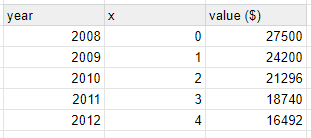
The table shows the value of a car during certain years. Using an expoential model, write an equation for the curve of best fit, then estimate the value of the car in 2016 (x=8).

1
1
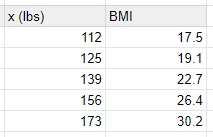
The table below shows the weights of five females of the same height (5'5") along with their body mass index, BMI. Using a logarithmic model, write an equation for the curve of best fit, then estimate the BMI of a female that weighs 130 pounds.


1
0
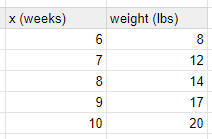
The Brown's adopted a 6-week-old puppy that weighed 8 pounds. The table below shows the weight of the puppy each week thereafter. Find which model best fits the data, then find the age (in weeks) at which the puppy will weigh 50 lbs.


1
1
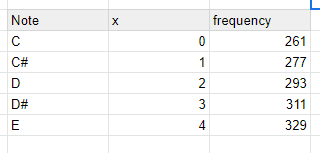
The notes of a musical scale and their frequencies are given in the table below. Find the model that would best fit the data, and use the model to estimate the frequency of the note G (x= 7)

Hint: If you get an error for a function, it is probably not the right one...

1
1
Question 12
12.

Question 13
13.

Review
Solve the equation.

(1.05)12x = 2.16

Enter your answer as a number rounded to three decimal places.

Question 14
14.

Review
Solve the equation.

73 - 20e1-2x = 60

Enter your answer as a number rounded to three decimal places.

Question 15
15.

What is the percentage growth/decay for the following function, per unit of x?

f(x) = 21 \cdot (2.51)^{.44x}

Enter your answer as a number rounded to three decimal places.

Question 16
16.

What is the percentage growth/decay for the following function, per unit of x?

f(x) = .996 \cdot (0.997)^{12x}

Enter your answer as a number rounded to three decimal places.

Question 17
17.

Rand earns 3% annual interest. What is his equivalent monthly interest, as a percent?

Enter your answer as a number rounded to 3 decimal places.

Review:
For the following questions,
f(x) = 3(0.25)^{x+1}-2
1
1
1
1
Review:
For the following questions,
f(x) = \frac{1}{2}(1.003)^{12x}
1
1
1
1
Review:
For the following questions,
f(x) = 2\cdot ln(x+3)
1
1
1
1
Categorize each situation by the type of function that would be the best model. You may use the internet as a resource
The amount of a radioactive material after some time decaying
The value of a savings account after some years collecting interest
The cases of a virus after some time spreading
The total earnings collected after some time working at a certain wage
The value of a car after some years depreciating
A scale describing the intensity of earthquakes
The amount of gas left in a tank after some miles driving
The height of a ball after some time launched from a cannon
Linear
Quadratic
Exponential Growth
Exponential Decay
Logarithmic
Categorize the situations according to the model best suited for them. Feel free to look up some equations.
the number of zombies some time after the first outbreak
a rating of intensity of an acid based on the concentration of ions
the distance of a car from the starting line after some time assuming constant acceleration
a rating of intensity of a sound according to human perception
the value of a savings account after some time collecting interest
the acceleration felt in a car taking a turn at some speed
the amount of candy in my classroom after some number of days (assuming I give roughly the same number of treats each day)
the temperature of a cake after some time being pulled out of the hot oven
Linear
Quadratic
Exponential Growth
Exponential Decay
Logarithmic
Put the following functions in decreasing order based on their values as x \rightarrow \infty

Hint: It may help to graph in Desmos and zoom out.
f(x) = (\frac{4}{3})^{2x}
f(x) = 22x^{2}
f(x) = (\frac{4}{3})^{\frac{1}{2}x}
f(x) = 222x^{3}
f(x) = (\frac{4}{3})^{-2x}
f(x) = 222x^{2}
f(x) = (\frac{3}{4})^{3x}
Question 4
4.

What is the value of growth/decay rate, as a percent?

Enter your answer as an integer.

Question 5
5.

What is the value of the car in 2016, in dollars?

Use four decimal places for the base.

Enter your answer as a number rounded to two decimal places. For example, if your answer were $12.366, you would enter "12.37".
Question 6
6.

According to your model, what is the BMI of a female that weighs 130 lbs?

Enter your answer as a number rounded to two decimal places.

Question 7
7.

Bonus:
Explain a process you could use to check #6 for reasonableness. You will use the internet.

Question 8
8.

Question 9
9.

At what age (in weeks) will the puppy weight 50 pounds?

Hint: be careful what is input and what is output.

Enter your answer as an integer.

Question 10
10.

Question 11
11.

What is the frequency of the note G (x=7)?

Enter you answer as a number rounded to two decimal places.

When using STAT to find regression curves, Dr. Demo got the following results.

Linear Regression: r = .99507
Quadratic Regression: r = .99932
Logarithmic Regression: = .99618
Exponential Regression: r = .99937

Which model best suits his data?
Linear
Quadratic
Logarithmic
Exponential
Question 18
18.

Question 19
19.

What is the percent rate of growth/decay?

Enter your answer as an integer.

Question 20
20.

What is the asymptote?

Question 21
21.

Question 22
22.

Question 23
23.

What is the asymptote?

Question 24
24.

What is the percent rate of growth/decay?

Enter your answer as a number rounded to 1 decimal place.

Question 25
25.

Question 26
26.

What is the asymptote?

Question 27
27.

What is the x-intercept?

Use (x, y) format, with exactly one space after the comma.

Question 28
28.

What is the y-intercept?

Use (x, y) format, with exactly one space after the comma. Round to three decimal places

Question 29
29.

Which model best fits this data?
Exponential
Logarithmic
Which model best suits the data?
Linear
Exponential
Logarithmic
Does the function represent exponential growth or decay?
growth
decay
Select the end behaviors for f(x).

Select two.
As x -> -2, f(x) -> \infty
As x -> \infty, f(x) -> \infty
As x -> \infty, f(x) -> -2
As x -> -\infty, f(x) -> \infty
As x -> -2, f(x) -> -2
As x -> -\infty, f(x) -> -2
Does the function represent exponential growth or decay?
growth
decay
Select the end behaviors for f(x).

Select two.
As x -> -\infty, f(x) -> 0
As x -> \infty, f(x) -> 0
As x -> \infty, f(x) -> \infty
As x -> 0, f(x) -> \infty
As x ->0 , f(x) -> 0
As x -> -\infty, f(x) -> \infty
Select the end behaviors for f(x).

Select two.
As x -> -\infty, f(x) -> -3
As x -> -3, f(x) -> -\infty
As x -> \infty, f(x) -> \infty
As x -> -3 , f(x) -> -3
As x -> \infty, f(x) -> -3
As x -> -\infty, f(x) -> -\infty