Log in
Sign up for FREE
arrow_back
Library

10/27 Demographic Transition

star
star
star
star
star
Last updated 9 months ago
6 questions
1
1
1
1
1
1
Background:
In 1945 demographer Frank Notestein recognized four demographic stages based on his observations of Europe as it became industrialized and urbanized. During these stages Europe converted from relatively high to relatively low birth rate and death rates. Demographers generally assume that the same demographic transition will occur in less developed countries as they become industrialized.
Directions
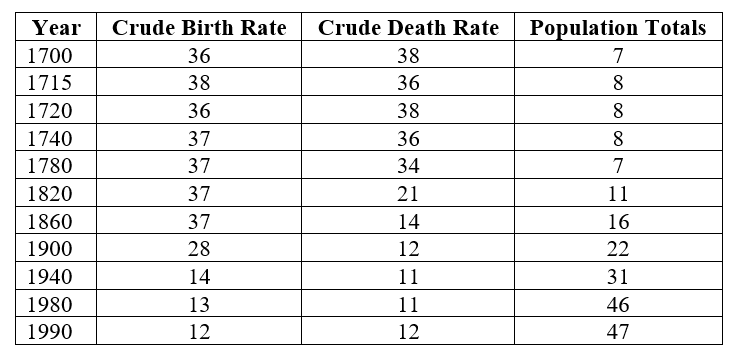
● On the graph provided plot the crude birth rate, crude death rate, and population totals for a hypothetical country as it moves through demographic transitions.
● Create a line graph- birth rates in green, death rates in red and population totals in blue.
● Anytime there is a difference (not the same) between death rate and birth rate shade the space in between the birth rate and death rate yellow.
Question 1
1.

Create a line graph- birth rates in green, death rates in red and population totals in blue.

Question 2
2.

Determine which descriptions belong under the four stages of the demographic transition. Match each description under the correct stage.

Draggable itemarrow_right_altCorresponding Item
Industrial Stage
arrow_right_alt
Stage 1
Pre-Industrial Stage
arrow_right_alt
Stage 2
Transitional Stage
arrow_right_alt
Stage 3
Post-industrial
arrow_right_alt
Stage 4
Question 3
3.

Determine which descriptions belong under the four stages of the demographic transition. Match each description under the correct stage.

Draggable itemarrow_right_altCorresponding Item
Parents don’t need kids- they still want them but only a few
arrow_right_alt
Stage 1
Because kids are expensive to raise people decide to have zero or only one child
arrow_right_alt
Stage 2
Children are important- they are free labor for farm work
arrow_right_alt
Stage 3
Children are unnecessary, but parents are making good money
arrow_right_alt
Stage 4
Question 4
4.

Determine which descriptions belong under the four stages of the demographic transition. Match each description under the correct stage.

Draggable itemarrow_right_altCorresponding Item
Birth rate and death rate become equal but the population is high
arrow_right_alt
Stage 1
Birth rates and death rates are equal but the population remains relatively low
arrow_right_alt
Stage 2
There is a decline in birth rates
arrow_right_alt
Stage 3
Better water and medicine so infant mortality and death rates decrease but people are not ready to give up free labor so they continue to have children and birth rates are high
arrow_right_alt
Stage 4
Question 5
5.

Determine which descriptions belong under the four stages of the demographic transition. Match each description under the correct stage.

Draggable itemarrow_right_altCorresponding Item
There is a high infant mortality rate as well as a low life expectancy
arrow_right_alt
Stage 1
Improved health care and reliable food/water increases life expectancy
arrow_right_alt
Stage 2
More educated women and more women in the workforce make birth rates decline
arrow_right_alt
Stage 3
Citizens are better educated and more affluent so birth rates are low
arrow_right_alt
Stage 4
Question 6
6.

Determine which descriptions belong under the four stages of the demographic transition. Match each description under the correct stage.

Draggable itemarrow_right_altCorresponding Item
arrow_right_alt
Stage 1
arrow_right_alt
Stage 2
arrow_right_alt
Stage 3
arrow_right_alt
Stage 4