Rank the cars from top (greatest) acceleration to bottom (smallest) acceleration.

Rank the cars from top (greatest) acceleration to bottom (smallest) acceleration.
blue
green
red
Rank the cars from top (greatest) acceleration to bottom (smallest) acceleration.
blue
green
red
Consider the position-time graph. Each one of the three lines on the position-time graph corresponds to the motion of one of the three cars. Match the appropriate line to the particular color of the cars in problem #1.
| Draggable item | arrow_right_alt | Corresponding Item |
|---|---|---|
blue | arrow_right_alt | B |
green | arrow_right_alt | A |
red | arrow_right_alt | C |
The velocity-time graph for a two-stage rocket is shown below. Use the graph and your understanding of slope calculations to determine the acceleration of the rocket during the listed time interval.

What is the acceleration of the rocket from t=4 -> t=12 ?
What is the graphical interpretation of the motion of the car?
What is the graphical interpretation of the motion of the car?
When interpreting a Velocity vs Time graph, the slope is the
On Earth, things fall towards the center of the Earth at m/s/s (m/s^2). BUT! On the moon, objects fall at m/s/s (m/s^2). This is due to the moon having mass than the Earth.
Draw what you predict 'freefall' on a pos vs. time graph and vel vs. time graph would look like.
REVIEW: Look at the distance-time graph below.
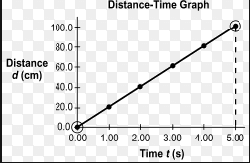
What is the total distance traveled?
REVIEW: A kayaker paddles along a river for 4 hours. In that time, she manages to move a total of 20 miles. What is the average speed of the kayak for this trip?
What is acceleration? Type a definition for this term in your own words.
A ball begins rolling down a hill. After 5 seconds, its velocity is 10 meters per second. What is the acceleration of the ball?
A vehicle brakes from 30 mph to 5 mph over a period of 10 seconds. What is the vehicles acceleration?
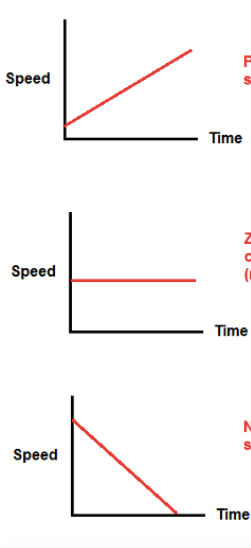
Describe the acceleration.
Explain why the velocity of an object decreases as it rises, but increases as it falls.
Acceleration ...
In your own words, what does a line with a slope of 1 on a Velocity-Time Graph mean?
Acceleration due to gravity is always ______________ (Direction and units needed for full points).
What was the speed of the ball when it hit the ground below the cliff?
What is the distance of the ball above its initial position when it reaches the peak?
Describe the acceleration.
Describe the acceleration.