Log in
Sign up for FREE
arrow_back
Library

Unit 4: Vertical Motion Lab

star
star
star
star
star
Last updated 3 days ago
22 questions
1
1
1
1
1
1
1
1
1
1
1
1
1
1
1
1
1
1
2
Follow this link to open the phet simulation that will be used in this lab.
https://phet.colorado.edu/sims/html/projectile-motion/latest/projectile-motion_en.html

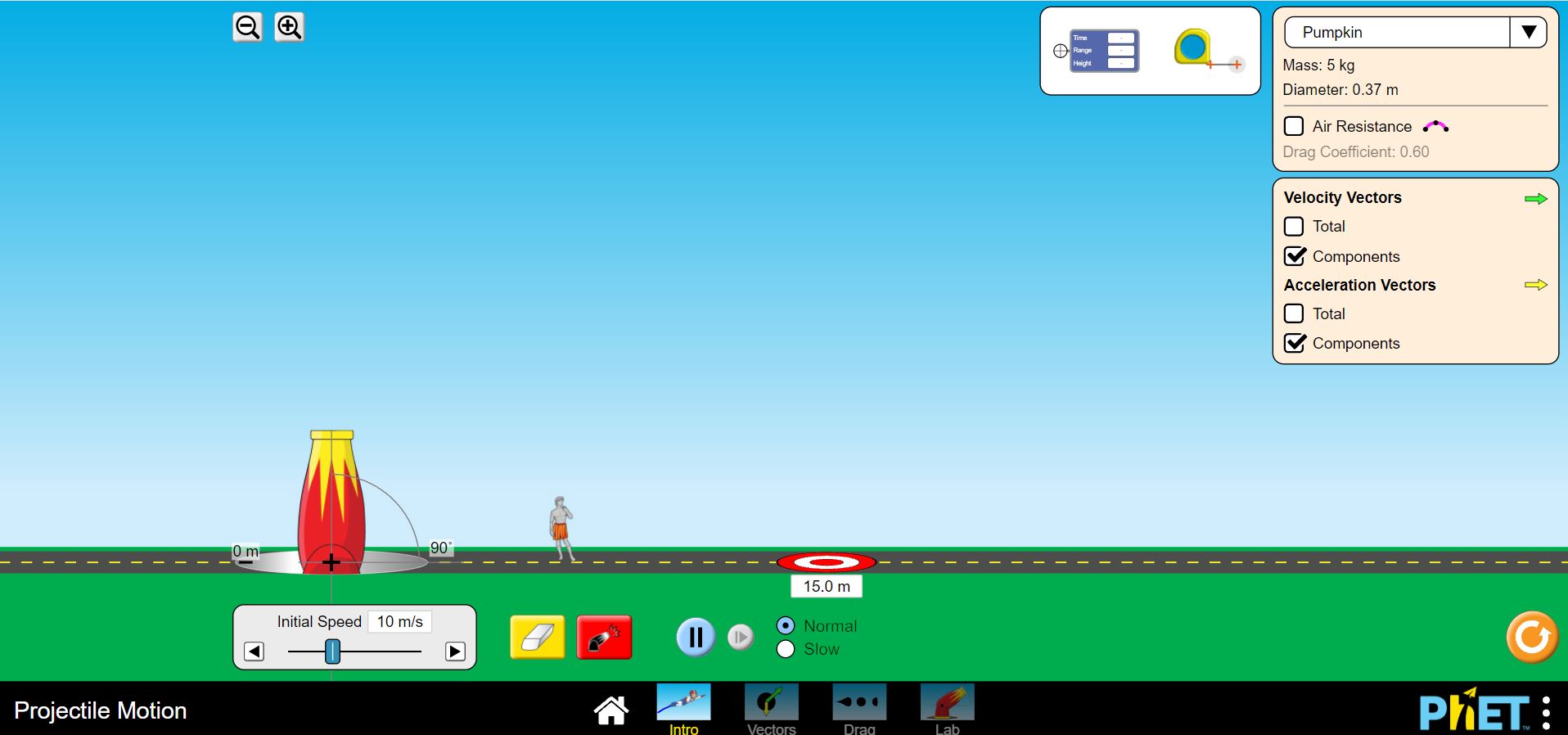
once opened, click on the icon labeled "intro"
Make your settings like the image.

1. Lower the height of the launcher to 0m

2. Change the initial speed to 10m/s on the slider

3. Check the components box for both the velocity vectors and acceleration vectors section.
The question we are investigating today is: How do mass and initial velocity affect the height and time of a projectile?


Lab instructions: Change the Mass and Initial Speed to match the table (provided as a link in question 2). Use the Blue Measuring tool from the simulation to take measurements
2
8
Question 3
3.

Question 4
4.

Question 5
5.

Explain why the height changed or did not change due to manipulating the
a. object's mass and
b. initial velocity.

Question 6
6.

Question 7
7.

Question 8
8.

Question 9
9.

Question 10
10.

Question 11
11.

Question 12
12.

Question 13
13.

Question 14
14.

Question 15
15.

Question 16
16.

A pumpkin is launched directly up and reaches a height of 10 m. How long would it take for the pumpkin to go up and down? (Hint, use the time equation)

Question 17
17.

A pumpkin is launched directly up and reaches a height of 10 m. How long would it take for the pumpkin to rise?

Question 18
18.

A pumpkin is launched directly up and reaches a height of 10 m. How long would it take for the pumpkin to fall?

Question 19
19.

A pumpkin is launched directly up and reaches a height of 10 m. What is the velocity just before the pumpkin hits the ground? (Hint, use the time in the previous question)

Question 20
20.

A pumpkin is launched directly up and reaches a height of 10 m. What is the velocity directly after the pumpkin is launched?

Question 21
21.

A pumpkin is launched directly up and reaches a height of 10 m. Using your previous answers, draw the scenario with labeled initial velocity, velocity at the top, final velocity, time to rise, and time to fall.

Scientific Question: How does initial velocity and mass affect the height and time of a vertical projectile?
20
Question 22
22.

Write a mini CER (8-15 sentences) for vertical projectiles (No need for procedure or sources of error)

Question 1
1.

Hypothesis: Write a testable answer to the above question in if/then format. 'How do mass and initial velocity affect the height and time of a projectile?'

Question 2
2.

Data table:
https://docs.google.com/spreadsheets/d/1YQEEsL9wPrFpcPxw-YnNO2LtBgtHGDQFWY0CFSwh3bY/edit?usp=copy
Add your completed data table.

What happens to the height as the initial speed increases.
Height increases
Height remains the same
Height decreases
What happens to the height as the mass increases.
Height increases
Height remains the same
Height decreases
Compare the time needed to reach max height and the total time for each launch. What is true.
The time to reach max height is the same as the total time for the launch.
The time to reach max height is a quarter of the total time for the launch.
The time to reach max height is half of the total time for the launch.
Launch one more time and watch the vectors. What happens to the Velocity Vector (Green arrow) throughout the launch?
The arrow remained the same throughout the entire launch
The arrow increased in size as the ball traveled higher then decreased in size as the ball traveled back to the ground.
The arrow decreased in size as the ball traveled higher then increased in size as the ball traveled back to the ground.
The arrow increased in size from the beginning to the end of the flight time
The arrow decreased in size during the beginning to the end of the flight time.
Launch on more time and watch the vectors. What happens to the Acceleration Vector (Yellow arrow) throughout the launch?
The arrow remained the same throughout the entire launch
The arrow increased in size as the ball traveled higher then decreased in size as the ball traveled back to the ground.
The arrow decreased in size as the ball traveled higher then increased in size as the ball traveled back to the ground.
The arrow increased in size from the beginning to the end of the flight time
The arrow decreased in size during the beginning to the end of the flight time.
Where on the path is the projectile the fastest?
when initially launched at 0m in height
mid way through the launch in the upwards direction
mid way through the launch in the downwards direction
at the heighest point
when returning to the ground at 0m in height
The speed is the same during the entire launch
Is there a part on the path when velocity = 0m/s?
when initially launched at 0m in height
mid way through the launch in the upwards direction
mid way through the launch in the downwards direction
at the highest point
when returning to the ground at 0m in height
there is no time when the velocity is 0m/s
Is there a part on the path when acceleration = 0m/s2?
when initially launched at 0m in height
mid way through the launch in the upwards direction
mid way through the launch in the downwards direction
at the heighest point
when returning to the ground at 0m in height
there is no time when the acceleration is 0m/s2
Does gravity affect the projectile when it is rising?
gravity affects the projectile only at the top
gravity affects the projectile all the time
gravity affects the projectile in greater amounts as it rises
gravity affects the projectile in less amounts as it rises
How does gravity affect the projectile when it is rising?
gravity opposes the motion and causes the object to speed up
gravity opposes the motion and causes the object to slow down
gravity is in the direction of the motion and causes the object to speed up
gravity is in the direction of the motion and causes the object to slow down
Does gravity affect the projectile when it is falling?
gravity affects the projectile only at the top
gravity affects the projectile all the time
gravity affects the projectile in greater amounts as it falls
gravity affects the projectile in less amounts as it falls
How does gravity affect the projectile when it is falling?
gravity opposes the motion and causes the object to speed up
gravity opposes the motion and causes the object to slow down
gravity is in the direction of the motion and causes the object to speed up
gravity is in the direction of the motion and causes the object to slow down