APES Unit 2: Part 1A--Introduction to Biodiversity
star
star
star
star
star
Last updated over 3 years ago
5 questions
1
Endangered/Threatened Species Victory!!Find a success story about an endangered species. Add the link and upload a photo below. Try to find one that no one else has!
Endangered/Threatened Species Victory!!
Find a success story about an endangered species. Add the link and upload a photo below. Try to find one that no one else has!
1
What is Biodiversity? Explain how biodiversity can be measured in different ways.
Species Diversity
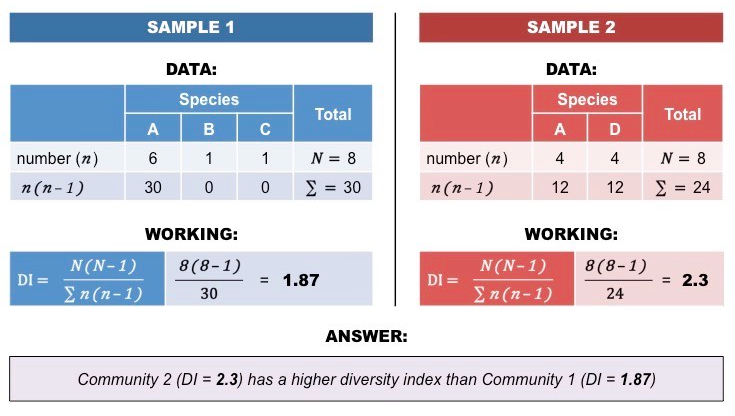
Every ecosystem contains a unique collection of species, all interacting with each other. Some ecosystems may have many more species than another. In some ecosystems, one species has grown so large that it dominates the natural community. When comparing the biodiversity of ecosystems, an ecosystem that has a large number of species, but no species greatly outnumbering the rest, would be considered to have the most species diversity. A large number of species can help an ecosystem recover from ecological threats, even if some species go extinct.
Species diversity can be further examined by comparing species richness with species evenness.
Species richness is the number of different species in a given area, regardless of how many individuals of each species exist.
Species evenness is a measure of the relative abundance, or the comparative numbers of individuals of each species present. The more even the numbers of individuals in each species in a community, the higher the species evenness in that community.
Species dominance is when the members of one or two species greatly outnumber members of other species.
You need to compare species richness and species evenness to get a true picture of species diversity in an area.
Genetic Diversity
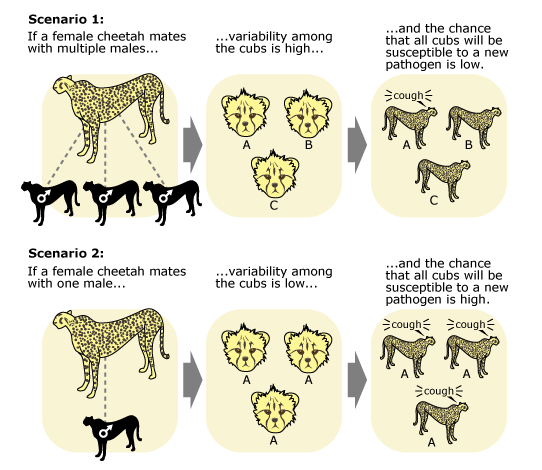
Genetic diversity describes how closely related the members of one species are in a given ecosystem. In simple terms, if all members have many similar genes, the species has low genetic diversity. Because of their small populations, endangered species may have low genetic diversity due to inbreeding. This can pose a threat to a population if it leads to inheritance of undesirable traits or makes the species more susceptible to disease. Having high genetic diversity helps species adapt to changing environments.
1
Look at the image above. How has the described mating behavior of cheetahs improved their genetic diversity? How does that increase the cheetah's chances of survival?
1
Why do you think that genetic diversity leads to resiliance and increased chances of species survival?
1
Which of the following areas would you expect to have the highest ecosystem diversity?
Functional Diversity
The way species behave, obtain food and use the natural resources of an ecosystem is known as functional diversity. In general a species-rich ecosystem is presumed to have high functional diversity, because there are many species with many different behaviors. Understanding an ecosystem’s functional diversity can be useful to ecologists trying to conserve or restore damaged it, because knowing the behaviors and roles of species can point to gaps in a food cycle or ecological niches that are lacking species.