APES Net Primary Productivity Lab

Last updated over 3 years ago
15 questions

Background Information:

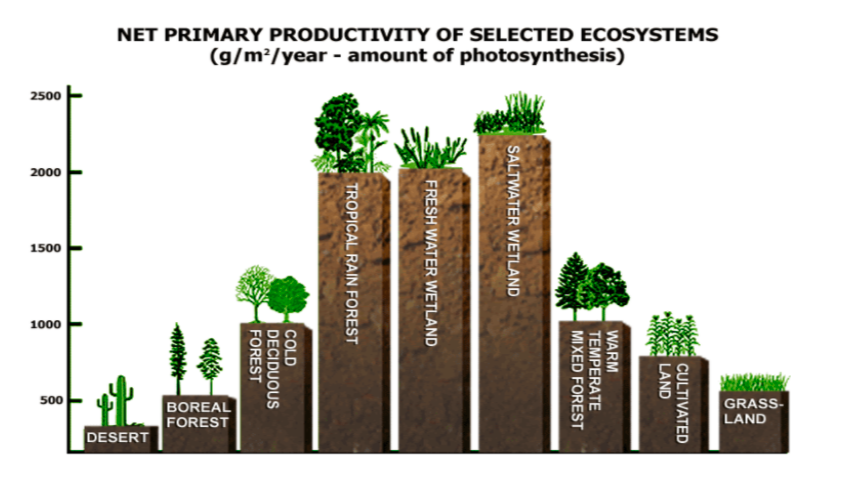
The rate at which an ecosystem’s producers (plants) convert solar energy into chemical energy as biomass is the ecosystem’s gross primary productivity (GPP). To stay alive, grow and reproduce, plants must use some of the total biomass they produce for their own respiration. What is left, net primary productivity (NPP) is available for use as food for consumers. NPP is the rate of the quantity of new vegetation that is added per day, per week, or per year. NPP is calculated as the total gain of biomass from photosynthesis minus the losses due to plant respiration. The higher the NPP is in a region, the higher the overall biomass and (usually) the biodiversity (see diagram).

How it is measured:
Net primary productivity is measured in the amount of energy or mass available to consumers in a certain area over a given time. The units are either (kcal/m2/yr) or (g/m2/yr). You will measure NPP in an artificial ecosystem by harvesting, drying, and weighing the dry biomass of the grass seedlings.

Materials:
Your container of grown grass
Aluminum foil
Scissors
Sharpie pen
Electronic balance
Oven or Plant press
DAY 1

1

How many days did your grass grow?

1

Calculate the growing area in your container in cm2.

1

BEFORE CUTTING, take a photo of your grass and place it in the "show your work" box. Then make some qualitative observations of your grass and write them below.
a) Describe how your grass looks. Does it look healthy, shorter/taller than you expected, straight/curved/split blades, etc.?
b) How does your soil appear? Does it look different than when you planted the seeds? GIVE A REASON FOR YOUR ANSWER.

Get a small sheet of aluminum foil and make a small tray for placing the cut grass. Write your name on the foil where it can easily be seen and mass the tray.
1

Mass of empty foil tray: (don’t forget units!)

Harvest your grass by clipping each blade off just above the soil surface (use scissors). Try to get as much of the grass leaf as you can without getting soil mixed in.

As you cut your grass, place the clippings in the foil tray. Mass your grass with the tray (with no soil) – and record it. This is your freshly cut mass. Remember to deduct the mass of the tray!
1

Mass of foil tray with grass – Mass of empty foil tray = Mass of fresh grass

1

It is very difficult to accurately measure GPP, since it includes the energy lost to respiration. For the purposes of this lab, we will use the mass of the grass before drying as the total GPP. Calculate the GPP of your grass crop by dividing that mass by the area of the pot and then the number of days of growth..

GPP of your grass = _____________________ g/cm2/day

Place the foil tray with the grass in the drying oven until the next class (or until I tell you.)
or
Place the grass in a plant press to be dried out.

Clean up at the end of the first day:
  • Place remaining soil/roots into the composter in the greenhouse. Mix all types.
  • DO NOT rinse the container. DO NOT pour soil into the sink!
  • Make sure desks/tables have been wiped down and cleaned.

DAY 2

1

Re-mass your dried grass. Remember to deduct the mass of the tray!
Mass of foil tray with grass – Mass of empty foil tray = Mass of dried grass

1

Calculate the NPP of your grass crop.
NPP of your grass = _____________________ g/cm2/day

ANALYSIS QUESTIONS

1

What is the actual difference between gross primary productivity (GPP) and net primary productivity (NPP)? (It is not water weight; that is what we used as a VERY rough estimate for this lab.)

1

Why do we need to dry the grass in order to calculate the NPP?

1

Research this question online: Why is it important for ecologists to understand the NPP rate of an ecosystem?

1

Rather than planting your grass in a small container, suppose you grew it in a 1 km2 field. What would be the NPP for the field? (Hint: You need to start with your answer from #9).

1

Now suppose you grew your grass in that field for an entire year. Calculate the NPP.

1

With NPP in mind, consider this: In a place like the Serengeti (Tanzania) there is a 6-month wet season followed by a 6-month drought. Explain the probable reason for large animal migrations (such as wildebeest).

1

In the eastern U.S., especially from Massachusetts to Virginia, climax hardwood forests are being rapidly replaced with large, single-family homes with large yards, golf courses and townhouse complexes. Despite this habitat destruction/fragmentation, deer herds in those states (including here in Pennsylvania!) have drastically increased. Give one reason why the deer herds in those states have increased. (In order to draft an informed answer, you may need to research what deer eat. Also, do not forget to make a connection with the purpose of this lab.)