Twa kɔ nsɛm atitiriw so
Log in
Sign up for FREE
arrow_back
Laabri

Formation of Planets

star
star
star
star
star
Last updated about 4 years ago
8 Nsɛmmisa

Unit Objective: Students can apply scientific reasoning and evidence to construct an account of Earth’s formation and early history.

Lesson Objective: Students can obtain information from a reading and communicate information verbally about the formation of the Earth, Moon and other planets.

Part 1: How do planets form?

Read and watch this video. https://www.youtube.com/watch?v=qhwpBxPwlj8

1
1
1
1
1
1
1
1
Asemmisa {{asɛmmisaAhyɛnsode}}
1.

What is the frost line? Which planets are on the inside of the frost line (closer to the Sun) and which planets are on the outside of the frost line (farther away from the Sun?)

Asemmisa {{asɛmmisaAhyɛnsode}}
2.

What is accretion?

Asemmisa {{asɛmmisaAhyɛnsode}}
3.

Explain in your own words how terrestrial planets, like Earth, form. Where in the solar system can they form?

Asemmisa {{asɛmmisaAhyɛnsode}}
4.

Explain in your own words how jovian planets, like Jupiter, form. Where in the solar system can they form?

Asemmisa {{asɛmmisaAhyɛnsode}}
5.

Could a jovian planet form very close to a star? Why or why not?

Part 2: How do moons form?

Read and watch this video.

https://www.youtube.com/watch?v=o2lRpiediP8

Asemmisa {{asɛmmisaAhyɛnsode}}
6.

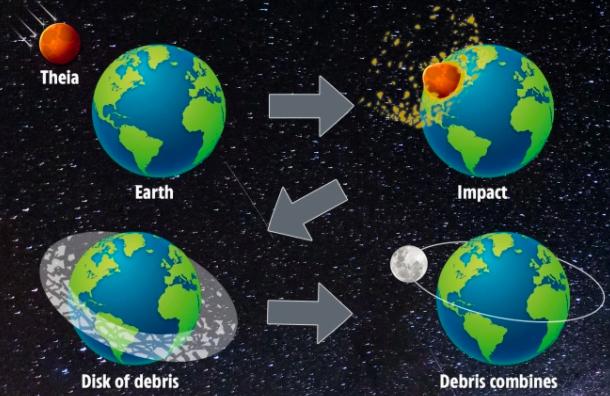
What are the four main theories scientists have to explain the formation of Earth’s moon. List and describe each.

Asemmisa {{asɛmmisaAhyɛnsode}}
7.

What evidence do scientists have to support the giant impact theory?

Asemmisa {{asɛmmisaAhyɛnsode}}
8.

What explanation does Sara give for why we don’t have a lot of impact craters on Earth but there are many visible on the moon?