Period 3, Day 5-6 Classwork: The Boston Massacre and Revolutionary War

Last updated over 1 year ago
13 questions
Note from the author:
Content Objective: I will be able to compare the perspective of two different portrayals of the Boston Massacre.
Standard Objective: I will be able to determine the point of view or perspective from which an image is related.

Warm Up: Please answer the following questions based on your understanding of last night’s pre-work:
Content Objective: I will be able to compare the perspective of two different portrayals of the Boston Massacre.
Standard Objective: I will be able to determine the point of view or perspective from which an image is related.

Warm Up: Please answer the following questions based on your understanding of last night’s pre-work:
0

Please rate how well you understood last night's pre-work on a scale from 1 to 4. If you have any questions, drop them in the "Show Your Work" area.

1

Have you ever participated in a protest? Demonstrate your mastery of Contextualization by telling the (hi)story of your experience.

1

Warm Up: One interesting historical fact I learned from the pre-work is…

1

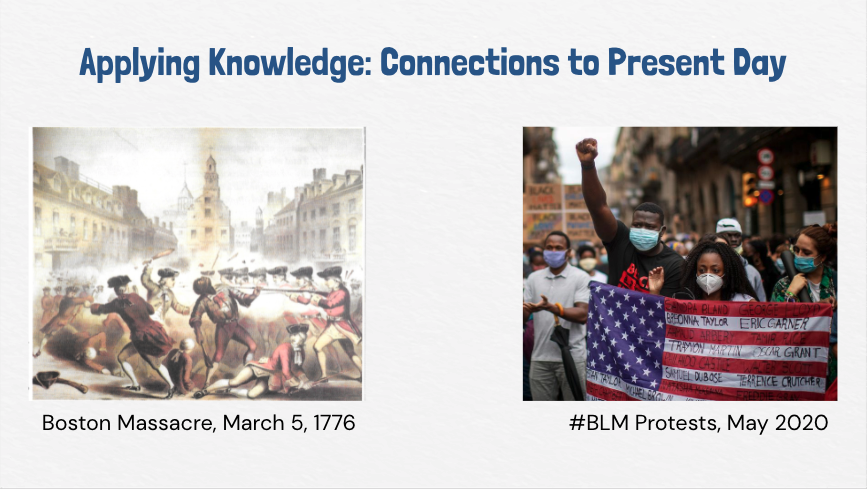
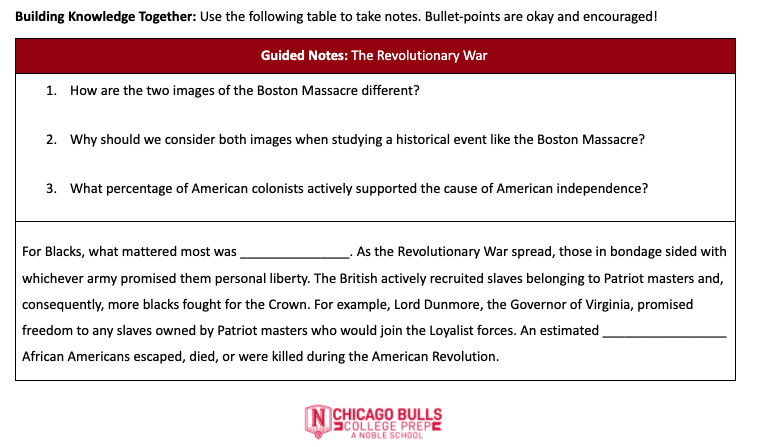
How are the two images of the Boston Massacre different?

1

Why should we consider both images when studying a historical event like the Boston Massacre?
1

What percentage of American colonists actively supported the cause of American independence (i.e. considered themselves to be Patriots)?

1

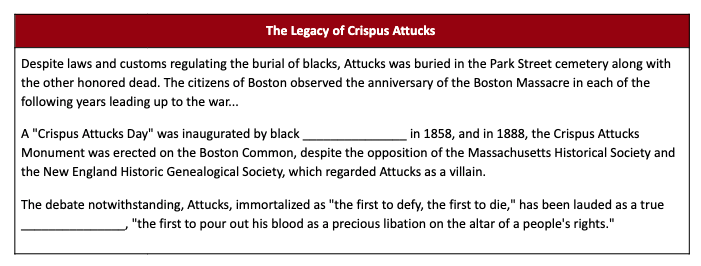
What word goes in the first blank?

1

What word goes in the second blank?

1

Why do you think that Champney chose to include Crispus Attucks in the image on the right whereas Revere completely leaves him out of his portrayal of the Boston Massacre on the left?

Revolutionary Event #2: Boycotts as a form of protest by the Sons and Daughters of Liberty in the 1760s and 1770s to stop using British goods and in favor of products made in the colonies.
1

How is the Revolutionary spirit of boycotts reflected in our lives today?

Revolutionary Event #5: Colonial resistance led to violence on March 5, 1770, when British soldiers opened fire on a crowd of colonists. The British officer in charge and five of his men were charged with killing five men including Crispus Attucks, a “mulatto” or mixed race man who was credited as the leader and instigator of the event.
1

How is the spirit of the Boston Massacre reflected in our lives today?

1

Exit Ticket: In what ways should we consider Crispus Attucks a martyr? How does his story represent a larger narrative of how Black men are depicted in American history?

0

Please evaluate how well you understood today’s lesson on a scale from 1 to 4: