Log in
Sign up for FREE
arrow_back
Library

Gas Laws TEST Question Bank 📅Thu 12.01.22

star
star
star
star
star
Last updated over 3 years ago
34 questions
1
1
1
1
1
1
1
1
1
1
1
1
1
Question 1
1.

Question 2
2.

Question 3
3.

A can of spray paint has a pressure of 1.76 atm at 296.15K. If the can is thrown into a fire (475K), what will be the pressure in the hot can?
1
1
1
A balloon that is 100.21L at 294.15K and 0.981 atm is released and just barely clears the top of Mount Crumpet in British Columbia. If the final volume of the balloon is 144.53L at a temperature of 278.39K, what is the pressure experienced by the balloon as it clears Mount Crumpet?
1
1
1
Question 10
10.

Question 11
11.

Question 12
12.

Question 13
13.

Question 14
14.

1
1
1
Question 18
18.

Question 19
19.

1 mole = ? molecules

Question 20
20.

Energy in motion?

Question 21
21.

Question 22
22.

P1 = 2 atm
T1 = 212.12K
P2 = ?
T2 = 400.04K
1
1
1
V1 = 12.01L
T1 = 273.15K
V2 = ?
T2 = 600.21K
1
1
1
P1 = 26.11mmHg
V1 = 0.76L
P2 = ?
V2 = 2.41L
1
1
1
I produce a gas in lab that has a temperature of 295.15K. I know that the pressure is 1atm and that 3.42 moles were produced. What is the volume?

R = 0.0821 atmL/moleK
1
1
1
Unit for temperature?
unicorns
moles
stone
L
seconds
K
F
mmHg
yards
leagues
atm
nautical miles
inHg
fathoms
Unit for volume?
fathoms
stone
F
K
nautical miles
moles
leagues
L
atm
inHg
mmHg
seconds
unicorns
yards
Unit for n?
seconds
moles
K
stone
fathoms
leagues
atm
F
unicorns
mmHg
L
nautical miles
inHg
yards
Question 4
4.

Question 5
5.

Question 6
6.

What will be the pressure in the hot can?

Question 7
7.

Question 8
8.

Question 9
9.

What is the pressure experienced by the balloon as it clears Mount Crumpet?

Which state of matter can easily be compressed?
solid
liquid
gas
State of matter with a definite volume and definite shape?
solid
liquid
gas
plasma
State of matter that is a ionized gas?
solid
liquid
gas
plasma
State of matter that can be easily compressed?
solid
liquid
gas
Liquid
ordered molecules that vibrate in place
molecules that can flow past each other, interactions between molecules still exist
molecules have so much energy they are flying around
Question 15
15.

Question 16
16.

Question 17
17.

Force that pulls particles together?
phase change
freezing
surface tension
viscosity
Matter changing states is a
chemical change
physical change
Kinetic Theory of Matter
matter does not move unless it is a gas
matter has potential energy because it is always in motion
all matter consists of constantly moving particles
Question 23
23.

Question 24
24.

Question 25
25.

What is P2?

Question 26
26.

Question 27
27.

Question 28
28.

What is V2?

Question 29
29.

Question 30
30.

Question 31
31.

What is V2?

Question 32
32.

Question 33
33.

Question 34
34.

What is the volume?

What equation should you use to solve this problem?
Boyle's Law (P1V1 = P2V2)
Charles' Law (V1/T1 = V2/T2)
Gay-Lussac's Law (P1/T1 = P2/T2)
Combined Gas Law
Ideal Gas Law (PV=nRT)
What unit will the answer have?
K
atm
mmHg
moles
L
What equation should you use to solve this problem?
Boyle's Law (P1V1 = P2V2)
Charles' Law (V1/T1 = V2/T2)
Gay-Lussac's Law (P1/T1 = P2/T2)
Combined Gas Law
Ideal Gas Law (PV=nRT)
What unit will the answer have?
moles
mmHg
K
atm
L
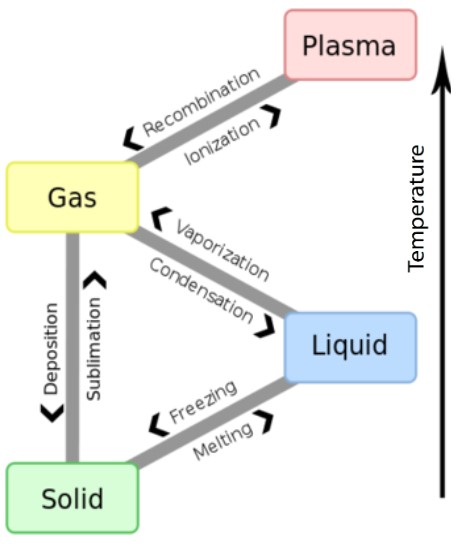
Gas to Plasma
melting
ionization
sublimation
vaporization
Liquid to Solid
deposition
sublimation
freezing
ionization
Solid to Gas
deposition
freezing
sublimation
condensation
What equation should you use to solve this problem?
Boyle's Law (P1V1 = P2V2)
Charles' Law (V1/T1 = V2/T2)
Gay-Lussac's Law (P1/T1 = P2/T2)
Combined Gas Law
Ideal Gas Law (PV=nRT)
What unit will the answer have?
K
mmHg
L
moles
atm
What equation should you use to solve this problem?
Boyle's Law (P1V1 = P2V2)
Charles' Law (V1/T1 = V2/T2)
Gay-Lussac's Law (P1/T1 = P2/T2)
Combined Gas Law
Ideal Gas Law (PV=nRT)
What unit will the answer have?
moles
L
atm
K
mmHg
What equation should you use to solve this problem?
Boyle's Law (P1V1 = P2V2)
Charles' Law (V1/T1 = V2/T2)
Gay-Lussac's Law (P1/T1 = P2/T2)
Combined Gas Law
Ideal Gas Law (PV=nRT)
What unit will the answer have?
L
K
moles
mmHg
atm
What equation should you use to solve this problem?
Boyle's Law (P1V1 = P2V2)
Charles' Law (V1/T1 = V2/T2)
Gay-Lussac's Law (P1/T1 = P2/T2)
Combined Gas Law
Ideal Gas Law (PV=nRT)
What unit will the answer have?
K
moles
mmHg
L
atm