Look at the picture. Put the following points in order from fastest to slowest wind speed:
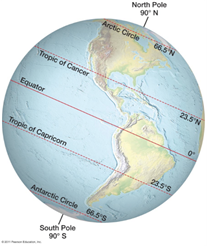
Look at the picture. Put the following points in order from fastest to slowest wind speed:
Arctic circle
Tropic of cancer
North pole
Equator
Read the section below and answer questions 1-4
There are some regions of the Earth that experience seasons characterized by changing temperatures and amounts of precipitation, while in other regions of the earth the temperature and precipitation stay pretty constant year-round. These conditions are the result of many different factors and influences that collectively determine the global climate – which we are going to talk about today.
To understand these factors, it is important first to distinguish between weather and climate. “Weather” describes short-term, specific conditions in an area, such as temperature, wind strength and direction, and precipitation in a specific region on a particular day. “Climate” refers to the long-term, collective, cumulative effects of these conditions on the region over a long period of time.
Things that affect global climate patterns include
(1) the tilt of the Earth and the rotation of the Earth on its axis,
(2) uneven heating of the Earth’s surface due to uneven amounts of sun/solar energy,
(3) convection currents, and
(4) the interactions of major air, land, and water masses, including the Coriolis effect.
Using a model globe and other materials, your group will explore important aspects of these mechanisms in greater detail over the course of these laboratory activities.
Describe the climate of Houston, TX.
What factors do you think might influence the climate of your particular region? (More than one answer)
What is the difference between weather and climate?
What are the four mechanisms that affect global climate patterns
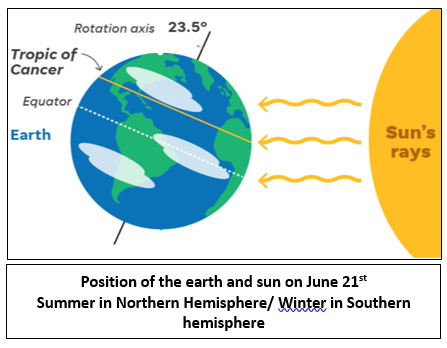
The Earth rotates from west to east at a tilt of 23.5°. Over the course of the Earth’s annual orbit, due to its tilt and rotation, the planet receives overall more solar radiation nearer the equator (the middle of the Earth) than it does at locations closer to the poles (the top and bottom of the Earth).
Distance from the equator is measured in degrees. Imagine measuring the curve of the Earth on a protractor, with the equator at the origin (0°). The Tropic of Cancer lies 23.5° north of the equator, and the Tropic of Capricorn lies 23.5° south of the equator. The Arctic Circle lies 66.5° north of the equator, and the Antarctic Circle lies 66.5° south of the equator. The poles are 90° north and south of the equator.
Consider two points on the Earth, one at the North Pole and a point at the equator. Over the course of one rotation of the planet, the Point at the North Pole would rotate once, moving in a very small circle. In the same amount of time, however, the point on the equator would have traveled, in a very large circle, almost 25,000 miles at 1,000 mph. This means, the Earth is moving faster at the equator than it is at the poles, and its speed is proportionally faster or slower at points between these.
What happens due to the Earth's tilt and rotation?
Where (at what degrees) are the following points found
| Draggable item | arrow_right_alt | Corresponding Item |
|---|---|---|
Tropic of Cancer | arrow_right_alt | 0o |
Tropic of Capricorn | arrow_right_alt | 23.5o N |
South Pole | arrow_right_alt | 23.5o S |
Equator | arrow_right_alt | 66.5o N |
Arctic Circle | arrow_right_alt | 90o N |
North Pole | arrow_right_alt | 90o S |
Which area of the earth would be spinning faster, an area close to the middle of the earth’s equator or an area closer to the South Pole?
Look at the picture. Put the following points in order from fastest to slowest wind speed:
Arctic circle
Tropic of cancer
North pole
Equator
Read the section below and answer questions 9-12
The sun gives off energy, known as solar energy, including light and heat. Some of this energy reaches the Earth as it orbits the sun while some of it gets reflected back into space. The amount of solar energy that any particular region on Earth receives is based on the mostly spherical shape of the Earth, the tilt of the Earth’s axis, and the angle of the sun’s rays. Let’s explore:
The regions close to the equator receive the most solar energy because they remain closer to the sun over the course of Earth’s orbit because they “stick out” further than the poles. This means that the regions near the North and South Poles receive less solar energy over the course of a year because these regions remain farther from the sun.
Annual seasonal changes can be attributed to the tilt of the Earth. On June 21st, the northern part of the Earth’s tilts toward the sun, and the regions at the Tropic of Cancer receive the most direct sunlight. This is when the Northern Hemisphere is not only in the summer season but also experiences the summer solstice or the most daylight hours of the year.
On the other hand, the Southern Hemisphere is experiencing winter at this time and has the fewest daylight hours of the year. On this day, June 21st, the Antarctic Circle receives no sunlight.
The opposite occurs on December 21st. On this day, the Tropic of Capricorn receives the most sunlight, and regions of the Southern Hemisphere experience the summer, while regions of the Northern Hemisphere experience winter. On December 21st, the Arctic Circle receives no sunlight.
Why do regions close to the equator receive more solar energy?
Why do regions near the poles receive less solar energy?
What happens on June 21st in the Northern and Southern hemispheres?
What happens on December 21st in the Northern and Southern hemispheres?
Activity 2: Solar Energy Distribution
Materials
Globe Flashlight
Procedure
1. Hold the inflatable globe upright, with the North Pole facing directly upward and the South Pole facing downward.
2. Have one person hold a flashlight and point the light at the equator of the globe.
3. Observe how the light from the flashlight is distributed across the globe.
4. Tilt the Earth slightly. Consult the figure to get an idea of the tilt of the Earth’s axis.
5. Have one person hold the glove and (without blocking the light) move in a circle around the person holding the flashlight. This represents the orbit of the Earth around the sun.
6. Shine the flashlight perpendicular to the glove, directly at the equator. As the glove orbits the flashlight, turn the flashlight so that it is always shining on the globe.
7. As you do so, observe how the light is distributed across the globe at different points of the globe’s rotation. Note the amount of “sunlight” received at the equator, at the poles, at the Tropic of Capricorn, and at the Tropic of Cancer, and consider how the amount of solar energy received would affect each region’s climate.
8. Answer the questions for Activity 2.
Which regions receive the most light?
Which regions receive the least light?
In terms of solar energy/light & temperature, how does June in the Northern Hemisphere compare with June in the Southern Hemisphere?
In terms of solar energy/light & temperature, how does December in Northern Hemisphere compare with December in Southern Hemisphere?
How does the amount of sunlight that a particular region receives influence the climate?