
What factors make up ClORPT?
How does climate affect soil formation?
How do organisms affect soil formation?
What is relief?
How does relief affect soil formation?
Where can the parent material for a soil come from?
How can time affect soils?
Fill in the table with the correct soil horizons: A, B, C, E, O, R
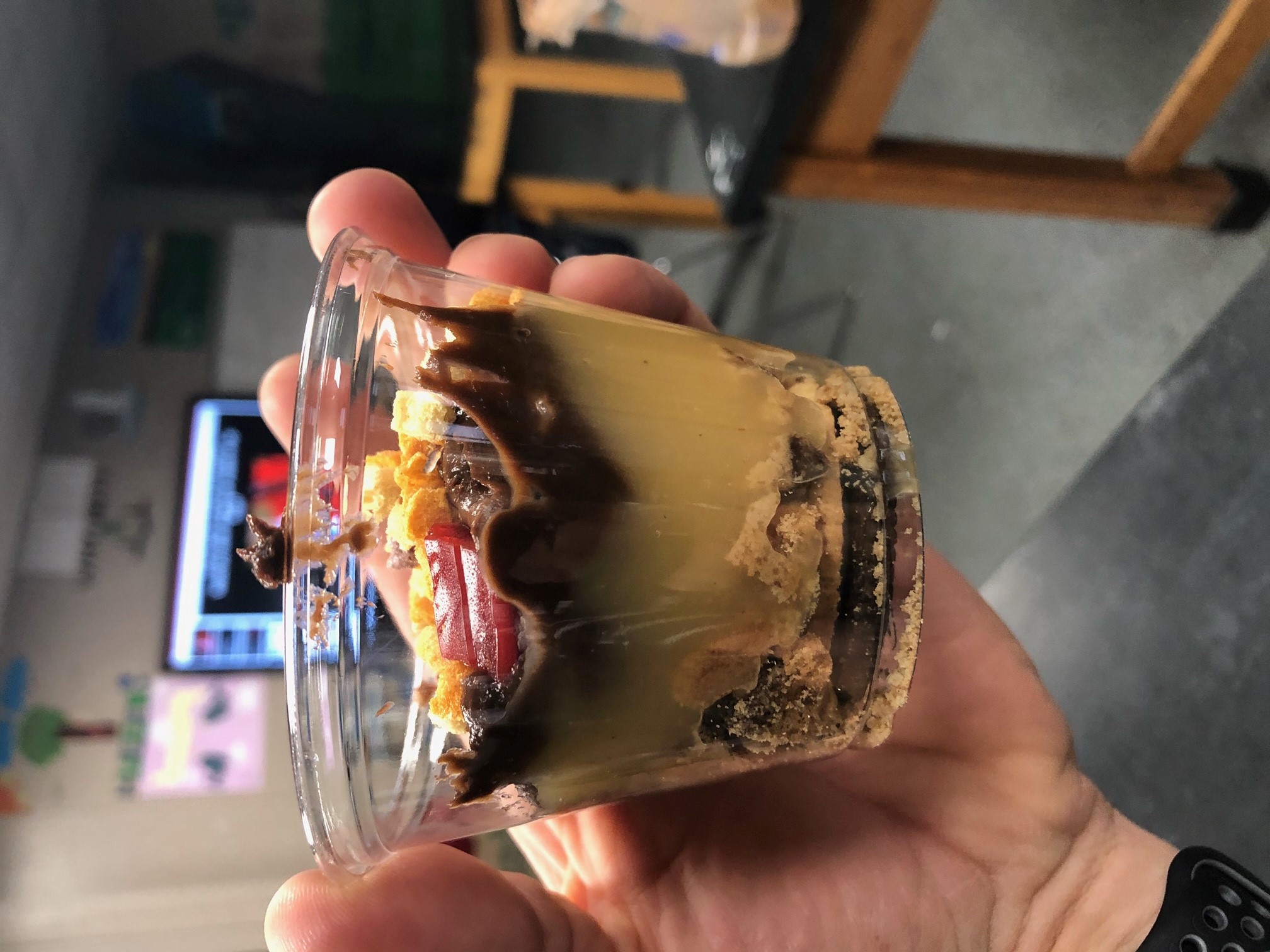
What types of material makes up the O Horizon?
How is the A Horizon different from the O?
What is the common process occurring the in B Horizon?
How are the C & R Horizons related?
Why do you think we are using an Oreo to represent horizon R?
Bedrock is solid rock. Parent material is formed from the bedrock after a long weathering process. There are two basic ways that weathering can happen.
What are the two main types of weathering?
How do the crumbled cookies represent horizon C?
Horizon B is also known as
Horizon A is also known as
What does the starburst represent?
The decomposed litter will become
In the cup below draw what you see in your cup. Label both the actual soil layer or part and the edible representation of the part.
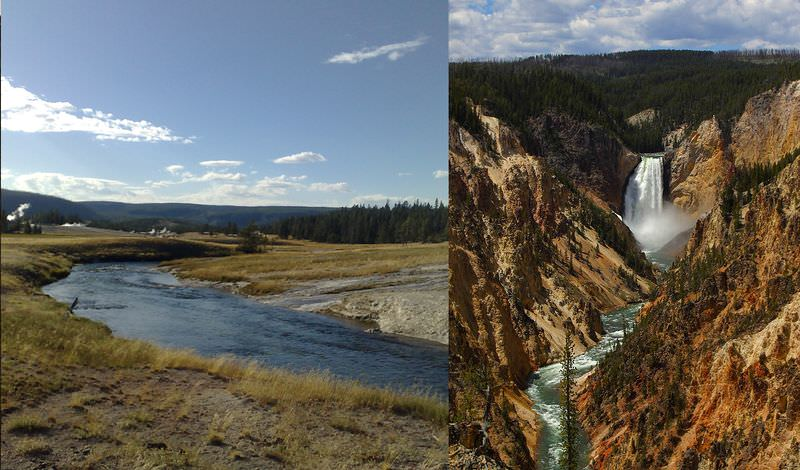
Both of these rivers run through Yellowstone National Park. The Firehole River is a tributary of the Madison. In this photo, it's flowing over flat ground. The Yellowstone River on the right is cascading over Yellowstone Falls. Which river is doing more erosion? In what direction is the stream eroding?
Which river is doing more erosion?
When a lot of rain falls in a short period of time, much of the water is unable to soak into the ground. Instead, it runs over the land. Gravity causes the water to flow from higher to lower ground. As the runoff flows, it may pick up loose bits of soil and sand.
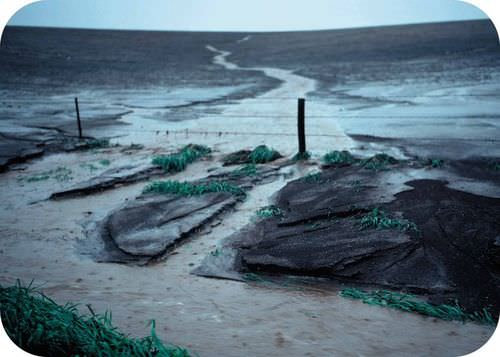
Runoff causes more erosion if the land is bare. Plants help hold the soil in place. The runoff water pictured below is brown because it eroded soil from a bare, sloping field.
What would stop erosion from an open field where soil is exposed?
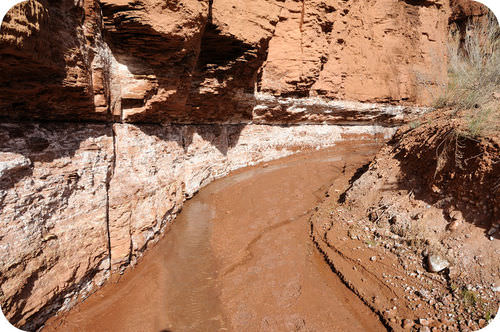
Streams erode sediment from their banks. They pick up and transport sediments.
What would stop erosion from the banks of a stream where soil is exposed?
Erosion by a stream depends on the velocity of the water. Fast water erodes more material than slow water. Eventually, the water deposits the materials. As water slows, larger particles are deposited first. As the water slows even more, smaller particles are deposited.
Streams often start in mountains, where the land is very steep. A mountain stream flows very quickly because of the steep slope. This causes a lot of erosion and very little deposition. The rapidly falling water digs down into the stream bed and makes it deeper. It carves a narrow, V-shaped channel.
Which of the following is more likely to occur?
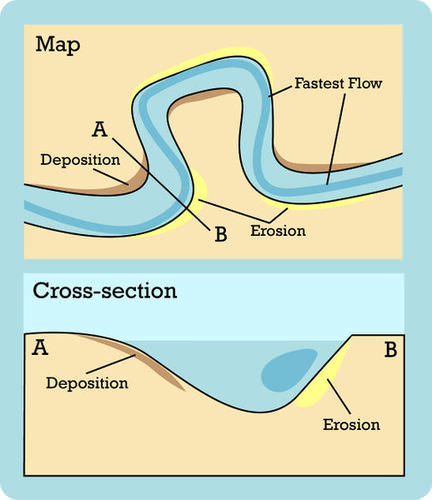
Streams eventually run onto flatter ground. Rivers flowing over gentle slopes erode the sides of their channels more than the bottom. Large curves, called meanders, form because of erosion and deposition by the moving water. The curves are called meanders because they slowly “wander,” or meander, over the land. Below, you can see how this happens.
Which of the following is true about slow-flowing rivers?
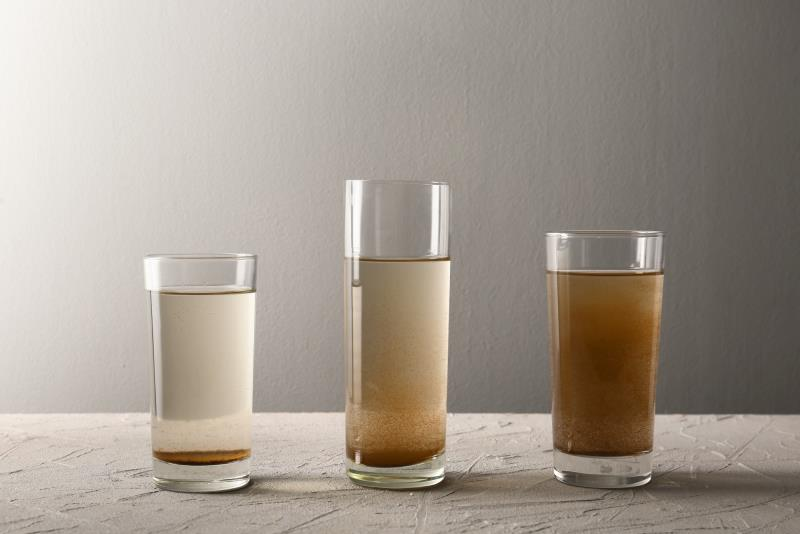
Turbidity is a measure of the degree to which the water loses its transparency due to the presence of suspended particulates. The more total suspended solids in the water, the murkier it seems, and the higher the turbidity. Turbidity is considered as a good measure of the quality of water.
Which of the following causes higher turbidity (more particles in the water (cloudy))?
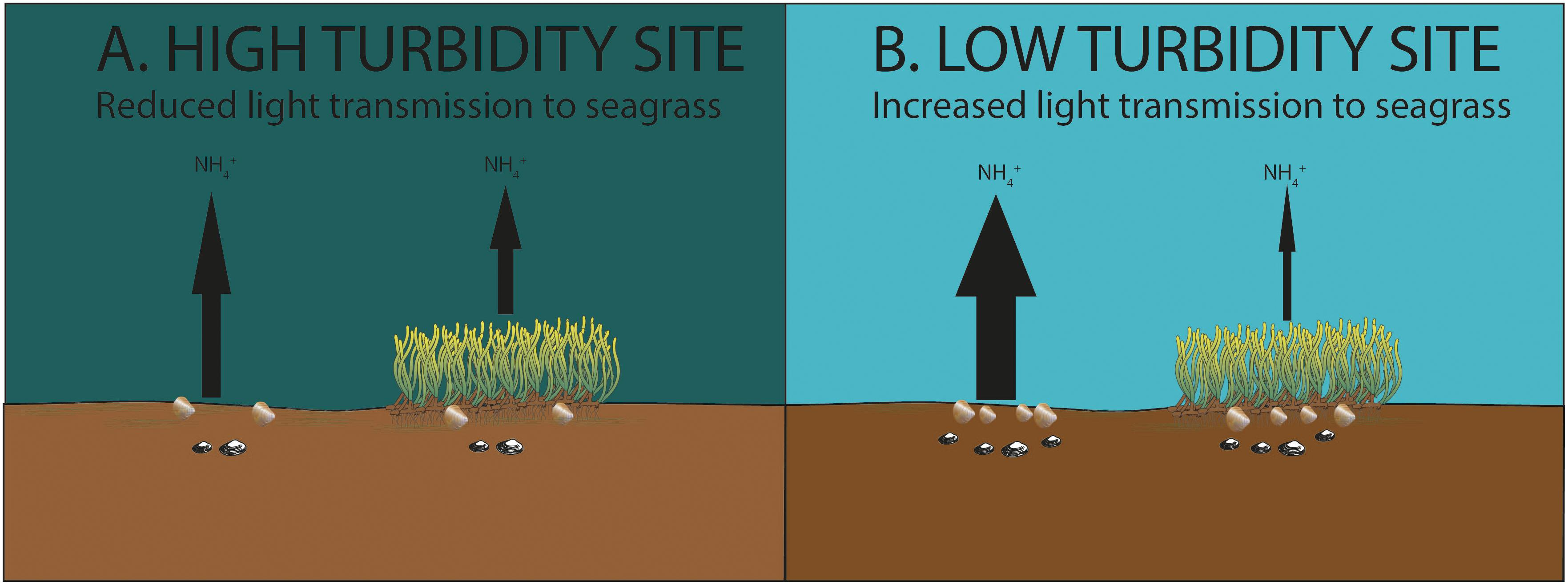
Turbidity (the increase of suspended solids (clarity)) of water has large impacts on the plants and animals that live in the body of water. Less sunlight can reach the organisms in the water if there is high turbidity.
What is the relationship between turbidity and sunlight reaching the bottom of a body of water?
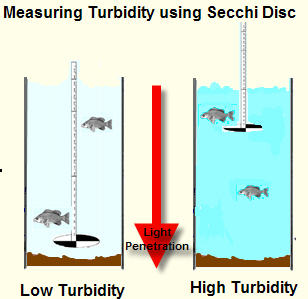
Turbidity is measured with a Secchi Disc. The further down the scientist can read the disc, the lower the turbidity.
A scientist uses a Secchi Disc to determine the turbidity of several locations along a river. She takes water samples along a river upstream (before) a new construction site (A), just downstream (after) a new construction site (B), and several miles downstream from a new construction site (C).
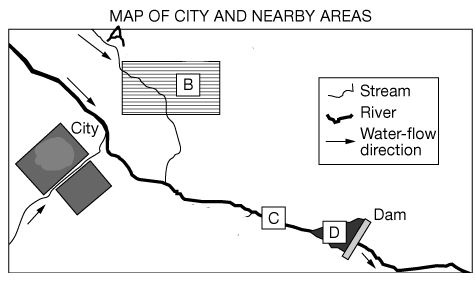
What is the likely outcome of the water samples for their turbidity?