On the sound wave in the show your work section, clearly label 1 compression, 1 rarefaction, and 1 wavelength.
Describe, in words below, how you would draw a sound wave with a lower amplitude.
4 points
4
Question 2
2.
In what state of matter do sound waves travel the quickest (solid, liquid, or gas)? Explain your choice.
4 points
4
Question 3
3.
A ray of light has a frequency of 5.75 x 10¹⁴ Hz. Determine the wavelength.
Type your numerical answer below with units. Show your work in the show your work section.
Instructions:
Include units in your answer
Separate your number and unit with a space (4 kg not 4kg)
Use the shorthand of the unit (kg not kilograms)
Use the keyboard to add scientific notation, exponents, and other math functions
All answers need to be in decimal form (0.2 not 1/5)
Equations:
v =f x λ
c = f x λ
f = 1/T
v = wave speed
f = frequency
λ = wavelength
c = 2.99 x 10⁸ m/s speed of light
T = period
4 points
4
Question 4
4.
Look at the drawing in the show your work section. What type of wave behavior will occur? Choose one option, then draw what will happen when the waves meet and how they will travel after.
Include amplitude labels for the meet and after drawings.
Include arrows in the after drawing to show wave direction.
4 points
4
Question 5
5.
A police car has its siren on and is moving to the left toward an observer. In the show your work section, draw the spherical wave representation of the situation. Label the source and observer.
Describe how the observed frequency will differ from the source frequency. Explain your reasoning.
4 points
4
Question 6
6.
On the wave in the show your work section,label the crest and trough.
Based off the wave in the show your work section, determine the amplitude, period and frequency. Record the numerical answers with units in the blue boxes below.
Amplitude:_______
Period:_______
Frequency:_______
Instructions:
Include units in your answer
Separate your number and unit with a space (4 kg not 4kg)
Use the shorthand of the unit (kg not kilograms)
Use the keyboard to add scientific notation, exponents, and other math functions
All answers need to be in decimal form (0.2 not 1/5)
Equations:
v =f x λ
c = f x λ
f = 1/T
v = wave speed
f = frequency
λ = wavelength
c = 2.99 x 10⁸ m/s speed of light
T = period
8 points
8
Question 7
7.
A red laser is directed from air to a glass semicircle. Some light is reflected and some light is refracted. The speed of light in glass is slower than in air.
Draw and clearly label:
the normal line
reflected ray (make sure to show direction with an arrow head)
refracted ray (make sure to show direction with an arrow head)
the angle of incidence
the angle of reflection
the angle of refraction
4 points
4
Question 8
8.
Infrared light with a frequency of 3.0 x 10¹⁴ Hz is shining on platinum. No electrons are being emitted from platinum.
Describe what a scientist should do to release electrons from platinum. Explain how your choice would allow for the ejection of electrons.
You can create exponents by highlighting the number and clicking on the superscript button (x2)
4 points
4
Question 9
9.
The threshold frequency of sodium is 4.4 x 10¹⁴ Hz and this frequency light beam is shining on sodium. If the light beam's frequency is increased to 6.7 x 10¹⁴ Hz...
Describe how will the kinetic energy of the ejected electrons change (increase, decrease, no change). Explain your reasoning.
You can create exponents by highlighting the number and clicking on the superscript button (x2)
4 points
4
Question 10
10.
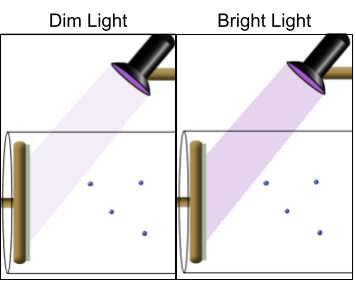
The image above shows a dim and bright purple light shining on calcium. The purple light shown in each scenario has a frequency that is above the threshold frequency for calcium.
Describe how electron emission will differ between the dim light and bright light scenarios. Explain why this occurs.
4 points
4
Question 11
11.
An interference pattern is shown below.
Clearly label the places of constructive and destructive interference.
On the black screen draw and clearly label the light and dark fringes that would be created from the interference pattern.
4 points
4
Question 12
12.
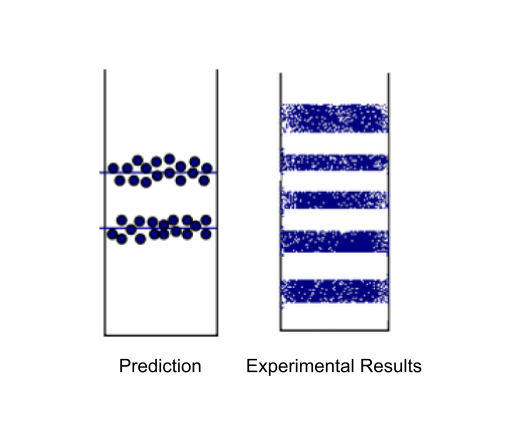
In the double slit experiment, light was shone through two slits and the pattern that the light created was observed on a screen. Scientists predicted to see two bright bands as shown in the left image. The experimental results are shown on the right image.
Do the experimental results support the particle or wave theory of light? Explain your reasoning.