Open this document to take your notes and help make meaning before putting this into practice. There will also be interactions on these slides.
This would be put into teach paced mode and students would follow along and interact throughout the lesson. There is a digital notetaking file added. This could also be added into a folder if the lesson concept had multiple components to it or would take multiple days.
Rephrase the learning targets into your own words.
In your own words, explain how you'll demonstrate your own learning.
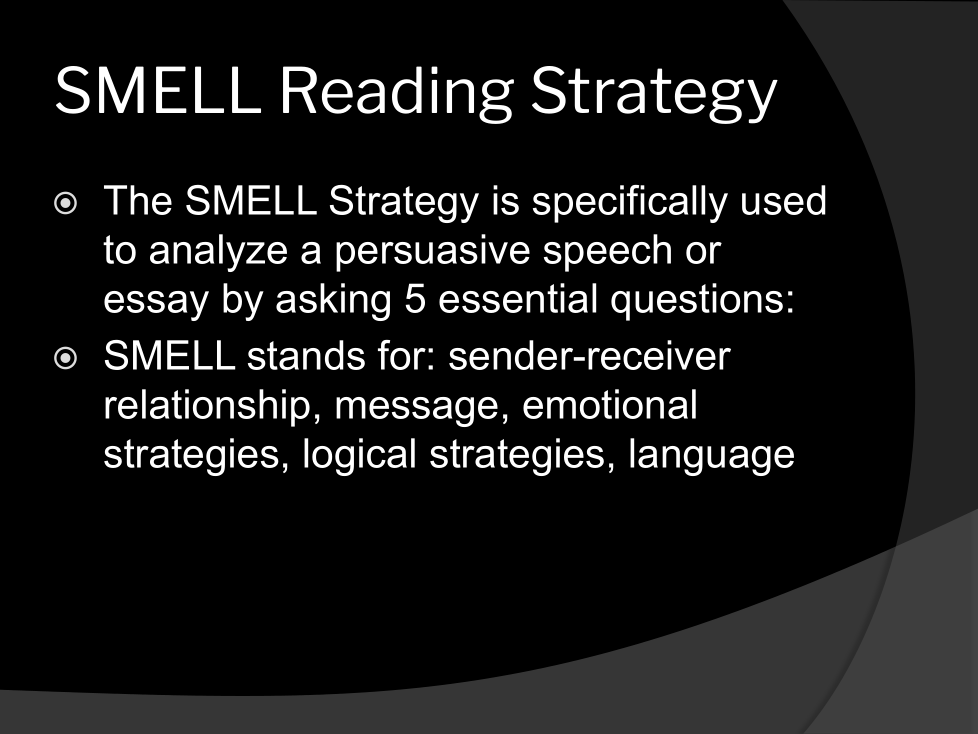

Summarize "S"
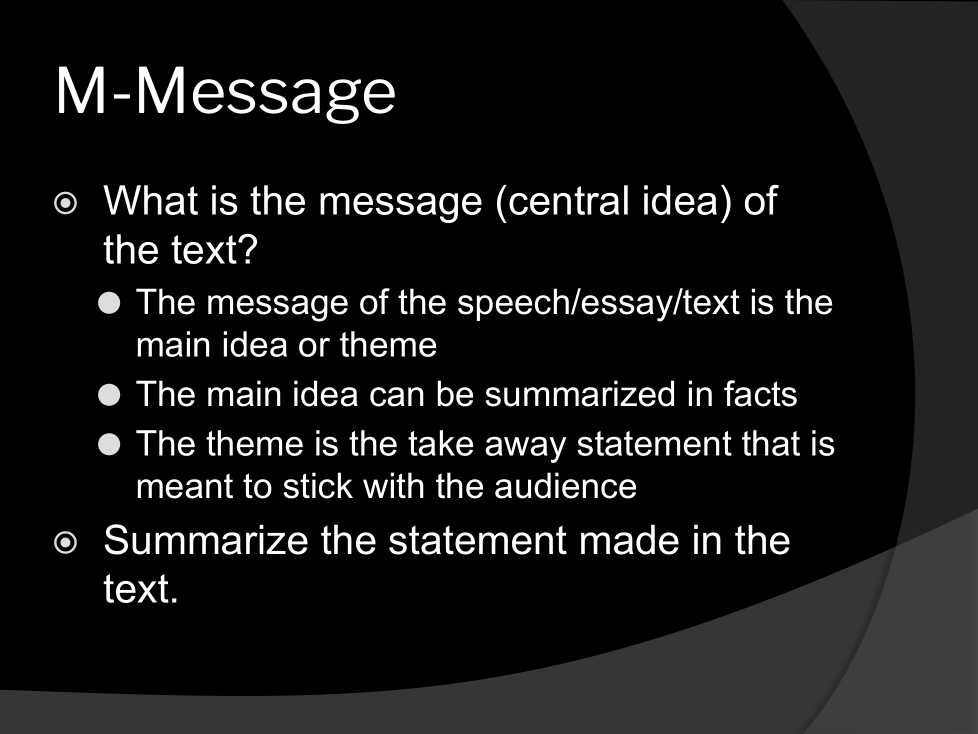
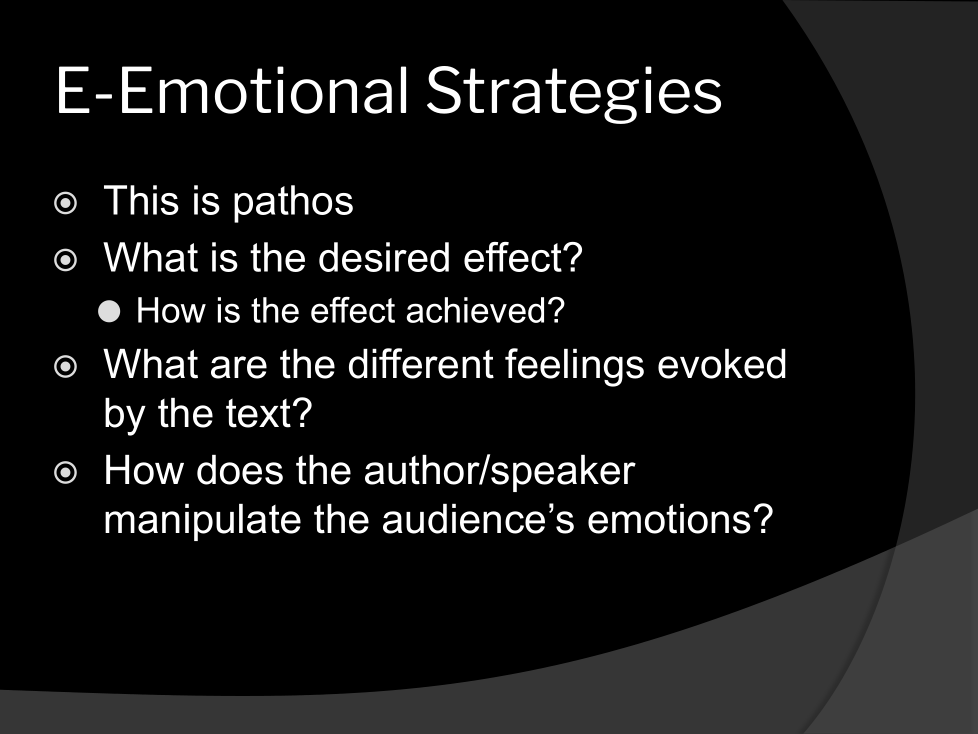
Summarize how this video used pathos.
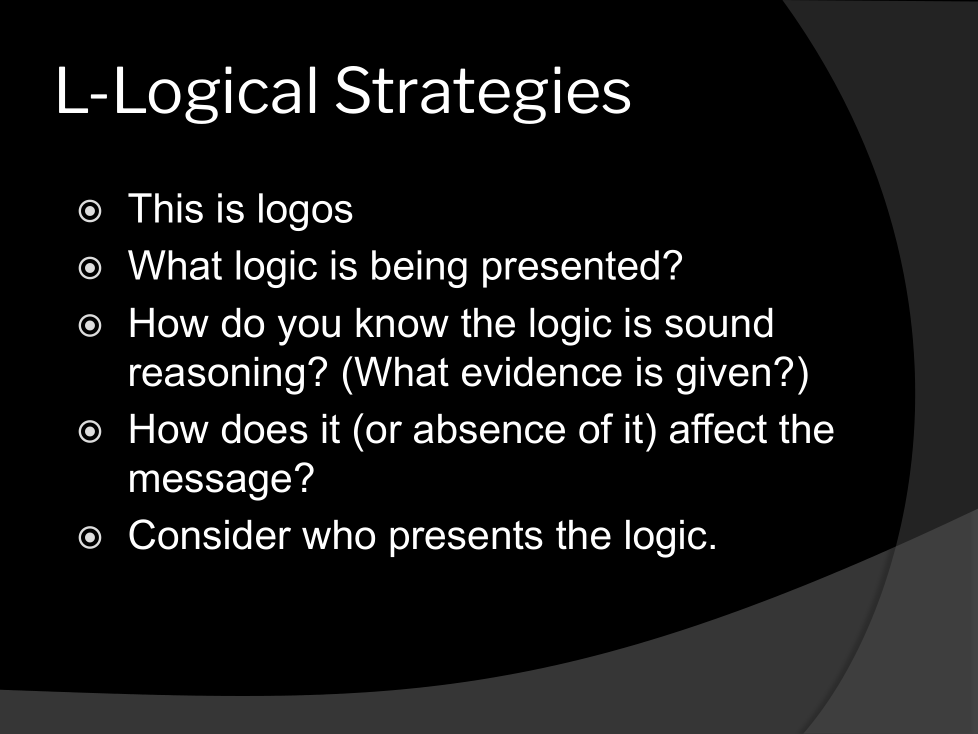
Who uses a logical strategy or illogical strategy? Is it effecive?
Strategy Check: Match the letter to the description for the SMELL strategy
| Draggable item | arrow_right_alt | Corresponding Item |
|---|---|---|
M | arrow_right_alt | How the author or speaker reaches the audience. What strategies or language would appeal to the audience? What does the author use to attract and appeal to an audience? What is the connection between the audience and author/speaker? |
L2 | arrow_right_alt | What is the main take away from the author/speaker? What does the speaker/author want the audience to do? What is the main idea? |
S | arrow_right_alt | What tactics are used to help the audience feel something? What is the audience supposed to feel? What feelings does the speaker convey? This is pathos. |
E | arrow_right_alt | What tactics are used to help make a logical or sensical understanding of the information for the audience? Uses evidence to support a claim. This is logos. |
L1 | arrow_right_alt | What diction is used? Formal/informal, connotation/denotation, repetition, sound devices, etc. |
If you use the file above, please upload it here. If you choose not to use it, please complete the following questions.
S
Part 3: Paragraph Practice
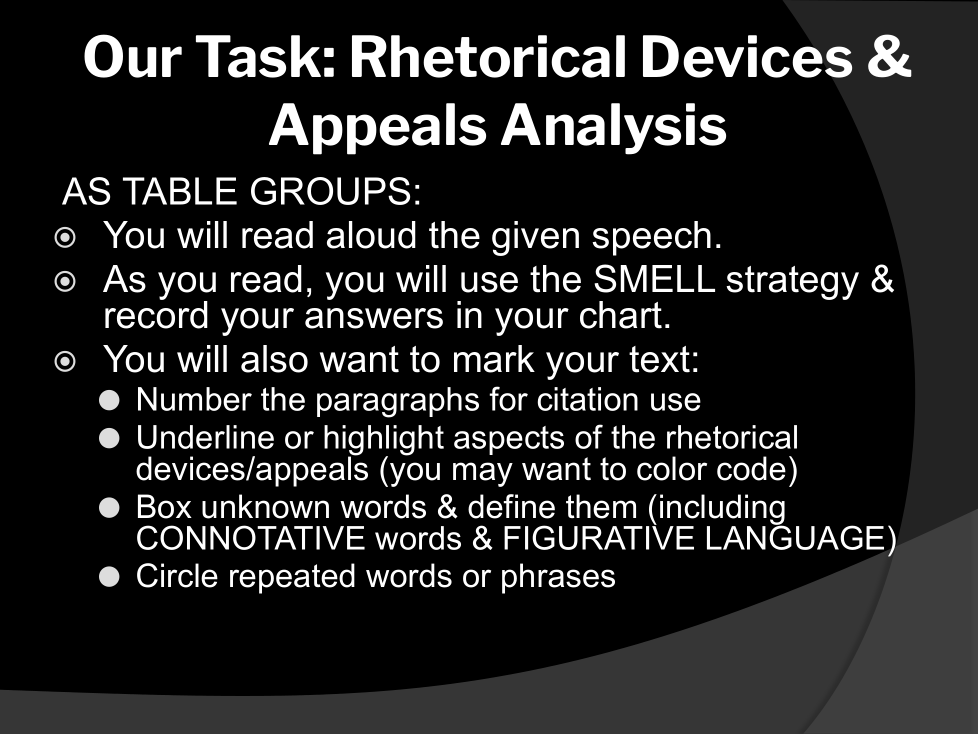
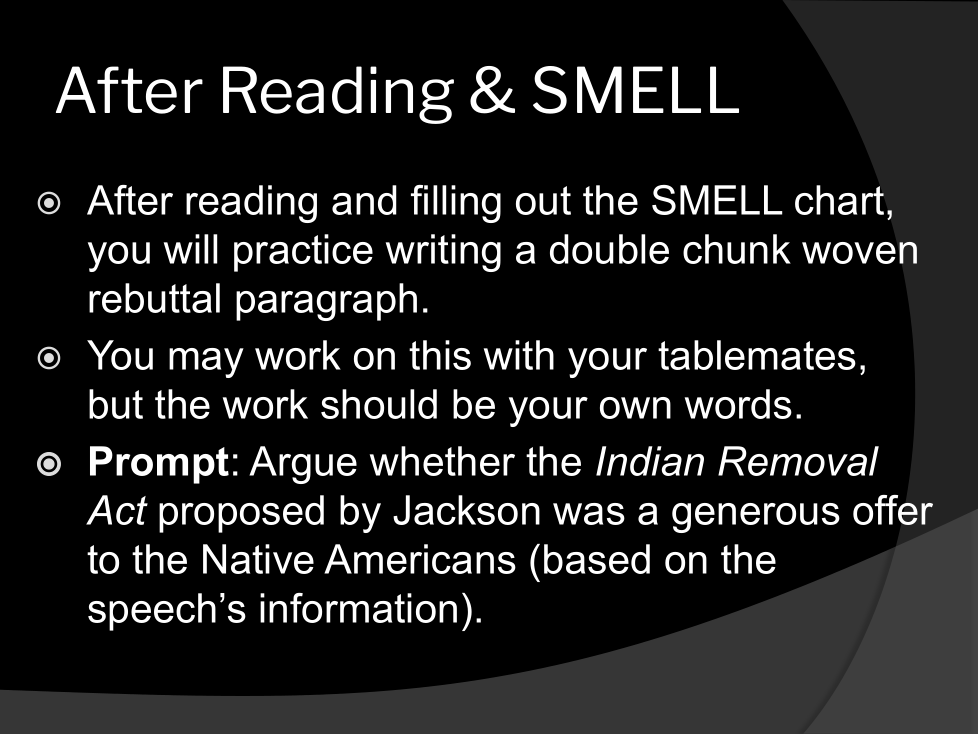
Prompt: Argue whether the Indian Removal Act proposed by Jackson was a generous offer to the Native Americans (based on the speech's information). Include references to rhetorical appeals in your explanation.
Andrew Jackson’s Message “On Indian Removal”
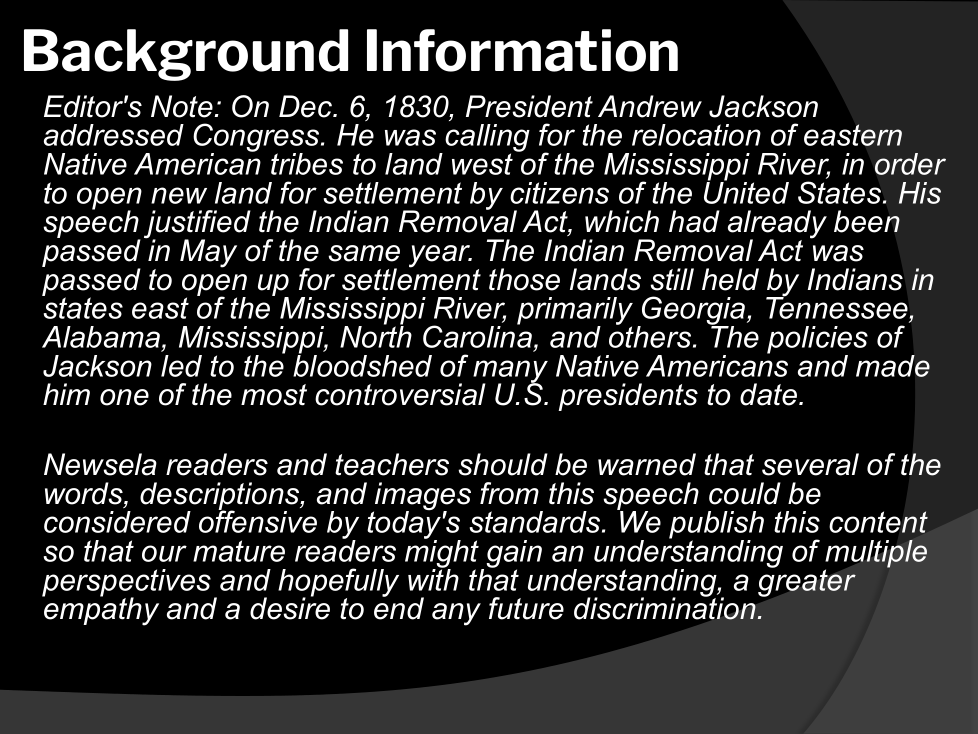
Editor's Note: On Dec. 6, 1830, President Andrew Jackson addressed Congress. He was calling for the relocation of eastern Native American tribes to land west of the Mississippi River, in order to open new land for settlement by citizens of the United States. His speech justified the Indian Removal Act, which had already been passed in May of the same year. The Indian Removal Act was passed to open up for settlement those lands still held by Indians in states east of the Mississippi River, primarily Georgia, Tennessee, Alabama, Mississippi, North Carolina, and others. The policies of Jackson led to the bloodshed of many Native Americans and made him one of the most controversial U.S. presidents to date. Newsela readers and teachers should be warned that several of the words, descriptions, and images from this speech could be considered offensive by today's standards. We publish this content so that our mature readers might gain an understanding of multiple perspectives and hopefully with that understanding, a greater empathy and a desire to end any future discrimination.
It gives me pleasure to announce to Congress that the benevolent policy of the Government, in relation to the removal of the Indians beyond the white settlements is approaching to a happy consummation. This policy has been steadily pursued for nearly thirty years. Two important tribes have accepted the provision made for their removal at the last session of Congress. It is believed that their example will encourage the remaining tribes also to seek the same obvious advantages.
The consequences of a speedy removal will be important to the United States, to individual States, and to the Indians themselves. The financial advantages which it promises to the Government are the least of its recommendations. It puts an end to all possible danger of collision between the authorities of the Federal and State Governments on account of the Indians. It will place a dense and civilized population in large tracts of country now occupied by a few savage hunters. By opening the whole territory between Tennessee on the north and Louisiana on the south to the settlement of the whites it will incalculably strengthen the southwestern frontier. It will also render the adjacent States strong enough to fight off future invasions without outside help. It will relieve the whole State of Mississippi and the western part of Alabama of Indian occupancy, and enable those States to advance rapidly in population, wealth, and power. It will separate the Indians from immediate contact with settlements of whites and free them from the power of the States. It will enable them to pursue happiness in their own way and under their own rude institutions. It will slow the progress of decay, which is lessening their numbers. Perhaps it will cause them gradually, under the protection of the Government and through the influence of good counsels, to cast off their savage habits and become an interesting, civilized, and Christian community.
What good man would prefer a country covered with forests and ranged by a few thousand savages to our extensive Republic? Who would not prefer a land studded with cities, towns, and prosperous farms embellished with all the improvements which art can devise or industry execute? Who would not prefer a land occupied by more than 12,000,000 happy people, and filled with all the blessings of liberty, civilization and religion?
"It Will Be Painful To Leave"
The present policy of the Government is but a continuation of the same progressive change by a milder process. The tribes which occupied the land now constituting the Eastern States were annihilated or have melted away to make room for the whites. The waves of population and civilization are rolling westward. We now propose to acquire the land occupied by the red men of the South and West by a fair exchange, and, aat the expense of the United States. We propose to send them to land where their existence may be prolonged and perhaps made perpetual. Doubtless it will be painful to leave the graves of their fathers; but how is that different than what our ancestors did or what our children are now doing? To better their condition in an unknown land our forefathers left all that was dear in earthly objects. Our children by thousands yearly leave the land of their birth to seek new homes in distant regions. Does Humanity weep at these painful separations from everything, living and nonliving, with which the young heart has become entwined? Far from it. It is rather a source of joy that our country offers space where our young population may range unconstrained in body or in mind, developing the power and facilities of man in their highest perfection. These young people move hundreds and almost thousands of miles at their own expense, purchase the lands they occupy, and support themselves in their new homes from the moment of their arrival. Because of events which the Government cannot control, the Indian has been made discontented in his ancient home. Is it cruel of the Government then to purchase the Indian's lands, give him a new and extensive territory, pay the expense of his removal, and support him a year in his new abode? How many thousands of our own people would gladly embrace the opportunity of moving to the West on such conditions! If the offers made to the Indians were extended to them, they would be hailed with gratitude and joy.
And is it supposed that the wandering savage has a stronger attachment to his home than the settled, civilized Christian? Is it more afflicting to him to leave the graves of his fathers than it is to our brothers and children? Rightly considered, the policy of the Federal Government toward the red man is not only liberal, but generous. He is unwilling to submit to the laws of the States and mingle with their population. To save him from this alternative, or perhaps utter annihilation, the Federal Government kindly offers him a new home, and proposes to pay the whole expense of his removal and settlement.
M
E
L1
L2
Check your work!